Advertisements
Advertisements
प्रश्न
Explain, giving three reasons, why tropics show greatest levels of species diversity.
Advertisements
उत्तर
The tropics exhibit the greatest levels of species diversity for these reasons:
- High solar energy: As there is more food available in tropical areas, which receive more solar radiation, productivity and biodiversity are higher.
- Stable climate: In the tropics, less seasonal change encourages niche specialisation, which makes it possible for more species to coexist.
- Evolutionary history: As tropical places have not been significantly impacted by glaciation, organisms have had more time to evolve and diversify.
APPEARS IN
संबंधित प्रश्न
The following graph shows the species-area relationship. Answer the following questions as directed.

(a) Name the naturalist who studied the kind of relationship shown in the graph. Write the observations made by him.
(b) Write the situations as discovered by the ecologists when the value of ‘Z’
(Slope of the line) lies between:
- 0.1 and 0.2
- 0.6 and 1.2
What does ‘Z’ stand for?
(c) When would the slope of the line ‘b’ become steeper?
Observe the graph and select the correct option:
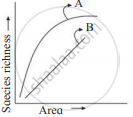
Short answer type question
Tropical regions exhibit species richness as compared to polar regions. Justify.
Latitudinal and altitudinal gradient is shown by which of the following habitat(s)?
Species richness - area relationship is given by ______.
Which of these is true about tropical environments?
Write the inference drawn by Alexander von Humboldt after his extensive explorations of South American jungle.
Which of the following hypothesis suggests that ecosystems are like aeroplanes where flight safety (ecosystem functioning) may or may not be compromised, depending upon which species are being lost?
Who observed that within a region, species richness increased with increasing explored area, to a certain limit?
Which of the following statements correctly describes the relationship between latitude and biodiversity?
