Advertisements
Advertisements
प्रश्न
Give three hypotheses for explaining why tropics show greatest levels of species richness.
Advertisements
उत्तर
- Speciation is generally a function of time. Temperate regions have been repeatedly glaciated since ancient times, while tropical latitudes have remained undisturbed for millions of years. Hence, there has been more time for species to evolve and diversify.
- The tropical environment is different from the temperate environment and shows fewer seasonal changes. This stable environment has encouraged niche specialisation, leading to greater species diversity.
- More solar energy is available in tropical regions, which leads to greater productivity and, indirectly, to more extraordinary biodiversity.
APPEARS IN
संबंधित प्रश्न
Explain, giving three reasons, why tropics show greatest levels of species diversity.
What is the significance of the slope of regression in a species-area relationship?
Short answer type question
Tropical regions exhibit species richness as compared to polar regions. Justify.
Which of the following hypothesis states: Rich species diversity leads to lesser variation in biomass production over a period of time.
Latitudinal and altitudinal gradient is shown by which of the following habitat(s)?
On a log scale the relationship of species richness and area becomes linear (straight line) and is given by the equation.
The graph of species richness and area for a number of taxa like angiospermic plants, freshwater fishes, and birds is found to be ______.
Oxygen dissociation curve for Myoglobin has the following shape:
Which of the below mentioned regions exhibit lees seasonal variations?
Which of these is true about tropical environments?
Which of these is true about tropical environments?
Which one of the following is not a major characteristic feature of biodiversity hot spots?
There is greater biodiversity in tropical /subtropical regions than in temperate region. Explain.
Is it true that there is more solar energy available in the tropics? Explain briefly.
The relation between species richness and area for a wide variety of taxa turns out to be a rectangular hyperbola. Give a brief explanation.
Given below is an equation describing the Species-Area relationship between species richness and area for a wide variety of taxa as angiosperm plants, birds, bats etc. S = CAz
- Give a graphical representation of the given equation showing Species-Area relationship.
- What does 'S' represent in the given equation?
- What is the value of 'Z' (regression coefficient) for frugivorous birds and mammals in the tropical forests of different continents?
Study the graph given below:
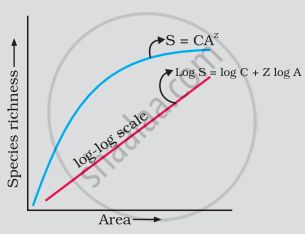
As per Alexander von Humboldt, what do the symbols S, A, Z and C in the graph stand for, in respect of a species and area relationship?
Lesser variation in biomass production over a period of time is called ______.
When pre-reproductive and post - reproductive age group is same in structure, the population is______.
Tropical regions show greatest level of species richness because -
- Tropical latitudes have remained relatively undisturbed for millions of years, hence more time was available for species diversification.
- Tropical environments are more seasonal.
- More solar energy is available in tropics.
- Constant environments promote niche specialization.
- Tropical environments are constant and predictable.
Choose the correct answer form the options given below:
Match the scientist in column I with their contribution in column II and choose the correct option.
| Column I | Column II | ||
| i. | Alexander Van Humboldt | a. | Estimated 7 million species round the globe |
| ii. | Robert May | b. | Rivet popper hypothesis |
| iii. | David Tillman | c. | Species Area Relationship |
| iv. | Paul Ehrlich | d. | Productivity stability hypothesis |
The latitudinal gradient describes a pattern where species richness is highest in which geographic region?
Which of the following environmental conditions becomes harsher as altitude increases on a mountain slope?
Alexander von Humboldt developed observations leading to the discovery of which relationship in ecology?
What does the variable Z represent in the species-area relationship formula log S = log C + Z log A?
What does the variable C represent in the species-area relationship formula log S = log C + Z log A?
For very large areas such as entire continents, what is the typical range of the Z value in the species-area relationship?
