Advertisements
Advertisements
प्रश्न
Species diversity decreases as we move away from the equator towards the poles. What could be the possible reasons?
Advertisements
उत्तर
In general, species diversity decreases as we move away from the equator toward the poles.
The possible reason could be as follows:
- Temperature decreases as we move away from the equator towards the poles.
- The intensity of sunlight decreases as we move away from the equator towards the poles and hence productivity.
- In polar regions, the temperature is very low so most of the organisms cannot survive in that habitat.
APPEARS IN
संबंधित प्रश्न
The following graph shows the species-area relationship. Answer the following questions as directed.
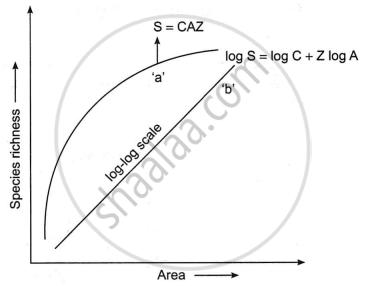
(a) Name the naturalist who studied the kind of relationship shown in the graph. Write the observations made by him.
(b) Write the situations as discovered by the ecologists when the value of ‘Z’
(Slope of the line) lies between:
- 0.1 and 0.2
- 0.6 and 1.2
What does ‘Z’ stand for?
(c) When would the slope of the line ‘b’ become steeper?
Short answer type question
Tropical regions exhibit species richness as compared to polar regions. Justify.
Extent of global diversity of invertebrates is shown in the pie diagram below. Choose the most appropriate alternative that the four portions (a-d) represent.

On a log scale the relationship of species richness and area becomes linear (straight line) and is given by the equation.
In the equation: log S = log C + Z log A , S= species richness; Z = slope of line (regression coefficient); A = area; C = Y intercept. For smaller area, the value of Z ranges from ____________.
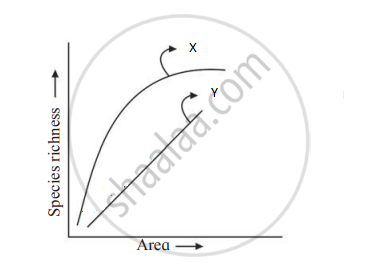
With reference to graph select the correct alternative
Species richness - area relationship is given by ______.
Select the correct alternative for x and y.
Oxygen dissociation curve for Myoglobin has the following shape:
The pattern of biodiversity is affected by ______.
Amongst the animal groups given below, which one appears to be more vulnerable to extinction?
What does the term ‘Frugivorous’ mean?
Is it possible that productivity and diversity of a natural community remain constant over a time period of, say one hundred years?
Given below is an equation describing the Species-Area relationship between species richness and area for a wide variety of taxa as angiosperm plants, birds, bats etc. S = CAz
- Give a graphical representation of the given equation showing Species-Area relationship.
- What does 'S' represent in the given equation?
- What is the value of 'Z' (regression coefficient) for frugivorous birds and mammals in the tropical forests of different continents?
Rivet Popper Hypothesis is an analogy to explain the significance of ______.
Match the scientist in column I with their contribution in column II and choose the correct option.
| Column I | Column II | ||
| i. | Alexander Van Humboldt | a. | Estimated 7 million species round the globe |
| ii. | Robert May | b. | Rivet popper hypothesis |
| iii. | David Tillman | c. | Species Area Relationship |
| iv. | Paul Ehrlich | d. | Productivity stability hypothesis |
Which of the following characteristics are seen in a stable community?
- It is strong enough to withstand environmental disturbance and recovers quickly.
- It is resistant to invasive species.
- It exhibits constant change in biomass production over a period of time.
- It has more species diversity.
Alexander von Humboldt developed observations leading to the discovery of which relationship in ecology?
In the species-area relationship formula log S = log C + Z log A, what does the variable A represent?
Which of the following ecosystems would be predicted to have the highest species richness based on the latitudinal and species-area principles?
