Advertisements
Advertisements
प्रश्न
What does the term ‘Frugivorous’ mean?
Advertisements
उत्तर
Frugivorous means fruit-eating organisms.
APPEARS IN
संबंधित प्रश्न
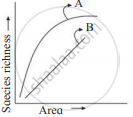
Observe the graph and select the correct option:
The 'rivet' in the rivet popper hypothesis is considered to represent the ______.
On a log scale the relationship of species richness and area becomes linear (straight line) and is given by the equation.
Maximum species richness is observed in the ______.
All are true regarding graph showing species richness - area relationship, EXCEPT ______.
Which of the following is an observation of Alexander von Humboldt's documented pattern in ecology?
Species richness - area relationship is given by ______.
Which of these is true about tropical environments?
Which of the following countries has the highest biodiversity?
Which one of the following is not a major characteristic feature of biodiversity hot spots?
Amongst the animal groups given below, which one appears to be more vulnerable to extinction?
Is it possible that productivity and diversity of a natural community remain constant over a time period of, say one hundred years?
Study the graph given below:
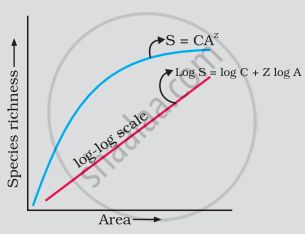
As per Alexander von Humboldt, what do the symbols S, A, Z and C in the graph stand for, in respect of a species and area relationship?
The relation between species richness and area for a wide variety of taxa appears as ______.
Rivet Popper Hypothesis is an analogy to explain the significance of ______.
Who observed that within a region, species richness increased with increasing explored area, to a certain limit?
Tropical regions show greatest level of species richness because -
- Tropical latitudes have remained relatively undisturbed for millions of years, hence more time was available for species diversification.
- Tropical environments are more seasonal.
- More solar energy is available in tropics.
- Constant environments promote niche specialization.
- Tropical environments are constant and predictable.
Choose the correct answer form the options given below:
Which of the following characteristics are seen in a stable community?
- It is strong enough to withstand environmental disturbance and recovers quickly.
- It is resistant to invasive species.
- It exhibits constant change in biomass production over a period of time.
- It has more species diversity.
What does the variable C represent in the species-area relationship formula log S = log C + Z log A?
For smaller areas, what is the typical range of the Z value (slope) in the species-area relationship?
