Advertisements
Advertisements
प्रश्न
Amongst the animal groups given below, which one appears to be more vulnerable to extinction?
विकल्प
Insects
Mammals
Amphibians
Reptiles
Advertisements
उत्तर
Amphibians
Explanation:
About 32 percent of amphibian species are at risk due to factors like habitat loss, pollution, and environmental changes. This vulnerability is higher compared to insects, reptiles, and mammals. The decline is largely caused by habitat destruction, environmental sensitivity, and other human-induced factors, making amphibians one of the most threatened groups in biodiversity conservation efforts.
APPEARS IN
संबंधित प्रश्न
The following graph shows the species-area relationship. Answer the following questions as directed.
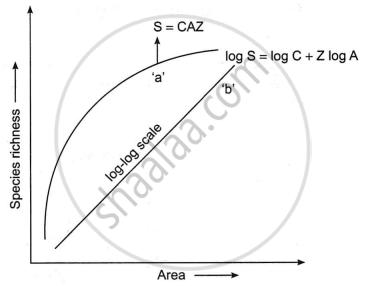
(a) Name the naturalist who studied the kind of relationship shown in the graph. Write the observations made by him.
(b) Write the situations as discovered by the ecologists when the value of ‘Z’
(Slope of the line) lies between:
- 0.1 and 0.2
- 0.6 and 1.2
What does ‘Z’ stand for?
(c) When would the slope of the line ‘b’ become steeper?
Observe the graph and select the correct option:
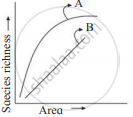
Which of the following hypothesis states: Rich species diversity leads to lesser variation in biomass production over a period of time.
Latitudinal and altitudinal gradient is shown by which of the following habitat(s)?
On a log scale the relationship of species richness and area becomes linear (straight line) and is given by the equation.
In the equation: log S = log C + Z log A , S= species richness; Z = slope of line (regression coefficient); A = area; C = Y intercept. For smaller area, the value of Z ranges from ____________.
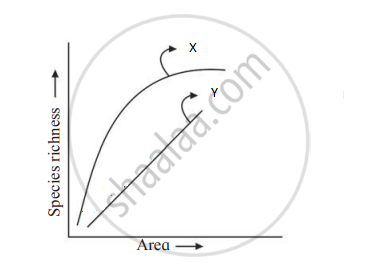
With reference to graph select the correct alternative
Species richness - area relationship is given by ______.
Select the correct alternative for x and y.
Amongst the animal group given below, which one has the highest percentage of endangered species?
Which of the below mentioned regions exhibit lees seasonal variations?
A species-area curve is drawn by plotting the number of species against the area. How is it that when a very large area is considered the slope is steeper than that for smaller areas?
There is greater biodiversity in tropical /subtropical regions than in temperate region. Explain.
Species diversity decreases as we move away from the equator towards the poles. What could be the possible reasons?
Write the inference drawn by Alexander von Humboldt after his extensive explorations of South American jungle.
Study the graph given below:
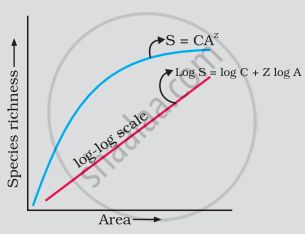
As per Alexander von Humboldt, what do the symbols S, A, Z and C in the graph stand for, in respect of a species and area relationship?
Who observed that within a region, species richness increased with increasing explored area, to a certain limit?
When pre-reproductive and post - reproductive age group is same in structure, the population is______.
Tropical regions show greatest level of species richness because -
- Tropical latitudes have remained relatively undisturbed for millions of years, hence more time was available for species diversification.
- Tropical environments are more seasonal.
- More solar energy is available in tropics.
- Constant environments promote niche specialization.
- Tropical environments are constant and predictable.
Choose the correct answer form the options given below:
What does the variable S represent in the species-area formula log S = log C + Z log A?
What does the variable C represent in the species-area relationship formula log S = log C + Z log A?
Which of the following ecosystems would be predicted to have the highest species richness based on the latitudinal and species-area principles?
