Advertisements
Advertisements
Question
Amongst the animal groups given below, which one appears to be more vulnerable to extinction?
Options
Insects
Mammals
Amphibians
Reptiles
Advertisements
Solution
Amphibians
Explanation:
About 32 percent of amphibian species are at risk due to factors like habitat loss, pollution, and environmental changes. This vulnerability is higher compared to insects, reptiles, and mammals. The decline is largely caused by habitat destruction, environmental sensitivity, and other human-induced factors, making amphibians one of the most threatened groups in biodiversity conservation efforts.
APPEARS IN
RELATED QUESTIONS
What is the significance of the slope of regression in a species-area relationship?
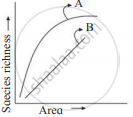
Observe the graph and select the correct option:
On a log scale the relationship of species richness and area becomes linear (straight line) and is given by the equation.
Maximum species richness is observed in the ______.
Which of the following is an observation of Alexander von Humboldt's documented pattern in ecology?
Species richness - area relationship is given by ______.
The graph of species richness and area for a number of taxa like angiospermic plants, freshwater fishes, and birds is found to be ______.
Which of the below mentioned regions exhibit lees seasonal variations?
Which of these is true about tropical environments?
Which of these is true about tropical environments?
Which of the following countries has the highest biodiversity?
Which one of the following is not a major characteristic feature of biodiversity hot spots?
What does the term ‘Frugivorous’ mean?
The relation between species richness and area for a wide variety of taxa turns out to be a rectangular hyperbola. Give a brief explanation.
Distribution of diversity on earth shows that biodiversity from higher latitudes to lower latitudes ______.
Rivet Popper Hypothesis is an analogy to explain the significance of ______.
Who observed that within a region, species richness increased with increasing explored area, to a certain limit?
The latitudinal gradient describes a pattern where species richness is highest in which geographic region?
The altitudinal gradient describes a pattern where species diversity is greatest at which elevation?
Which of the following environmental conditions becomes harsher as altitude increases on a mountain slope?
Alexander von Humboldt developed observations leading to the discovery of which relationship in ecology?
What does the variable S represent in the species-area formula log S = log C + Z log A?
What does the variable Z represent in the species-area relationship formula log S = log C + Z log A?
For smaller areas, what is the typical range of the Z value (slope) in the species-area relationship?
For very large areas such as entire continents, what is the typical range of the Z value in the species-area relationship?
Which of the following ecosystems would be predicted to have the highest species richness based on the latitudinal and species-area principles?
