Advertisements
Advertisements
Question
Which of the below mentioned regions exhibit lees seasonal variations?
Options
Tropics
Temperates
Alpines
Both Tropics and Temperates
Advertisements
Solution
Tropics
Explanation:
The tropics have the most biodiversity because they have less seasonal fluctuations and hence remain undisturbed.
Temperate environments are more seasonal, have less Wnstand, and have fewer species variety; yet, alpine locations with cold temperatures and high elevations have diversity.
APPEARS IN
RELATED QUESTIONS
The following graph shows the species-area relationship. Answer the following questions as directed.
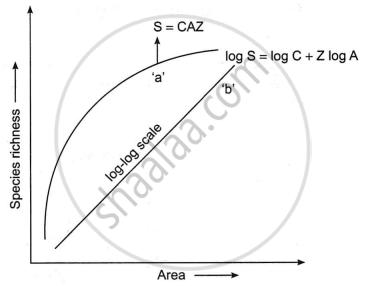
(a) Name the naturalist who studied the kind of relationship shown in the graph. Write the observations made by him.
(b) Write the situations as discovered by the ecologists when the value of ‘Z’
(Slope of the line) lies between:
- 0.1 and 0.2
- 0.6 and 1.2
What does ‘Z’ stand for?
(c) When would the slope of the line ‘b’ become steeper?
What is the significance of the slope of regression in a species-area relationship?
Extent of global diversity of invertebrates is shown in the pie diagram below. Choose the most appropriate alternative that the four portions (a-d) represent.

Maximum species richness is observed in the ______.
In the equation: log S = log C + Z log A , S= species richness; Z = slope of line (regression coefficient); A = area; C = Y intercept. For smaller area, the value of Z ranges from ____________.
With reference to graph select the correct alternative
All are true regarding graph showing species richness - area relationship, EXCEPT ______.
Amongst the animal group given below, which one has the highest percentage of endangered species?
Which of these is true about tropical environments?
Which of the following countries has the highest biodiversity?
Which one of the following is not a major characteristic feature of biodiversity hot spots?
There is greater biodiversity in tropical /subtropical regions than in temperate region. Explain.
Write the inference drawn by Alexander von Humboldt after his extensive explorations of South American jungle.
Distribution of diversity on earth shows that biodiversity from higher latitudes to lower latitudes ______.
Which of the following hypothesis suggests that ecosystems are like aeroplanes where flight safety (ecosystem functioning) may or may not be compromised, depending upon which species are being lost?
Alexander von Humboldt observed that, within a region species richness ______ with increasing explored area.
Which of the following statements correctly describes the relationship between latitude and biodiversity?
For smaller areas, what is the typical range of the Z value (slope) in the species-area relationship?
