Advertisements
Advertisements
प्रश्न
Write the inference drawn by Alexander von Humboldt after his extensive explorations of South American jungle.
Advertisements
उत्तर
Alexander von Humboldt observed that within a region species richness increased with increasing explored area, but only up to a limit. In fact, the relation between species richness and area for a wide variety of taxa (angiosperm plants, birds, bats, freshwater fishes) turns out to be a rectangular hyperbola.
संबंधित प्रश्न
Explain, giving three reasons, why tropics show greatest levels of species diversity.
Which of these is true about tropical environments?
Which of these is true about tropical environments?
Is it true that there is more solar energy available in the tropics? Explain briefly.
The relation between species richness and area for a wide variety of taxa turns out to be a rectangular hyperbola. Give a brief explanation.
Study the graph given below:
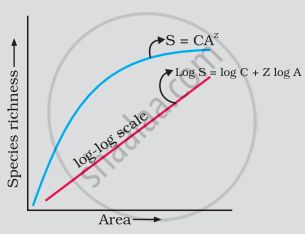
As per Alexander von Humboldt, what do the symbols S, A, Z and C in the graph stand for, in respect of a species and area relationship?
The altitudinal gradient describes a pattern where species diversity is greatest at which elevation?
What does the variable S represent in the species-area formula log S = log C + Z log A?
In the species-area relationship formula log S = log C + Z log A, what does the variable A represent?
Which of the following ecosystems would be predicted to have the highest species richness based on the latitudinal and species-area principles?
