Advertisements
Advertisements
प्रश्न
What is the significance of the slope of regression in a species-area relationship?
Advertisements
उत्तर
The slope of regression measures the rate at which species richness increases as the explored area expands. Its significance is explained below:
- For Small/Limited Areas: For a limited region like a country, the value of the slope remains constant and ranges from 0.1 to 0.2, regardless of the taxonomic group or the geographic region.
- For Large Areas: When measuring the species-area relationship over vast areas, such as entire continents, the regression slope becomes much steeper, typically ranging from 0.6 to 1.2. This indicates that larger areas support a much higher rate of species accumulation.
APPEARS IN
संबंधित प्रश्न
The following graph shows the species-area relationship. Answer the following questions as directed.
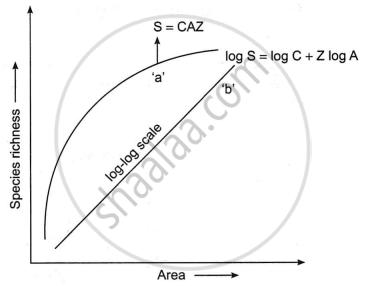
(a) Name the naturalist who studied the kind of relationship shown in the graph. Write the observations made by him.
(b) Write the situations as discovered by the ecologists when the value of ‘Z’
(Slope of the line) lies between:
- 0.1 and 0.2
- 0.6 and 1.2
What does ‘Z’ stand for?
(c) When would the slope of the line ‘b’ become steeper?
The 'rivet' in the rivet popper hypothesis is considered to represent the ______.
On a log scale the relationship of species richness and area becomes linear (straight line) and is given by the equation.
Maximum species richness is observed in the ______.
All are true regarding graph showing species richness - area relationship, EXCEPT ______.
Which of the following is an observation of Alexander von Humboldt's documented pattern in ecology?
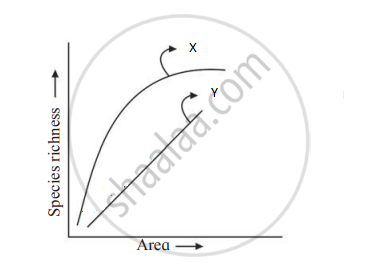
Select the correct alternative for x and y.
Which of the below mentioned regions exhibit lees seasonal variations?
Which of these is true about tropical environments?
The pattern of biodiversity is affected by ______.
"Species richness increased with increased explored area but only a limit". This statement was given by.
Amongst the animal groups given below, which one appears to be more vulnerable to extinction?
A species-area curve is drawn by plotting the number of species against the area. How is it that when a very large area is considered the slope is steeper than that for smaller areas?
Species diversity decreases as we move away from the equator towards the poles. What could be the possible reasons?
The relation between species richness and area for a wide variety of taxa turns out to be a rectangular hyperbola. Give a brief explanation.
Given below is an equation describing the Species-Area relationship between species richness and area for a wide variety of taxa as angiosperm plants, birds, bats etc. S = CAz
- Give a graphical representation of the given equation showing Species-Area relationship.
- What does 'S' represent in the given equation?
- What is the value of 'Z' (regression coefficient) for frugivorous birds and mammals in the tropical forests of different continents?
The species-area relationship is represented on a log scale as ______.
The relation between species richness and area for a wide variety of taxa appears as ______.
Who observed that within a region, species richness increased with increasing explored area, to a certain limit?
Match the scientist in column I with their contribution in column II and choose the correct option.
| Column I | Column II | ||
| i. | Alexander Van Humboldt | a. | Estimated 7 million species round the globe |
| ii. | Robert May | b. | Rivet popper hypothesis |
| iii. | David Tillman | c. | Species Area Relationship |
| iv. | Paul Ehrlich | d. | Productivity stability hypothesis |
Which of the following statements correctly describes the relationship between latitude and biodiversity?
Which of the following environmental conditions becomes harsher as altitude increases on a mountain slope?
Alexander von Humboldt developed observations leading to the discovery of which relationship in ecology?
What does the variable S represent in the species-area formula log S = log C + Z log A?
For very large areas such as entire continents, what is the typical range of the Z value in the species-area relationship?
