Advertisements
Advertisements
प्रश्न
There is greater biodiversity in tropical /subtropical regions than in temperate region. Explain.
Advertisements
उत्तर
- Speciation is generally a function of time, unlike temperate regions subjected to frequent glaciations in the past, tropical latitudes have remained relatively undisturbed for millions of years and thus, had a long evolutionary time for species diversification.
- Tropical environments, unlike temperate ones, are less seasonal, relatively more constant and predictable. Such constant environments promote niche specialisation and lead to greater species diversity.
- There is more solar energy available in the tropics, which contributes to higher productivity; this in turn might contribute indirectly to greater diversity.
APPEARS IN
संबंधित प्रश्न
The following graph shows the species-area relationship. Answer the following questions as directed.
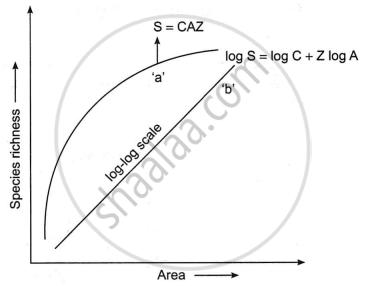
(a) Name the naturalist who studied the kind of relationship shown in the graph. Write the observations made by him.
(b) Write the situations as discovered by the ecologists when the value of ‘Z’
(Slope of the line) lies between:
- 0.1 and 0.2
- 0.6 and 1.2
What does ‘Z’ stand for?
(c) When would the slope of the line ‘b’ become steeper?
Give three hypotheses for explaining why tropics show greatest levels of species richness.
Latitudinal and altitudinal gradient is shown by which of the following habitat(s)?
Maximum species richness is observed in the ______.
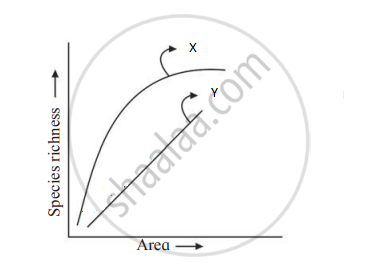
Select the correct alternative for x and y.
Oxygen dissociation curve for Myoglobin has the following shape:
Which of these is true about tropical environments?
Which one of the following is not a major characteristic feature of biodiversity hot spots?
Amongst the animal groups given below, which one appears to be more vulnerable to extinction?
Is it possible that productivity and diversity of a natural community remain constant over a time period of, say one hundred years?
Species diversity decreases as we move away from the equator towards the poles. What could be the possible reasons?
Lesser variation in biomass production over a period of time is called ______.
Distribution of diversity on earth shows that biodiversity from higher latitudes to lower latitudes ______.
The relation between species richness and area for a wide variety of taxa appears as ______.
Which of the following hypothesis suggests that ecosystems are like aeroplanes where flight safety (ecosystem functioning) may or may not be compromised, depending upon which species are being lost?
Which of the following statements correctly describes the relationship between latitude and biodiversity?
Which of the following environmental conditions becomes harsher as altitude increases on a mountain slope?
What does the variable S represent in the species-area formula log S = log C + Z log A?
What does the variable Z represent in the species-area relationship formula log S = log C + Z log A?
Which of the following ecosystems would be predicted to have the highest species richness based on the latitudinal and species-area principles?
