Advertisements
Advertisements
Question
Form the differential equation of all parabolas whose axis is the X-axis.
Advertisements
Solution
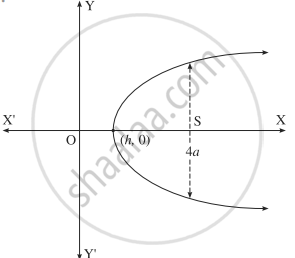
The equation of the parbola whose axis is the X-axis is y2 = 4a(x - h), ....(1)
where a and h are arbitrary constants.
Differentiating (1) w.r.t. x, we get
`"2y"("dy"/"dx") = 4"a"(1 - 0)`
∴ y`"dy"/"dx" = "2a"`
Differentiating again w.r.t. x, we get
`"y" * "d"/"dx"("dy"/"dx") + "dy"/"dx" * "dy"/"dx" = 0`
∴ `"y"("d"^2"y")/"dx"^2 + ("dy"/"dx")^2 = 0`
This is the required D.E.
APPEARS IN
RELATED QUESTIONS
Obtain the differential equation by eliminating the arbitrary constants from the following equation:
x3 + y3 = 4ax
Obtain the differential equation by eliminating the arbitrary constants from the following equation:
Ax2 + By2 = 1
Obtain the differential equation by eliminating the arbitrary constants from the following equation:
y = Ae5x + Be-5x
Find the differential equation of the ellipse whose major axis is twice its minor axis.
In the following example verify that the given expression is a solution of the corresponding differential equation:
xy = log y +c; `"dy"/"dx" = "y"^2/(1 - "xy")`
In the following example verify that the given expression is a solution of the corresponding differential equation:
y = e-x + Ax + B; `"e"^"x" ("d"^2"y")/"dx"^2 = 1`
In the following example verify that the given expression is a solution of the corresponding differential equation:
y = xm; `"x"^2 ("d"^2"y")/"dx"^2 - "mx" "dy"/"dx" + "my" = 0`
Solve the following differential equation:
`"y" - "x" "dy"/"dx" = 0`
Solve the following differential equation:
`"dy"/"dx" = - "k",` where k is a constant.
Solve the following differential equation:
`(cos^2y)/x dy + (cos^2x)/y dx` = 0
Solve the following differential equation:
`"y"^3 - "dy"/"dx" = "x"^2 "dy"/"dx"`
For the following differential equation find the particular solution satisfying the given condition:
`(e^y + 1) cos x + e^y sin x. dy/dx = 0, "when" x = pi/6,` y = 0
For the following differential equation find the particular solution satisfying the given condition:
`cos("dy"/"dx") = "a", "a" ∈ "R", "y"(0) = 2`
Solve the following differential equation:
(x2 + y2)dx - 2xy dy = 0
Choose the correct option from the given alternatives:
The differential equation of y = `"c"^2 + "c"/"x"` is
Choose the correct option from the given alternatives:
x2 + y2 = a2 is a solution of
In the following example verify that the given function is a solution of the differential equation.
`"y" = "e"^"ax" sin "bx"; ("d"^2"y")/"dx"^2 - 2"a" "dy"/"dx" + ("a"^2 + "b"^2)"y" = 0`
In the following example verify that the given function is a solution of the differential equation.
`"x"^2 = "2y"^2 log "y", "x"^2 + "y"^2 = "xy" "dx"/"dy"`
Obtain the differential equation by eliminating the arbitrary constants from the following equation:
y = a sin (x + b)
Form the differential equation of all the lines which are normal to the line 3x + 2y + 7 = 0.
Solve the following differential equation:
`"dy"/"dx" = "x"^2"y" + "y"`
Solve the following differential equation:
`"dy"/"dx" = ("2y" - "x")/("2y + x")`
Solve the following differential equation:
x dy = (x + y + 1) dx
Solve the following differential equation:
`"dy"/"dx" + "y cot x" = "x"^2 "cot x" + "2x"`
Find the particular solution of the following differential equation:
`("x + 2y"^2) "dy"/"dx" = "y",` when x = 2, y = 1
Find the particular solution of the following differential equation:
y(1 + log x) = (log xx) `"dy"/"dx"`, when y(e) = e2
The general solution of `(dy)/(dx)` = e−x is ______.
Select and write the correct alternative from the given option for the question
The solution of `("d"y)/("d"x)` = 1 is
Form the differential equation of family of standard circle
Find the differential equation of family of all ellipse whose major axis is twice the minor axis
Verify y = log x + c is the solution of differential equation `x ("d"^2y)/("d"x^2) + ("d"y)/("d"x)` = 0
The differential equation having y = (cos-1 x)2 + P (sin-1 x) + Q as its general solution, where P and Q are arbitrary constants, is
Find the differential equation of the family of circles passing through the origin and having their centres on the x-axis
Find the differential equation of the family of all the parabolas with latus rectum 4a and whose axes are parallel to the x-axis
Find the differential equation of the family of parabolas with vertex at (0, –1) and having axis along the y-axis
If `x^2 y^2 = sin^-1 sqrt(x^2 + y^2) + cos^-1 sqrt(x^2 + y^2)`, then `"dy"/"dx"` = ?
If m and n are respectively the order and degree of the differential equation of the family of parabolas with focus at the origin and X-axis as its axis, then mn - m + n = ______.
The differential equation whose solution is (x – h)2 + (y – k)2 = a2 is (where a is a constant) ______.
The differential equation of the family of circles touching Y-axis at the origin is ______.
Solve the differential equation
cos2(x – 2y) = `1 - 2dy/dx`
If 2x = `y^(1/m) + y^(-1/m)`, then show that `(x^2 - 1) (dy/dx)^2` = m2y2
Find the particular solution of the differential equation `x^2 dy/dx + y^2 = xy dy/dx`, if y = 1 when x = 1.
Solve the differential equation
ex tan y dx + (1 + ex) sec2 y dy = 0
The differential equation whose solution represents the family \[x^{2}y=4e^{x}+c\], where c is an arbitrary constant, is
