Advertisements
Advertisements
प्रश्न
Form the differential equation of all parabolas whose axis is the X-axis.
Advertisements
उत्तर
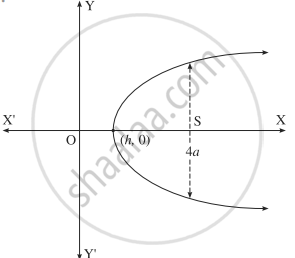
The equation of the parbola whose axis is the X-axis is y2 = 4a(x - h), ....(1)
where a and h are arbitrary constants.
Differentiating (1) w.r.t. x, we get
`"2y"("dy"/"dx") = 4"a"(1 - 0)`
∴ y`"dy"/"dx" = "2a"`
Differentiating again w.r.t. x, we get
`"y" * "d"/"dx"("dy"/"dx") + "dy"/"dx" * "dy"/"dx" = 0`
∴ `"y"("d"^2"y")/"dx"^2 + ("dy"/"dx")^2 = 0`
This is the required D.E.
APPEARS IN
संबंधित प्रश्न
Obtain the differential equation by eliminating the arbitrary constants from the following equation:
x3 + y3 = 4ax
Obtain the differential equation by eliminating the arbitrary constants from the following equation:
y2 = (x + c)3
Obtain the differential equation by eliminating the arbitrary constants from the following equation:
y = c1e2x + c2e5x
Obtain the differential equation by eliminating the arbitrary constants from the following equation:
c1x3 + c2y2 = 5
Obtain the differential equation by eliminating the arbitrary constants from the following equation:
y = e−2x (A cos x + B sin x)
Find the differential equation of the ellipse whose major axis is twice its minor axis.
In the following example verify that the given expression is a solution of the corresponding differential equation:
xy = log y +c; `"dy"/"dx" = "y"^2/(1 - "xy")`
Solve the following differential equation:
`"y" - "x" "dy"/"dx" = 0`
Solve the following differential equation:
`"sec"^2 "x" * "tan y" "dx" + "sec"^2 "y" * "tan x" "dy" = 0`
Solve the following differential equation:
cos x . cos y dy − sin x . sin y dx = 0
Solve the following differential equation:
`"y"^3 - "dy"/"dx" = "x"^2 "dy"/"dx"`
For the following differential equation find the particular solution satisfying the given condition:
3ex tan y dx + (1 + ex) sec2 y dy = 0, when x = 0, y = π.
For the following differential equation find the particular solution satisfying the given condition:
`y(1 + log x) dx/dy - x log x = 0, y = e^2,` when x = e
For the following differential equation find the particular solution satisfying the given condition:
`cos("dy"/"dx") = "a", "a" ∈ "R", "y"(0) = 2`
Reduce the following differential equation to the variable separable form and hence solve:
(2x - 2y + 3)dx - (x - y + 1)dy = 0, when x = 0, y = 1.
Solve the following differential equation:
(x2 + y2)dx - 2xy dy = 0
Choose the correct option from the given alternatives:
x2 + y2 = a2 is a solution of
Choose the correct option from the given alternatives:
The solution of `"dy"/"dx" = ("y" + sqrt("x"^2 - "y"^2))/"x"` is
Choose the correct option from the given alternatives:
The solution of `"dy"/"dx" + "y" = cos "x" - sin "x"`
In the following example verify that the given function is a solution of the differential equation.
`"y" = "e"^"ax" sin "bx"; ("d"^2"y")/"dx"^2 - 2"a" "dy"/"dx" + ("a"^2 + "b"^2)"y" = 0`
In the following example verify that the given function is a solution of the differential equation.
`"y" = 3 "cos" (log "x") + 4 sin (log "x"); "x"^2 ("d"^2"y")/"dx"^2 + "x" "dy"/"dx" + "y" = 0`
Obtain the differential equation by eliminating the arbitrary constants from the following equation:
y = a sin (x + b)
Form the differential equation of the hyperbola whose length of transverse and conjugate axes are half of that of the given hyperbola `"x"^2/16 - "y"^2/36 = "k"`.
Solve the following differential equation:
`"dy"/"dx" = "x"^2"y" + "y"`
Solve the following differential equation:
`"dy"/"dx" = ("2y" - "x")/("2y + x")`
Solve the following differential equation:
y log y = (log y2 - x) `"dy"/"dx"`
Find the particular solution of the following differential equation:
`("x + 2y"^2) "dy"/"dx" = "y",` when x = 2, y = 1
Find the particular solution of the following differential equation:
`"dy"/"dx" - 3"y" cot "x" = sin "2x"`, when `"y"(pi/2) = 2`
Find the particular solution of the following differential equation:
y(1 + log x) = (log xx) `"dy"/"dx"`, when y(e) = e2
The general solution of `(dy)/(dx)` = e−x is ______.
Find the differential equation of the family of parabolas with vertex at (0, –1) and having axis along the y-axis
Find the differential equation corresponding to the family of curves represented by the equation y = Ae8x + Be –8x, where A and B are arbitrary constants
The rate of disintegration of a radio active element at time t is proportional to its mass, at the time. Then the time during which the original mass of 1.5 gm. Will disintegrate into its mass of 0.5 gm. is proportional to ______.
If `x^2 y^2 = sin^-1 sqrt(x^2 + y^2) + cos^-1 sqrt(x^2 + y^2)`, then `"dy"/"dx"` = ?
Form the differential equation of all lines which makes intercept 3 on x-axis.
For the curve C: (x2 + y2 – 3) + (x2 – y2 – 1)5 = 0, the value of 3y' – y3 y", at the point (α, α), α < 0, on C, is equal to ______.
If y = (tan–1 x)2 then `(x^2 + 1)^2 (d^2y)/(dx^2) + 2x(x^2 + 1) (dy)/(dx)` = ______.
The differential equation of all circles passing through the origin and having their centres on the X-axis is ______.
Solve the differential equation
cos2(x – 2y) = `1 - 2dy/dx`
If 2x = `y^(1/m) + y^(-1/m)`, then show that `(x^2 - 1) (dy/dx)^2` = m2y2
Find the particular solution of the differential equation `x^2 dy/dx + y^2 = xy dy/dx`, if y = 1 when x = 1.
Solve the differential equation
ex tan y dx + (1 + ex) sec2 y dy = 0
