Advertisements
Advertisements
Question
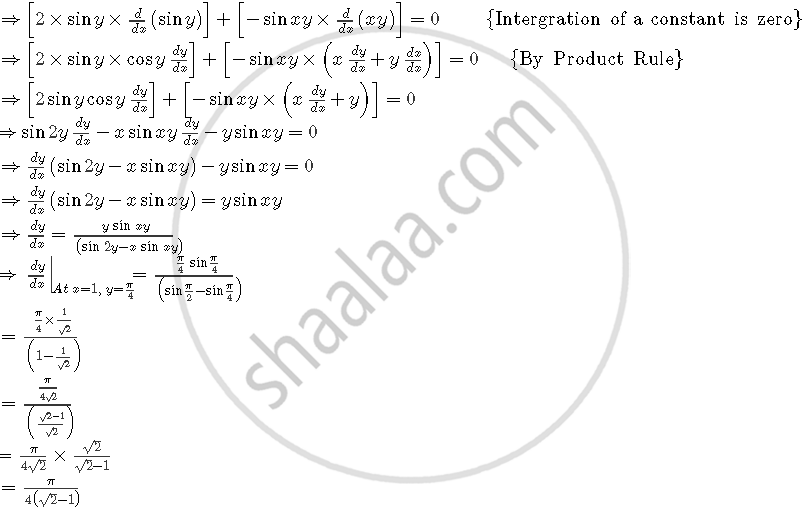
Find `(dy)/(dx)` at x = 1, y = `pi/4` if `sin^2 y + cos xy = K`
Advertisements
Solution
Consider the differential equation sin2y + cosxy = K
Differentiate the above differential equation with respect to x, to get the value of `(dy)/(dx)`
`=> d/dx (sin^2 y) + d/dx (cos xy) = d/(dx) (K)`
RELATED QUESTIONS
Solve the differential equation cos(x +y) dy = dx hence find the particular solution for x = 0 and y = 0.
The differential equation of the family of curves y=c1ex+c2e-x is......
(a)`(d^2y)/dx^2+y=0`
(b)`(d^2y)/dx^2-y=0`
(c)`(d^2y)/dx^2+1=0`
(d)`(d^2y)/dx^2-1=0`
Form the differential equation of the family of circles in the second quadrant and touching the coordinate axes.
Solve the differential equation `dy/dx -y =e^x`
The general solution of the differential equation \[\frac{dy}{dx} + y \] cot x = cosec x, is
Solution of the differential equation \[\frac{dy}{dx} + \frac{y}{x}=\sin x\] is
The solution of the differential equation \[2x\frac{dy}{dx} - y = 3\] represents
If m and n are the order and degree of the differential equation \[\left( y_2 \right)^5 + \frac{4 \left( y_2 \right)^3}{y_3} + y_3 = x^2 - 1\], then
The solution of the differential equation x dx + y dy = x2 y dy − y2 x dx, is
(1 + y + x2 y) dx + (x + x3) dy = 0
(x2 + 1) dy + (2y − 1) dx = 0
\[\cos^2 x\frac{dy}{dx} + y = \tan x\]
`x cos x(dy)/(dx)+y(x sin x + cos x)=1`
For the following differential equation, find the general solution:- \[\frac{dy}{dx} = \sin^{- 1} x\]
For the following differential equation, find a particular solution satisfying the given condition:- \[\cos\left( \frac{dy}{dx} \right) = a, y = 1\text{ when }x = 0\]
Solve the following differential equation:-
\[\frac{dy}{dx} + 3y = e^{- 2x}\]
Find a particular solution of the following differential equation:- x2 dy + (xy + y2) dx = 0; y = 1 when x = 1
Solve the differential equation: `(d"y")/(d"x") - (2"x")/(1+"x"^2) "y" = "x"^2 + 2`
Solve the differential equation: ` ("x" + 1) (d"y")/(d"x") = 2e^-"y" - 1; y(0) = 0.`
The solution of the differential equation `x "dt"/"dx" + 2y` = x2 is ______.
x + y = tan–1y is a solution of the differential equation `y^2 "dy"/"dx" + y^2 + 1` = 0.
Solve: `y + "d"/("d"x) (xy) = x(sinx + logx)`
The differential equation for y = Acos αx + Bsin αx, where A and B are arbitrary constants is ______.
The integrating factor of the differential equation `("d"y)/("d"x) + y = (1 + y)/x` is ______.
The general solution of the differential equation `("d"y)/("d"x) = "e"^(x^2/2) + xy` is ______.
The differential equation for which y = acosx + bsinx is a solution, is ______.
The solution of the differential equation `("d"y)/("d"x) = "e"^(x - y) + x^2 "e"^-y` is ______.
Find a particular solution, satisfying the condition `(dy)/(dx) = y tan x ; y = 1` when `x = 0`
Find the general solution of the differential equation:
`(dy)/(dx) = (3e^(2x) + 3e^(4x))/(e^x + e^-x)`
