Advertisements
Advertisements
Question
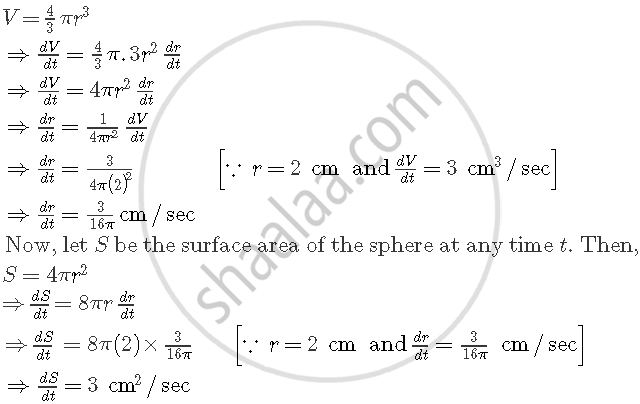
The volume of a sphere is increasing at the rate of 3 cubic centimeter per second. Find the rate of increase of its surface area, when the radius is 2 cm
Advertisements
Solution
Let r be the radius and V be the volume of the sphere at any time t. Then,
RELATED QUESTIONS
If y = f (u) is a differential function of u and u = g(x) is a differential function of x, then prove that y = f [g(x)] is a differential function of x and `dy/dx=dy/(du) xx (du)/dx`
Find the rate of change of the area of a circle with respect to its radius r when r = 3 cm.
The radius of a circle is increasing at the rate of 0.7 cm/s. What is the rate of increase of its circumference?
A balloon, which always remains spherical, has a variable diameter `3/2 (2x + 1)` Find the rate of change of its volume with respect to x.
The total revenue in rupees received from the sale of x units of a product is given by R(x) = 3x2 + 36x + 5. The marginal revenue, when x = 15 is ______.
The total cost C (x) associated with the production of x units of an item is given by C (x) = 0.007x3 − 0.003x2 + 15x + 4000. Find the marginal cost when 17 units are produced ?
The radius of a spherical soap bubble is increasing at the rate of 0.2 cm/sec. Find the rate of increase of its surface area, when the radius is 7 cm.
A stone is dropped into a quiet lake and waves move in circles at a speed of 4 cm/sec. At the instant when the radius of the circular wave is 10 cm, how fast is the enclosed area increasing?
A ladder 13 m long leans against a wall. The foot of the ladder is pulled along the ground away from the wall, at the rate of 1.5 m/sec. How fast is the angle θ between the ladder and the ground is changing when the foot of the ladder is 12 m away from the wall.
A particle moves along the curve y = x3. Find the points on the curve at which the y-coordinate changes three times more rapidly than the x-coordinate.
Find an angle θ which increases twice as fast as its cosine ?
Sand is being poured onto a conical pile at the constant rate of 50 cm3/ minute such that the height of the cone is always one half of the radius of its base. How fast is the height of the pile increasing when the sand is 5 cm deep ?
A circular disc of radius 3 cm is being heated. Due to expansion, its radius increases at the rate of 0.05 cm/sec. Find the rate at which its area is increasing when radius is 3.2 cm.
The amount of pollution content added in air in a city due to x diesel vehicles is given by P(x) = 0.005x3 + 0.02x2 + 30x. Find the marginal increase in pollution content when 3 diesel vehicles are added and write which value is indicated in the above questions ?
Side of an equilateral triangle expands at the rate of 2 cm/sec. The rate of increase of its area when each side is 10 cm is
The radius of a sphere is changing at the rate of 0.1 cm/sec. The rate of change of its surface area when the radius is 200 cm is
The altitude of a cone is 20 cm and its semi-vertical angle is 30°. If the semi-vertical angle is increasing at the rate of 2° per second, then the radius of the base is increasing at the rate of
The radius of a sphere is increasing at the rate of 0.2 cm/sec. The rate at which the volume of the sphere increase when radius is 15 cm, is
The volume of a cube increases at a constant rate. Prove that the increase in its surface area varies inversely as the length of the side
If the rate of change of volume of a sphere is equal to the rate of change of its radius then the surface area of a sphere is ____________.
Let y = f(x) be a function. If the change in one quantity 'y’ varies with another quantity x, then which of the following denote the rate of change of y with respect to x.
What is the rate of change of the area of a circle with respect to its radius when, r = 3 cm
If the circumference of circle is increasing at the constant rate, prove that rate of change of area of circle is directly proportional to its radius.
An edge of a variable cube is increasing at the rate of 10 cm/sec. How fast will the volume of the cube increase if the edge is 5 cm long?
Given that `1/y + 1/x = 1/12` and y decreases at a rate of 1 cms–1, find the rate of change of x when x = 5 cm and y = 1 cm.
If a quantity \(y\) varies with another quantity \(x\) based on the rule \(y=f(x)\), which expression represents the rate of change of \(y\) with respect to \(x\)?
For the Chain Rule for Rates \[\frac{dy}{dx}=\frac{\frac{dy}{dt}}{\frac{dx}{dt}}\], which condition is required?
For \[A=\pi r^2\], what is the rate of change of area with respect to radius when \[r=5\] cm?
