Advertisements
Advertisements
प्रश्न
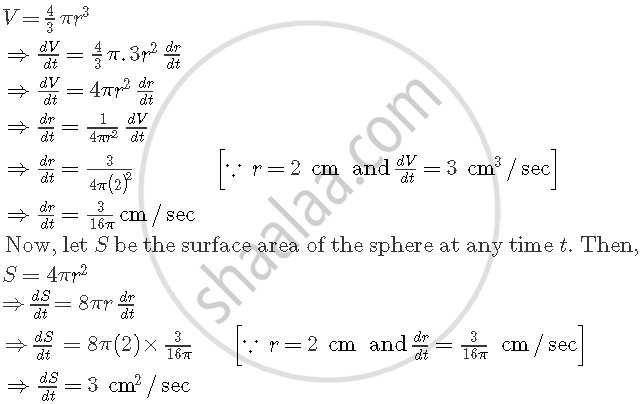
The volume of a sphere is increasing at the rate of 3 cubic centimeter per second. Find the rate of increase of its surface area, when the radius is 2 cm
Advertisements
उत्तर
Let r be the radius and V be the volume of the sphere at any time t. Then,
संबंधित प्रश्न
If y = f (u) is a differential function of u and u = g(x) is a differential function of x, then prove that y = f [g(x)] is a differential function of x and `dy/dx=dy/(du) xx (du)/dx`
A balloon, which always remains spherical has a variable radius. Find the rate at which its volume is increasing with the radius when the later is 10 cm.
A particle moves along the curve 6y = x3 +2. Find the points on the curve at which the y-coordinate is changing 8 times as fast as the x-coordinate.
The volume of a sphere is increasing at the rate of 8 cm3/s. Find the rate at which its surface area is increasing when the radius of the sphere is 12 cm.
The total cost C(x) associated with the production of x units of an item is given by C(x) = 0.005x3 – 0.02x2 + 30x + 5000. Find the marginal cost when 3 units are produced, whereby marginal cost we mean the instantaneous rate of change of total cost at any level of output.
Find the rate of change of the volume of a sphere with respect to its surface area when the radius is 2 cm ?
The total cost C (x) associated with the production of x units of an item is given by C (x) = 0.007x3 − 0.003x2 + 15x + 4000. Find the marginal cost when 17 units are produced ?
The money to be spent for the welfare of the employees of a firm is proportional to the rate of change of its total revenue (Marginal revenue). If the total revenue (in rupees) recieved from the sale of x units of a product is given by R(x) = 3x2 + 36x + 5, find the marginal revenue, when x = 5, and write which value does the question indicate ?
An edge of a variable cube is increasing at the rate of 3 cm per second. How fast is the volume of the cube increasing when the edge is 10 cm long?
A man 160 cm tall, walks away from a source of light situated at the top of a pole 6 m high, at the rate of 1.1 m/sec. How fast is the length of his shadow increasing when he is 1 m away from the pole?
A man 180 cm tall walks at a rate of 2 m/sec. away, from a source of light that is 9 m above the ground. How fast is the length of his shadow increasing when he is 3 m away from the base of light?
Water is running into an inverted cone at the rate of π cubic metres per minute. The height of the cone is 10 metres, and the radius of its base is 5 m. How fast the water level is rising when the water stands 7.5 m below the base.
Find the point on the curve y2 = 8x for which the abscissa and ordinate change at the same rate ?
The volume of a cube is increasing at the rate of 9 cm3/sec. How fast is the surface area increasing when the length of an edge is 10 cm?
If a particle moves in a straight line such that the distance travelled in time t is given by s = t3 − 6t2+ 9t + 8. Find the initial velocity of the particle ?
If \[V = \frac{4}{3}\pi r^3\] , at what rate in cubic units is V increasing when r = 10 and \[\frac{dr}{dt} = 0 . 01\] ? _________________
The radius of the base of a cone is increasing at the rate of 3 cm/minute and the altitude is decreasing at the rate of 4 cm/minute. The rate of change of lateral surface when the radius = 7 cm and altitude 24 cm is
The distance moved by a particle travelling in straight line in t seconds is given by s = 45t + 11t2 − t3. The time taken by the particle to come to rest is
If the rate of change of area of a circle is equal to the rate of change of its diameter, then its radius is equal to
In a sphere the rate of change of surface area is
A 13 m long ladder is leaning against a wall, touching the wall at a certain height from the ground level. The bottom of the ladder is pulled away from the wall, along the ground, at the rate of 2 m/s. How fast is the height on the wall decreasing when the foot of the ladder is 5 m away from the wall?
Evaluate: `int (x(1+x^2))/(1+x^4)dx`
If the area of a circle increases at a uniform rate, then prove that perimeter varies inversely as the radius
If the rate of change of the area of the circle is equal to the rate of change of its diameter then its radius is equal to ____________.
A particle moves along the curve 3y = ax3 + 1 such that at a point with x-coordinate 1, y-coordinate is changing twice as fast at x-coordinate. Find the value of a.
If the circumference of circle is increasing at the constant rate, prove that rate of change of area of circle is directly proportional to its radius.
For \[A=\pi r^2\], what is the rate of change of area with respect to radius when \[r=5\] cm?
Which procedure is used in related rates?
