Advertisements
Advertisements
प्रश्न
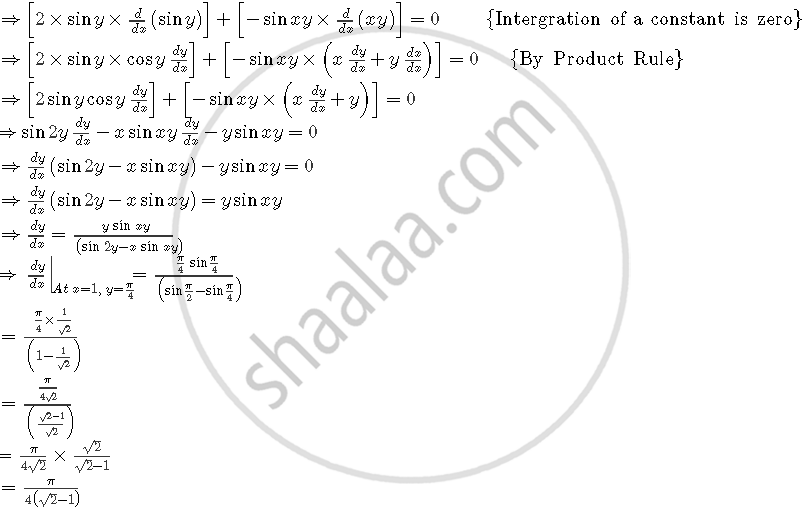
Find `(dy)/(dx)` at x = 1, y = `pi/4` if `sin^2 y + cos xy = K`
Advertisements
उत्तर
Consider the differential equation sin2y + cosxy = K
Differentiate the above differential equation with respect to x, to get the value of `(dy)/(dx)`
`=> d/dx (sin^2 y) + d/dx (cos xy) = d/(dx) (K)`
संबंधित प्रश्न
Solve : 3ex tanydx + (1 +ex) sec2 ydy = 0
Also, find the particular solution when x = 0 and y = π.
Find the differential equation representing the curve y = cx + c2.
The number of arbitrary constants in the particular solution of a differential equation of third order are ______.
Show that the general solution of the differential equation `dy/dx + (y^2 + y +1)/(x^2 + x + 1) = 0` is given by (x + y + 1) = A (1 - x - y - 2xy), where A is parameter.
Solve the differential equation `[e^(-2sqrtx)/sqrtx - y/sqrtx] dx/dy = 1 (x != 0).`
The general solution of the differential equation \[\frac{dy}{dx} + y \] cot x = cosec x, is
The solution of the differential equation \[\frac{dy}{dx} = \frac{x^2 + xy + y^2}{x^2}\], is
\[\frac{dy}{dx} = \left( x + y \right)^2\]
\[\frac{dy}{dx} - y \tan x = e^x\]
\[\left( 1 + y^2 \right) + \left( x - e^{- \tan^{- 1} y} \right)\frac{dy}{dx} = 0\]
`2 cos x(dy)/(dx)+4y sin x = sin 2x," given that "y = 0" when "x = pi/3.`
Solve the following differential equation:- `y dx + x log (y)/(x)dy-2x dy=0`
Find a particular solution of the following differential equation:- x2 dy + (xy + y2) dx = 0; y = 1 when x = 1
Find the equation of a curve passing through the point (0, 0) and whose differential equation is \[\frac{dy}{dx} = e^x \sin x.\]
Find the equation of a curve passing through the point (0, 1). If the slope of the tangent to the curve at any point (x, y) is equal to the sum of the x-coordinate and the product of the x-coordinate and y-coordinate of that point.
The general solution of the differential equation `"dy"/"dx" = "e"^(x - y)` is ______.
The general solution of the differential equation `"dy"/"dx" + y sec x` = tan x is y(secx – tanx) = secx – tanx + x + k.
x + y = tan–1y is a solution of the differential equation `y^2 "dy"/"dx" + y^2 + 1` = 0.
Find the general solution of `"dy"/"dx" + "a"y` = emx
Find the general solution of y2dx + (x2 – xy + y2) dy = 0.
Solve: `y + "d"/("d"x) (xy) = x(sinx + logx)`
Find the general solution of (1 + tany)(dx – dy) + 2xdy = 0.
The general solution of ex cosy dx – ex siny dy = 0 is ______.
The integrating factor of the differential equation `("d"y)/("d"x) + y = (1 + y)/x` is ______.
General solution of `("d"y)/("d"x) + ytanx = secx` is ______.
General solution of `("d"y)/("d"x) + y` = sinx is ______.
Find the general solution of the differential equation `x (dy)/(dx) = y(logy - logx + 1)`.
The curve passing through (0, 1) and satisfying `sin(dy/dx) = 1/2` is ______.
