हिंदी

Find (Dy)By(Dx) at X = 1, Y = `Piby4` If `Sin^2 Y + Cos Xy = K` - Mathematics

Advertisements
Advertisements

प्रश्न

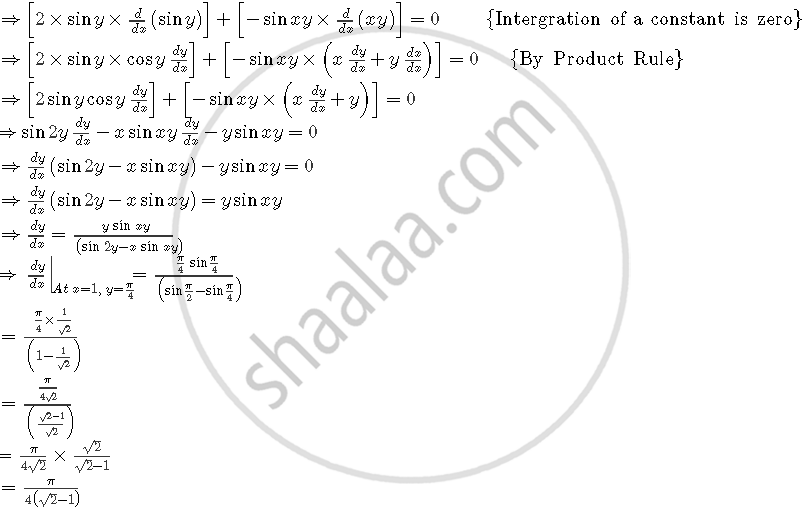
Find `(dy)/(dx)` at x = 1, y = `pi/4` if `sin^2 y + cos xy = K`

Advertisements

उत्तर

Consider the differential equation sin2y + cosxy = K

Differentiate the above differential equation with respect to x, to get the value of `(dy)/(dx)`

`=> d/dx (sin^2 y) + d/dx (cos xy) = d/(dx) (K)`
shaalaa.com
  क्या इस प्रश्न या उत्तर में कोई त्रुटि है?
2016-2017 (March) Delhi Set 1

वीडियो ट्यूटोरियलVIEW ALL [2]

संबंधित प्रश्न

If   `y=sqrt(sinx+sqrt(sinx+sqrt(sinx+..... oo))),` then show that `dy/dx=cosx/(2y-1)`


The solution of the differential equation dy/dx = sec x – y tan x is:

(A) y sec x = tan x + c

(B) y sec x + tan x = c

(C) sec x = y tan x + c

(D) sec x + y tan x = c


The differential equation of the family of curves y=c1ex+c2e-x is......

(a)`(d^2y)/dx^2+y=0`

(b)`(d^2y)/dx^2-y=0`

(c)`(d^2y)/dx^2+1=0`

(d)`(d^2y)/dx^2-1=0`


Verify that the given function (explicit or implicit) is a solution of the corresponding differential equation:

y = cos x + C : y′ + sin x = 0


Show that the general solution of the differential equation  `dy/dx + (y^2 + y +1)/(x^2 + x + 1) = 0` is given by (x + y + 1) = A (1 - x - y - 2xy), where A is parameter.


Solve the differential equation `[e^(-2sqrtx)/sqrtx - y/sqrtx] dx/dy = 1 (x != 0).`


Find a particular solution of the differential equation`(x + 1) dy/dx = 2e^(-y) - 1`, given that y = 0 when x = 0.


The general solution of the differential equation \[\frac{dy}{dx} + y\] g' (x) = g (x) g' (x), where g (x) is a given function of x, is


If m and n are the order and degree of the differential equation \[\left( y_2 \right)^5 + \frac{4 \left( y_2 \right)^3}{y_3} + y_3 = x^2 - 1\], then


cos (x + y) dy = dx


(x + y − 1) dy = (x + y) dx


x2 dy + (x2 − xy + y2) dx = 0


For the following differential equation, find the general solution:- \[\frac{dy}{dx} = \sqrt{4 - y^2}, - 2 < y < 2\]


Solve the following differential equation:-

\[\left( x + y \right)\frac{dy}{dx} = 1\]


Solve the following differential equation:-

y dx + (x − y2) dy = 0


Find the equation of the curve passing through the point (1, 1) whose differential equation is x dy = (2x2 + 1) dx, x ≠ 0.


Find the differential equation of all non-horizontal lines in a plane.


Form the differential equation having y = (sin–1x)2 + Acos–1x + B, where A and B are arbitrary constants, as its general solution.


Find the general solution of the differential equation `(1 + y^2) + (x - "e"^(tan - 1y)) "dy"/"dx"` = 0.


Solve:

`2(y + 3) - xy  (dy)/(dx)` = 0, given that y(1) = – 2.


Integrating factor of `(x"d"y)/("d"x) - y = x^4 - 3x` is ______.


The general solution of ex cosy dx – ex siny dy = 0 is ______.


General solution of `("d"y)/("d"x) + ytanx = secx` is ______.


The solution of the differential equation `x(dy)/("d"x) + 2y = x^2` is ______.


Polio drops are delivered to 50 K children in a district. The rate at which polio drops are given is directly proportional to the number of children who have not been administered the drops. By the end of 2nd week half the children have been given the polio drops. How many will have been given the drops by the end of 3rd week can be estimated using the solution to the differential equation `"dy"/"dx" = "k"(50 - "y")` where x denotes the number of weeks and y the number of children who have been given the drops.

The value of c in the particular solution given that y(0) = 0 and k = 0.049 is ______.


Find a particular solution, satisfying the condition `(dy)/(dx) = y tan x ; y = 1` when `x = 0`


Find the general solution of the differential equation `x (dy)/(dx) = y(logy - logx + 1)`.


The differential equation of all parabolas that have origin as vertex and y-axis as axis of symmetry is ______.


Share
Notifications

Englishहिंदीमराठी


      Forgot password?
Use app×