Advertisements
Advertisements
Question
A kite is moving horizontally at a height of 151.5 meters. If the speed of kite is 10 m/s, how fast is the string being let out; when the kite is 250 m away from the boy who is flying the kite? The height of boy is 1.5 m.
Advertisements
Solution
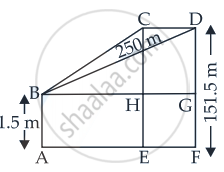
Given that height of the kite (h) = 151.5 m
Speed of the kite(V) = 10 m/s
Let FD be the height of the kite and AB be the height of the boy.
Let AF = xm
∴ BG = AF = xm
And `"dx"/"dt"` = 10 m/s
From the figure, we get that
GD = DF – GF
⇒ DF – AB
= (151.5 – 1.5) m = 150 m ......[∵ AB = GF]
Now in ΔBGD,
BG2 + GD2 = BD2 ......(By Pythagoras Theorem)
⇒ x2 + (150)2 = (250)2
⇒ x2 + 22500 = 62500
⇒ x2 = 62500 – 22500
⇒ x2 = 40000
⇒ x2 = 40000
Let initially the length of the string be y m
∴ In ΔBGD
BG2 + GD2 = BD2
⇒ x2 + (150)2 = y2
Differentiating both sides w.r.t., t, we get
⇒ `2x * "dx"/"dt" + 0 = 2y * "dy"/"dt"` ......`[because "dx"/"dt" = 10 "m"/"s"]`
⇒ 2 × 200 × 10 = 2 × 250 × `"dy"/"dt"`
∴ `"dy"/"dt" = (2 xx 200 xx 10)/(2 xx 250)` = 8 m/s
Hence, the rate of change of the length of the string is 8 m/s.
APPEARS IN
RELATED QUESTIONS
The rate of growth of bacteria is proportional to the number present. If, initially, there were
1000 bacteria and the number doubles in one hour, find the number of bacteria after 2½
hours.
[Take `sqrt2` = 1.414]
The volume of a cube is increasing at the rate of 8 cm3/s. How fast is the surface area increasing when the length of an edge is 12 cm?
A ladder 5 m long is leaning against a wall. The bottom of the ladder is pulled along the ground, away from the wall, at the rate of 2 cm/s. How fast is its height on the wall decreasing when the foot of the ladder is 4 m away from the wall?
Sand is pouring from a pipe at the rate of 12 cm3/s. The falling sand forms a cone on the ground in such a way that the height of the cone is always one-sixth of the radius of the base. How fast is the height of the sand cone increasing when the height is 4 cm?
The total cost C(x) in rupees associated with the production of x units of an item is given by C(x) = 0.007x3 – 0.003x2 + 15x + 4000. Find the marginal cost when 17 units are produced
The total revenue in rupees received from the sale of x units of a product is given by R(x) = 13x2 + 26x + 15. Find the marginal revenue when x = 7.
The two equal sides of an isosceles triangle with fixed base b are decreasing at the rate of 3 cm per second. How fast is the area decreasing when the two equal sides are equal to the base?
The sum of the perimeter of a circle and square is k, where k is some constant. Prove that the sum of their areas is least when the side of square is double the radius of the circle.
Find the rate of change of the volume of a sphere with respect to its diameter ?
An edge of a variable cube is increasing at the rate of 3 cm per second. How fast is the volume of the cube increasing when the edge is 10 cm long?
A balloon which always remains spherical, is being inflated by pumping in 900 cubic centimetres of gas per second. Find the rate at which the radius of the balloon is increasing when the radius is 15 cm.
A man 160 cm tall, walks away from a source of light situated at the top of a pole 6 m high, at the rate of 1.1 m/sec. How fast is the length of his shadow increasing when he is 1 m away from the pole?
A man 180 cm tall walks at a rate of 2 m/sec. away, from a source of light that is 9 m above the ground. How fast is the length of his shadow increasing when he is 3 m away from the base of light?
A particle moves along the curve y = x2 + 2x. At what point(s) on the curve are the x and y coordinates of the particle changing at the same rate?
The top of a ladder 6 metres long is resting against a vertical wall on a level pavement, when the ladder begins to slide outwards. At the moment when the foot of the ladder is 4 metres from the wall, it is sliding away from the wall at the rate of 0.5 m/sec. How fast is the top-sliding downwards at this instance?
How far is the foot from the wall when it and the top are moving at the same rate?
The radius of a cylinder is increasing at the rate 2 cm/sec. and its altitude is decreasing at the rate of 3 cm/sec. Find the rate of change of volume when radius is 3 cm and altitude 5 cm.
A particle moves along the curve y = (2/3)x3 + 1. Find the points on the curve at which the y-coordinate is changing twice as fast as the x-coordinate ?
The length x of a rectangle is decreasing at the rate of 5 cm/minute and the width y is increasing at the rate of 4 cm/minute. When x = 8 cm and y = 6 cm, find the rates of change of the area of the rectangle.
A circular disc of radius 3 cm is being heated. Due to expansion, its radius increases at the rate of 0.05 cm/sec. Find the rate at which its area is increasing when radius is 3.2 cm.
The side of an equilateral triangle is increasing at the rate of \[\frac{1}{3}\] cm/sec. Find the rate of increase of its perimeter ?
Find the surface area of a sphere when its volume is changing at the same rate as its radius ?
If the rate of change of volume of a sphere is equal to the rate of change of its radius, find the radius of the sphere ?
The radius of a sphere is changing at the rate of 0.1 cm/sec. The rate of change of its surface area when the radius is 200 cm is
If the rate of change of volume of a sphere is equal to the rate of change of its radius, then its radius is equal to
If the rate of change of area of a circle is equal to the rate of change of its diameter, then its radius is equal to
The equation of motion of a particle is s = 2t2 + sin 2t, where s is in metres and t is in seconds. The velocity of the particle when its acceleration is 2 m/sec2, is
The diameter of a circle is increasing at the rate of 1 cm/sec. When its radius is π, the rate of increase of its area is
A cylindrical tank of radius 10 m is being filled with wheat at the rate of 314 cubic metre per hour. Then the depth of the wheat is increasing at the rate of
For the curve y = 5x – 2x3, if x increases at the rate of 2 units/sec, then how fast is the slope of curve changing when x = 3?
A spherical ball of salt is dissolving in water in such a manner that the rate of decrease of the volume at any instant is proportional to the surface. Prove that the radius is decreasing at a constant rate
A ladder 5 m long is leaning against a wall. The bottom of the ladder is pulled along the ground, away from the wall, at the rate of 2 cm/s. How fast is its height on the wall decreasing when the foot of the ladder is 4 m away from the wall?
A cylindrical tank of radius 10 feet is being filled with wheat at the rate of 3/4 cubic feet per minute. The then depth of the wheat is increasing at the rate of
A spherical balloon is filled with 4500π cubic meters of helium gas. If a leak in the balloon causes the gas to escape at the rate of 72π cubic meters per minute, then the rate (in meters per minute) at which the radius of the balloon decreases 49 minutes after the leakage began is ______.
If equal sides of an isosceles triangle with fixed base 10 cm are increasing at the rate of 4 cm/sec, how fast is the area of triangle increasing at an instant when all sides become equal?
An edge of a variable cube is increasing at the rate of 10 cm/sec. How fast will the volume of the cube increase if the edge is 5 cm long?
When \(x\) and \(y\) both vary with respect to \(t\), which formula gives the rate of change of \(y\) with respect to \(x\)?
What does a positive derivative mean for a quantity?
What does a negative derivative mean for a quantity?
Which procedure is used in related rates?
