Advertisements
Advertisements
प्रश्न
A kite is moving horizontally at a height of 151.5 meters. If the speed of kite is 10 m/s, how fast is the string being let out; when the kite is 250 m away from the boy who is flying the kite? The height of boy is 1.5 m.
Advertisements
उत्तर
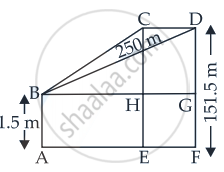
Given that height of the kite (h) = 151.5 m
Speed of the kite(V) = 10 m/s
Let FD be the height of the kite and AB be the height of the boy.
Let AF = xm
∴ BG = AF = xm
And `"dx"/"dt"` = 10 m/s
From the figure, we get that
GD = DF – GF
⇒ DF – AB
= (151.5 – 1.5) m = 150 m ......[∵ AB = GF]
Now in ΔBGD,
BG2 + GD2 = BD2 ......(By Pythagoras Theorem)
⇒ x2 + (150)2 = (250)2
⇒ x2 + 22500 = 62500
⇒ x2 = 62500 – 22500
⇒ x2 = 40000
⇒ x2 = 40000
Let initially the length of the string be y m
∴ In ΔBGD
BG2 + GD2 = BD2
⇒ x2 + (150)2 = y2
Differentiating both sides w.r.t., t, we get
⇒ `2x * "dx"/"dt" + 0 = 2y * "dy"/"dt"` ......`[because "dx"/"dt" = 10 "m"/"s"]`
⇒ 2 × 200 × 10 = 2 × 250 × `"dy"/"dt"`
∴ `"dy"/"dt" = (2 xx 200 xx 10)/(2 xx 250)` = 8 m/s
Hence, the rate of change of the length of the string is 8 m/s.
APPEARS IN
संबंधित प्रश्न
If y = f (u) is a differential function of u and u = g(x) is a differential function of x, then prove that y = f [g(x)] is a differential function of x and `dy/dx=dy/(du) xx (du)/dx`
Find the rate of change of the area of a circle with respect to its radius r when r = 3 cm.
The total revenue in rupees received from the sale of x units of a product is given by R(x) = 13x2 + 26x + 15. Find the marginal revenue when x = 7.
The two equal sides of an isosceles triangle with fixed base b are decreasing at the rate of 3 cm per second. How fast is the area decreasing when the two equal sides are equal to the base?
The volume of a sphere is increasing at the rate of 3 cubic centimeter per second. Find the rate of increase of its surface area, when the radius is 2 cm
Find the rate of change of the volume of a sphere with respect to its diameter ?
Find the rate of change of the volume of a sphere with respect to its surface area when the radius is 2 cm ?
Find the rate of change of the area of a circular disc with respect to its circumference when the radius is 3 cm ?
Find the rate of change of the area of a circle with respect to its radius r when r = 5 cm
A man 160 cm tall, walks away from a source of light situated at the top of a pole 6 m high, at the rate of 1.1 m/sec. How fast is the length of his shadow increasing when he is 1 m away from the pole?
A man 2 metres high walks at a uniform speed of 6 km/h away from a lamp-post 6 metres high. Find the rate at which the length of his shadow increases ?
The volume of metal in a hollow sphere is constant. If the inner radius is increasing at the rate of 1 cm/sec, find the rate of increase of the outer radius when the radii are 4 cm and 8 cm respectively.
A kite is 120 m high and 130 m of string is out. If the kite is moving away horizontally at the rate of 52 m/sec, find the rate at which the string is being paid out.
If the rate of change of volume of a sphere is equal to the rate of change of its radius, find the radius of the sphere ?
If \[V = \frac{4}{3}\pi r^3\] , at what rate in cubic units is V increasing when r = 10 and \[\frac{dr}{dt} = 0 . 01\] ? _________________
The volume of a sphere is increasing at 3 cm3/sec. The rate at which the radius increases when radius is 2 cm, is
If the rate of change of volume of a sphere is equal to the rate of change of its radius, then its radius is equal to
If s = t3 − 4t2 + 5 describes the motion of a particle, then its velocity when the acceleration vanishes, is
The equation of motion of a particle is s = 2t2 + sin 2t, where s is in metres and t is in seconds. The velocity of the particle when its acceleration is 2 m/sec2, is
The radius of a circular plate is increasing at the rate of 0.01 cm/sec. The rate of increase of its area when the radius is 12 cm, is
In a sphere the rate of change of volume is
For the curve y = 5x – 2x3, if x increases at the rate of 2 units/sec, then how fast is the slope of curve changing when x = 3?
Water is dripping out from a conical funnel of semi-vertical angle `pi/4` at the uniform rate of 2cm2/sec in the surface area, through a tiny hole at the vertex of the bottom. When the slant height of cone is 4 cm, find the rate of decrease of the slant height of water.
A spherical ball of salt is dissolving in water in such a manner that the rate of decrease of the volume at any instant is proportional to the surface. Prove that the radius is decreasing at a constant rate
The volume of a cube increases at a constant rate. Prove that the increase in its surface area varies inversely as the length of the side
Let y = f(x) be a function. If the change in one quantity 'y’ varies with another quantity x, then which of the following denote the rate of change of y with respect to x.
What is the rate of change of the area of a circle with respect to its radius when, r = 3 cm
Given that `1/y + 1/x = 1/12` and y decreases at a rate of 1 cms–1, find the rate of change of x when x = 5 cm and y = 1 cm.
For \[A=\pi r^2\], what is the rate of change of area with respect to radius when \[r=5\] cm?
For \[\text{C}(x)=0.005x^3-0.02x^2+30x+5000\], what is the marginal cost when \[x=3\]?
Which procedure is used in related rates?
When should a given value be substituted while finding a rate of change?
What must be included in the final answer for a rate of change?
