Advertisements
Advertisements
प्रश्न
A ladder, 5 meter long, standing on a horizontal floor, leans against a vertical wall. If the top of the ladder slides downwards at the rate of 10 cm/sec, then the rate at which the angle between the floor and the ladder is decreasing when lower end of ladder is 2 metres from the wall is ______.
विकल्प
1/10` radian/sec
1/20 radian/sec
20 radian/sec
10 radian/sec
Advertisements
उत्तर
A ladder, 5 meter long, standing on a horizontal floor, leans against a vertical wall. If the top of the ladder slides downwards at the rate of 10 cm/sec, then the rate at which the angle between the floor and the ladder is decreasing when lower end of ladder is 2 metres from the wall is 1/20 radian/sec.
Explanation: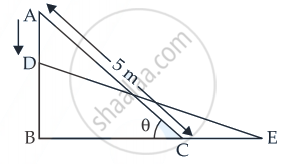
Length of ladder = 5 m
Let AB = y m and BC = x m
∴ In right ΔABC,
AB2 + BC2 = AC2
⇒ x2 + y2 = (5)2
⇒ x2 + y2 = 25
Differentiating both sides w.r.t x, we have
`2x * "dx"/"dt" + 2y * "dy"/"dt"` = 0
⇒ `x "dx"/"dt" + y * "dy"/"dt"` = 0
⇒ `2 * "dx"/"dt" + y xx (-0.1)` = 0 ....[∵ x = 2m]
⇒ `2 * "dx"/"dt" + sqrt(25 - x^2) xx (-0.1)` = 0
⇒ `2 * "dx"/"dt" + sqrt(25 - 4) xx (-0.1)` = 0
⇒ `2 * "dx"/"dt" - sqrt(21)/10` = 0
⇒ `"dx"/"dt" = sqrt(21)/20`
Now cos θ = `"BC"/"AC"` ....(θ is in radian)
⇒ cos θ = `x/5`
Differentiating both sides w.r.t. t, we get
`"d"/"dt" cos theta = 1/5 * "dx"/"dt"`
⇒ `- sin theta ("d"theta)/"dt" = 1/5 * sqrt(21)/20`
⇒ `("d"theta)/"dt" = sqrt(21)/100 xx (- 1/sin theta)`
= `sqrt(21)/100 xx -(1/("AB"/"AC"))`
= `- sqrt(21)/100 xx "AC"/"AB"`
= `- sqrt(21)/100 xx 5/sqrt(21)`
= `- 1/20` radian/sec
[(–) sign shows the decrease of change of angle]
Hence, the required rate = `1/20` radian/sec
APPEARS IN
संबंधित प्रश्न
The radius of a circle is increasing uniformly at the rate of 3 cm/s. Find the rate at which the area of the circle is increasing when the radius is 10 cm.
The radius of a circle is increasing at the rate of 0.7 cm/s. What is the rate of increase of its circumference?
The total revenue in rupees received from the sale of x units of a product is given by R(x) = 13x2 + 26x + 15. Find the marginal revenue when x = 7.
The sum of the perimeter of a circle and square is k, where k is some constant. Prove that the sum of their areas is least when the side of square is double the radius of the circle.
The volume of a sphere is increasing at the rate of 3 cubic centimeter per second. Find the rate of increase of its surface area, when the radius is 2 cm
The total cost C(x) associated with the production of x units of an item is given by C(x) = 0.005x3 – 0.02x2 + 30x + 5000. Find the marginal cost when 3 units are produced, whereby marginal cost we mean the instantaneous rate of change of total cost at any level of output.
The side of a square sheet is increasing at the rate of 4 cm per minute. At what rate is the area increasing when the side is 8 cm long?
A balloon which always remains spherical, is being inflated by pumping in 900 cubic centimetres of gas per second. Find the rate at which the radius of the balloon is increasing when the radius is 15 cm.
A man 2 metres high walks at a uniform speed of 5 km/hr away from a lamp-post 6 metres high. Find the rate at which the length of his shadow increases.
A ladder 13 m long leans against a wall. The foot of the ladder is pulled along the ground away from the wall, at the rate of 1.5 m/sec. How fast is the angle θ between the ladder and the ground is changing when the foot of the ladder is 12 m away from the wall.
The surface area of a spherical bubble is increasing at the rate of 2 cm2/s. When the radius of the bubble is 6 cm, at what rate is the volume of the bubble increasing?
A kite is 120 m high and 130 m of string is out. If the kite is moving away horizontally at the rate of 52 m/sec, find the rate at which the string is being paid out.
A particle moves along the curve y = (2/3)x3 + 1. Find the points on the curve at which the y-coordinate is changing twice as fast as the x-coordinate ?
If the rate of change of volume of a sphere is equal to the rate of change of its radius, then its radius is equal to
If s = t3 − 4t2 + 5 describes the motion of a particle, then its velocity when the acceleration vanishes, is
The equation of motion of a particle is s = 2t2 + sin 2t, where s is in metres and t is in seconds. The velocity of the particle when its acceleration is 2 m/sec2, is
A man 2 metres tall walks away from a lamp post 5 metres height at the rate of 4.8 km/hr. The rate of increase of the length of his shadow is
A man of height 6 ft walks at a uniform speed of 9 ft/sec from a lamp fixed at 15 ft height. The length of his shadow is increasing at the rate of
If the area of a circle increases at a uniform rate, then prove that perimeter varies inversely as the radius
A kite is moving horizontally at a height of 151.5 meters. If the speed of kite is 10 m/s, how fast is the string being let out; when the kite is 250 m away from the boy who is flying the kite? The height of boy is 1.5 m.
Two men A and B start with velocities v at the same time from the junction of two roads inclined at 45° to each other. If they travel by different roads, find the rate at which they are being seperated.
The radius of a cylinder is increasing at the rate of 3 m/s and its height is decreasing at the rate of 4 m/s. The rate of change of volume when the radius is 4 m and height is 6 m, is ____________.
The rate of change of volume of a sphere is equal to the rate of change of the radius than its radius equal to ____________.
If the rate of change of volume of a sphere is equal to the rate of change of its radius then the surface area of a sphere is ____________.
The radius of a circle is increasing uniformly at the rate of 3 cm per second. Find the rate at which the area of the circle is increasing when the radius is 10 cm.
A particle moves along the curve 3y = ax3 + 1 such that at a point with x-coordinate 1, y-coordinate is changing twice as fast at x-coordinate. Find the value of a.
If equal sides of an isosceles triangle with fixed base 10 cm are increasing at the rate of 4 cm/sec, how fast is the area of triangle increasing at an instant when all sides become equal?
An edge of a variable cube is increasing at the rate of 10 cm/sec. How fast will the volume of the cube increase if the edge is 5 cm long?
Given that `1/y + 1/x = 1/12` and y decreases at a rate of 1 cms–1, find the rate of change of x when x = 5 cm and y = 1 cm.
A kite is being pulled down by a string that goes through a ring on the ground 8 meters away from the person pulling it. If the string is pulled in at 1 meter per second, how fast is the kite coming down when it is 15 meters high?
For \[\text{C}(x)=0.005x^3-0.02x^2+30x+5000\], what is the marginal cost when \[x=3\]?
What does a negative derivative mean for a quantity?
Which procedure is used in related rates?
What must be included in the final answer for a rate of change?
In calculus, which expression represents the rate of change of \(y\) with respect to \(x\) and is used in geometry, motion, business mathematics, and many real-life situations?
