Advertisements
Advertisements
Question
A ladder, 5 meter long, standing on a horizontal floor, leans against a vertical wall. If the top of the ladder slides downwards at the rate of 10 cm/sec, then the rate at which the angle between the floor and the ladder is decreasing when lower end of ladder is 2 metres from the wall is ______.
Options
1/10` radian/sec
1/20 radian/sec
20 radian/sec
10 radian/sec
Advertisements
Solution
A ladder, 5 meter long, standing on a horizontal floor, leans against a vertical wall. If the top of the ladder slides downwards at the rate of 10 cm/sec, then the rate at which the angle between the floor and the ladder is decreasing when lower end of ladder is 2 metres from the wall is 1/20 radian/sec.
Explanation: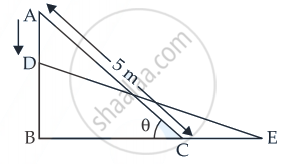
Length of ladder = 5 m
Let AB = y m and BC = x m
∴ In right ΔABC,
AB2 + BC2 = AC2
⇒ x2 + y2 = (5)2
⇒ x2 + y2 = 25
Differentiating both sides w.r.t x, we have
`2x * "dx"/"dt" + 2y * "dy"/"dt"` = 0
⇒ `x "dx"/"dt" + y * "dy"/"dt"` = 0
⇒ `2 * "dx"/"dt" + y xx (-0.1)` = 0 ....[∵ x = 2m]
⇒ `2 * "dx"/"dt" + sqrt(25 - x^2) xx (-0.1)` = 0
⇒ `2 * "dx"/"dt" + sqrt(25 - 4) xx (-0.1)` = 0
⇒ `2 * "dx"/"dt" - sqrt(21)/10` = 0
⇒ `"dx"/"dt" = sqrt(21)/20`
Now cos θ = `"BC"/"AC"` ....(θ is in radian)
⇒ cos θ = `x/5`
Differentiating both sides w.r.t. t, we get
`"d"/"dt" cos theta = 1/5 * "dx"/"dt"`
⇒ `- sin theta ("d"theta)/"dt" = 1/5 * sqrt(21)/20`
⇒ `("d"theta)/"dt" = sqrt(21)/100 xx (- 1/sin theta)`
= `sqrt(21)/100 xx -(1/("AB"/"AC"))`
= `- sqrt(21)/100 xx "AC"/"AB"`
= `- sqrt(21)/100 xx 5/sqrt(21)`
= `- 1/20` radian/sec
[(–) sign shows the decrease of change of angle]
Hence, the required rate = `1/20` radian/sec
APPEARS IN
RELATED QUESTIONS
The rate of growth of bacteria is proportional to the number present. If, initially, there were
1000 bacteria and the number doubles in one hour, find the number of bacteria after 2½
hours.
[Take `sqrt2` = 1.414]
The volume of a cube is increasing at the rate of 8 cm3/s. How fast is the surface area increasing when the length of an edge is 12 cm?
The radius of a circle is increasing uniformly at the rate of 3 cm/s. Find the rate at which the area of the circle is increasing when the radius is 10 cm.
An edge of a variable cube is increasing at the rate of 3 cm/s. How fast is the volume of the cube increasing when the edge is 10 cm long?
A particle moves along the curve 6y = x3 +2. Find the points on the curve at which the y-coordinate is changing 8 times as fast as the x-coordinate.
A balloon, which always remains spherical, has a variable diameter `3/2 (2x + 1)` Find the rate of change of its volume with respect to x.
The two equal sides of an isosceles triangle with fixed base b are decreasing at the rate of 3 cm per second. How fast is the area decreasing when the two equal sides are equal to the base?
The volume of a sphere is increasing at the rate of 3 cubic centimeter per second. Find the rate of increase of its surface area, when the radius is 2 cm
Find the rate of change of the volume of a sphere with respect to its diameter ?
Find the rate of change of the volume of a cone with respect to the radius of its base ?
A particle moves along the curve y = x3. Find the points on the curve at which the y-coordinate changes three times more rapidly than the x-coordinate.
A balloon in the form of a right circular cone surmounted by a hemisphere, having a diameter equal to the height of the cone, is being inflated. How fast is its volume changing with respect to its total height h, when h = 9 cm.
Water is running into an inverted cone at the rate of π cubic metres per minute. The height of the cone is 10 metres, and the radius of its base is 5 m. How fast the water level is rising when the water stands 7.5 m below the base.
The radius of a cylinder is increasing at the rate 2 cm/sec. and its altitude is decreasing at the rate of 3 cm/sec. Find the rate of change of volume when radius is 3 cm and altitude 5 cm.
The volume of metal in a hollow sphere is constant. If the inner radius is increasing at the rate of 1 cm/sec, find the rate of increase of the outer radius when the radii are 4 cm and 8 cm respectively.
A particle moves along the curve y = (2/3)x3 + 1. Find the points on the curve at which the y-coordinate is changing twice as fast as the x-coordinate ?
Find the point on the curve y2 = 8x for which the abscissa and ordinate change at the same rate ?
The volume of a cube is increasing at the rate of 9 cm3/sec. How fast is the surface area increasing when the length of an edge is 10 cm?
The length x of a rectangle is decreasing at the rate of 5 cm/minute and the width y is increasing at the rate of 4 cm/minute. When x = 8 cm and y = 6 cm, find the rates of change of the area of the rectangle.
If a particle moves in a straight line such that the distance travelled in time t is given by s = t3 − 6t2+ 9t + 8. Find the initial velocity of the particle ?
If the rate of change of volume of a sphere is equal to the rate of change of its radius, find the radius of the sphere ?
Side of an equilateral triangle expands at the rate of 2 cm/sec. The rate of increase of its area when each side is 10 cm is
A cone whose height is always equal to its diameter is increasing in volume at the rate of 40 cm3/sec. At what rate is the radius increasing when its circular base area is 1 m2?
For what values of x is the rate of increase of x3 − 5x2 + 5x + 8 is twice the rate of increase of x ?
If the rate of change of volume of a sphere is equal to the rate of change of its radius, then its radius is equal to
If the rate of change of area of a circle is equal to the rate of change of its diameter, then its radius is equal to
If s = t3 − 4t2 + 5 describes the motion of a particle, then its velocity when the acceleration vanishes, is
In a sphere the rate of change of surface area is
The rate of change of volume of a sphere with respect to its surface area, when the radius is 2 cm, is ______.
Two men A and B start with velocities v at the same time from the junction of two roads inclined at 45° to each other. If they travel by different roads, find the rate at which they are being seperated.
The sides of an equilateral triangle are increasing at the rate of 2 cm/sec. The rate at which the area increases, when side is 10 cm is ______.
The radius of a cylinder is increasing at the rate of 3 m/s and its height is decreasing at the rate of 4 m/s. The rate of change of volume when the radius is 4 m and height is 6 m, is ____________.
The rate of change of area of a circle with respect to its radius r at r = 6 cm is ____________.
What is the rate of change of the area of a circle with respect to its radius when, r = 3 cm
If equal sides of an isosceles triangle with fixed base 10 cm are increasing at the rate of 4 cm/sec, how fast is the area of triangle increasing at an instant when all sides become equal?
For the Chain Rule for Rates \[\frac{dy}{dx}=\frac{\frac{dy}{dt}}{\frac{dx}{dt}}\], which condition is required?
