Advertisements
Advertisements
प्रश्न
A ladder 5 m long is leaning against a wall. The bottom of the ladder is pulled along the ground, away from the wall, at the rate of 2 cm/s. How fast is its height on the wall decreasing when the foot of the ladder is 4 m away from the wall?
Advertisements
उत्तर
If the foot of the ladder is at distance x from the wall and the top is at a height y at any instant of ti,e t, then
(5 m)2 = x2 + y2 ....(i)
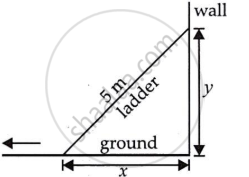
Differentiating (i) w.r.t. t, we have
`= d/dt (25 m^2) = 2x dx/dt + 2y dy/dt` ....(ii)
we have `dx/dt = 0.02 m //sec`
x = 4 m and y = `sqrt(25-4^2) m = 3`
`(∵ x^2 + y^2 = 25 m^2, y = sqrt (25 = x^2)) m`
Hence from (ii), we get,
`0 = 2 xx 4 m xx 0.02 m// sec + 2 xx 3 dy/dt`
`= dy/dt = -0.16/6` m/sec
∴ Rate of decrease of height on the wall
`= 16/600 m// sec = 1600/600 cm//sec = 8/3 cm//sec.`
APPEARS IN
संबंधित प्रश्न
Find the rate of change of the area of a circle with respect to its radius r when r = 3 cm.
The total revenue in rupees received from the sale of x units of a product is given by R(x) = 13x2 + 26x + 15. Find the marginal revenue when x = 7.
The rate of change of the area of a circle with respect to its radius r at r = 6 cm is ______.
The volume of a sphere is increasing at the rate of 8 cm3/s. Find the rate at which its surface area is increasing when the radius of the sphere is 12 cm.
Find the rate of change of the total surface area of a cylinder of radius r and height h, when the radius varies?
The total revenue received from the sale of x units of a product is given by R (x) = 13x2 + 26x + 15. Find the marginal revenue when x = 7 ?
The side of a square sheet is increasing at the rate of 4 cm per minute. At what rate is the area increasing when the side is 8 cm long?
A man 2 metres high walks at a uniform speed of 5 km/hr away from a lamp-post 6 metres high. Find the rate at which the length of his shadow increases.
Find an angle θ which increases twice as fast as its cosine ?
The radius of a cylinder is increasing at the rate 2 cm/sec. and its altitude is decreasing at the rate of 3 cm/sec. Find the rate of change of volume when radius is 3 cm and altitude 5 cm.
A kite is 120 m high and 130 m of string is out. If the kite is moving away horizontally at the rate of 52 m/sec, find the rate at which the string is being paid out.
The length x of a rectangle is decreasing at the rate of 5 cm/minute and the width y is increasing at the rate of 4 cm/minute. When x = 8 cm and y = 6 cm, find the rates of change of the area of the rectangle.
A circular disc of radius 3 cm is being heated. Due to expansion, its radius increases at the rate of 0.05 cm/sec. Find the rate at which its area is increasing when radius is 3.2 cm.
The side of a square is increasing at the rate of 0.1 cm/sec. Find the rate of increase of its perimeter ?
The radius of a sphere is changing at the rate of 0.1 cm/sec. The rate of change of its surface area when the radius is 200 cm is
The radius of the base of a cone is increasing at the rate of 3 cm/minute and the altitude is decreasing at the rate of 4 cm/minute. The rate of change of lateral surface when the radius = 7 cm and altitude 24 cm is
The volume of a sphere is increasing at 3 cm3/sec. The rate at which the radius increases when radius is 2 cm, is
The volume of a sphere is increasing at the rate of 4π cm3/sec. The rate of increase of the radius when the volume is 288 π cm3, is
The radius of a circular plate is increasing at the rate of 0.01 cm/sec. The rate of increase of its area when the radius is 12 cm, is
A man 2 metres tall walks away from a lamp post 5 metres height at the rate of 4.8 km/hr. The rate of increase of the length of his shadow is
Find the rate of change of the area of a circle with respect to its radius r when r = 4 cm.
Evaluate: `int (x(1+x^2))/(1+x^4)dx`
Water is dripping out at a steady rate of 1 cu cm/sec through a tiny hole at the vertex of the conical vessel, whose axis is vertical. When the slant height of water in the vessel is 4 cm, find the rate of decrease of slant height, where the vertical angle of the conical vessel is `pi/6`
If the area of a circle increases at a uniform rate, then prove that perimeter varies inversely as the radius
A man, 2m tall, walks at the rate of `1 2/3` m/s towards a street light which is `5 1/3`m above the ground. At what rate is the tip of his shadow moving? At what rate is the length of the shadow changing when he is `3 1/3`m from the base of the light?
A swimming pool is to be drained for cleaning. If L represents the number of litres of water in the pool t seconds after the pool has been plugged off to drain and L = 200 (10 – t)2. How fast is the water running out at the end of 5 seconds? What is the average rate at which the water flows out during the first 5 seconds?
The volume of a cube increases at a constant rate. Prove that the increase in its surface area varies inversely as the length of the side
A ladder, 5 meter long, standing on a horizontal floor, leans against a vertical wall. If the top of the ladder slides downwards at the rate of 10 cm/sec, then the rate at which the angle between the floor and the ladder is decreasing when lower end of ladder is 2 metres from the wall is ______.
A particle is moving along the curve x = at2 + bt + c. If ac = b2, then particle would be moving with uniform ____________.
The rate of change of area of a circle with respect to its radius r at r = 6 cm is ____________.
If the rate of change of the area of the circle is equal to the rate of change of its diameter then its radius is equal to ____________.
The rate of change of volume of a sphere is equal to the rate of change of the radius than its radius equal to ____________.
What is the rate of change of the area of a circle with respect to its radius when, r = 3 cm
A particle moves along the curve 3y = ax3 + 1 such that at a point with x-coordinate 1, y-coordinate is changing twice as fast at x-coordinate. Find the value of a.
What does a positive derivative mean for a quantity?
What does a negative derivative mean for a quantity?
In calculus, which expression represents the rate of change of \(y\) with respect to \(x\) and is used in geometry, motion, business mathematics, and many real-life situations?
