Advertisements
Advertisements
प्रश्न
A kite is 120 m high and 130 m of string is out. If the kite is moving away horizontally at the rate of 52 m/sec, find the rate at which the string is being paid out.
Advertisements
उत्तर
\[\text { In the right triangle ABC },\]
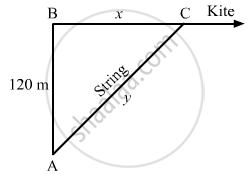
\[\text { Here,} \]
\[A B^2 + B C^2 = A C^2 \]
\[ \Rightarrow x^2 + \left( 120 \right)^2 = y^2 \]
\[ \Rightarrow 2x\frac{dx}{dt} = 2y\frac{dy}{dt}\]
\[ \Rightarrow \frac{dy}{dt} = \frac{x}{y}\frac{dx}{dt}\]
\[ \Rightarrow \frac{dy}{dt} = \frac{50}{130} \times 52 \left[ \because x = \sqrt{\left( 130 \right)^2 - \left( 120 \right)^2} = 50 \right]\]
\[ \Rightarrow \frac{dy}{dt} = 20 m/\sec\]
APPEARS IN
संबंधित प्रश्न
The rate of growth of bacteria is proportional to the number present. If, initially, there were
1000 bacteria and the number doubles in one hour, find the number of bacteria after 2½
hours.
[Take `sqrt2` = 1.414]
The radius of a circle is increasing uniformly at the rate of 3 cm/s. Find the rate at which the area of the circle is increasing when the radius is 10 cm.
A particle moves along the curve 6y = x3 +2. Find the points on the curve at which the y-coordinate is changing 8 times as fast as the x-coordinate.
The radius of an air bubble is increasing at the rate `1/2` cm/s. At what rate is the volume of the bubble increasing when the radius is 1 cm?
The total cost C(x) in rupees associated with the production of x units of an item is given by C(x) = 0.007x3 – 0.003x2 + 15x + 4000. Find the marginal cost when 17 units are produced
The total revenue in rupees received from the sale of x units of a product is given by R(x) = 13x2 + 26x + 15. Find the marginal revenue when x = 7.
The rate of change of the area of a circle with respect to its radius r at r = 6 cm is ______.
The two equal sides of an isosceles triangle with fixed base b are decreasing at the rate of 3 cm per second. How fast is the area decreasing when the two equal sides are equal to the base?
The sum of the perimeter of a circle and square is k, where k is some constant. Prove that the sum of their areas is least when the side of square is double the radius of the circle.
The volume of a sphere is increasing at the rate of 3 cubic centimeter per second. Find the rate of increase of its surface area, when the radius is 2 cm
The total cost C(x) associated with the production of x units of an item is given by C(x) = 0.005x3 – 0.02x2 + 30x + 5000. Find the marginal cost when 3 units are produced, whereby marginal cost we mean the instantaneous rate of change of total cost at any level of output.
Find the rate of change of the volume of a sphere with respect to its diameter ?
Find the rate of change of the volume of a sphere with respect to its surface area when the radius is 2 cm ?
An edge of a variable cube is increasing at the rate of 3 cm per second. How fast is the volume of the cube increasing when the edge is 10 cm long?
A stone is dropped into a quiet lake and waves move in circles at a speed of 4 cm/sec. At the instant when the radius of the circular wave is 10 cm, how fast is the enclosed area increasing?
A man 160 cm tall, walks away from a source of light situated at the top of a pole 6 m high, at the rate of 1.1 m/sec. How fast is the length of his shadow increasing when he is 1 m away from the pole?
The surface area of a spherical bubble is increasing at the rate of 2 cm2/s. When the radius of the bubble is 6 cm, at what rate is the volume of the bubble increasing?
The radius of a cylinder is increasing at the rate 2 cm/sec. and its altitude is decreasing at the rate of 3 cm/sec. Find the rate of change of volume when radius is 3 cm and altitude 5 cm.
The volume of a sphere is increasing at 3 cubic centimeter per second. Find the rate of increase of the radius, when the radius is 2 cms ?
The sides of an equilateral triangle are increasing at the rate of 2 cm/sec. How far is the area increasing when the side is 10 cms?
The side of an equilateral triangle is increasing at the rate of \[\frac{1}{3}\] cm/sec. Find the rate of increase of its perimeter ?
The radius of a sphere is changing at the rate of 0.1 cm/sec. The rate of change of its surface area when the radius is 200 cm is
The distance moved by the particle in time t is given by x = t3 − 12t2 + 6t + 8. At the instant when its acceleration is zero, the velocity is
The radius of the base of a cone is increasing at the rate of 3 cm/minute and the altitude is decreasing at the rate of 4 cm/minute. The rate of change of lateral surface when the radius = 7 cm and altitude 24 cm is
The radius of a sphere is increasing at the rate of 0.2 cm/sec. The rate at which the volume of the sphere increase when radius is 15 cm, is
The radius of a circular plate is increasing at the rate of 0.01 cm/sec. The rate of increase of its area when the radius is 12 cm, is
A 13 m long ladder is leaning against a wall, touching the wall at a certain height from the ground level. The bottom of the ladder is pulled away from the wall, along the ground, at the rate of 2 m/s. How fast is the height on the wall decreasing when the foot of the ladder is 5 m away from the wall?
A ladder 13 m long is leaning against a vertical wall. The bottom of the ladder is dragged away from the wall along the ground at the rate of 2 cm/sec. How fast is the height on the wall decreasing when the foot of the ladder is 5 m away from the wall?
Water is dripping out from a conical funnel of semi-vertical angle `pi/4` at the uniform rate of 2cm2/sec in the surface area, through a tiny hole at the vertex of the bottom. When the slant height of cone is 4 cm, find the rate of decrease of the slant height of water.
If the rate of change of the area of the circle is equal to the rate of change of its diameter then its radius is equal to ____________.
The median of an equilateral triangle is increasing at the ratio of `2sqrt(3)` cm/s. Find the rate at which its side is increasing.
An edge of a variable cube is increasing at the rate of 10 cm/sec. How fast will the volume of the cube increase if the edge is 5 cm long?
When \(x\) and \(y\) both vary with respect to \(t\), which formula gives the rate of change of \(y\) with respect to \(x\)?
For the Chain Rule for Rates \[\frac{dy}{dx}=\frac{\frac{dy}{dt}}{\frac{dx}{dt}}\], which condition is required?
For \[\text{C}(x)=0.005x^3-0.02x^2+30x+5000\], what is the marginal cost when \[x=3\]?
What does a negative derivative mean for a quantity?
When should a given value be substituted while finding a rate of change?
In calculus, which expression represents the rate of change of \(y\) with respect to \(x\) and is used in geometry, motion, business mathematics, and many real-life situations?
