A Kite is 120 M High and 130 M of String is Out. If the Kite is Moving Away Horizontally at the Rate of 52 M/Sec, Find the Rate at Which the String is Being Paid Out.
Advertisements
Advertisements
Question
A kite is 120 m high and 130 m of string is out. If the kite is moving away horizontally at the rate of 52 m/sec, find the rate at which the string is being paid out.
Advertisements
Solution
\[\text { In the right triangle ABC },\]
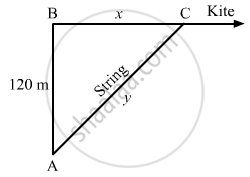
\[\text { Here,} \]
\[A B^2 + B C^2 = A C^2 \]
\[ \Rightarrow x^2 + \left( 120 \right)^2 = y^2 \]
\[ \Rightarrow 2x\frac{dx}{dt} = 2y\frac{dy}{dt}\]
\[ \Rightarrow \frac{dy}{dt} = \frac{x}{y}\frac{dx}{dt}\]
\[ \Rightarrow \frac{dy}{dt} = \frac{50}{130} \times 52 \left[ \because x = \sqrt{\left( 130 \right)^2 - \left( 120 \right)^2} = 50 \right]\]
\[ \Rightarrow \frac{dy}{dt} = 20 m/\sec\]
APPEARS IN
RELATED QUESTIONS
If y = f (u) is a differential function of u and u = g(x) is a differential function of x, then prove that y = f [g(x)] is a differential function of x and `dy/dx=dy/(du) xx (du)/dx`
A point source of light is hung 30 feet directly above a straight horizontal path on which a man of 6 feet in height is walking. How fast will the man’s shadow lengthen and how fast will the tip of shadow move when he is walking away from the light at the rate of 100 ft/min.
Find the rate of change of the area of a circle with respect to its radius r when r = 3 cm.
An edge of a variable cube is increasing at the rate of 3 cm/s. How fast is the volume of the cube increasing when the edge is 10 cm long?
A stone is dropped into a quiet lake and waves move in circles at the speed of 5 cm/s. At the instant when the radius of the circular wave is 8 cm, how fast is the enclosed area increasing?
A balloon, which always remains spherical has a variable radius. Find the rate at which its volume is increasing with the radius when the later is 10 cm.
The radius of an air bubble is increasing at the rate `1/2` cm/s. At what rate is the volume of the bubble increasing when the radius is 1 cm?
Find the rate of change of the total surface area of a cylinder of radius r and height h, when the radius varies?
The side of a square sheet is increasing at the rate of 4 cm per minute. At what rate is the area increasing when the side is 8 cm long?
The side of a square is increasing at the rate of 0.2 cm/sec. Find the rate of increase of the perimeter of the square.
The surface area of a spherical bubble is increasing at the rate of 2 cm2/s. When the radius of the bubble is 6 cm, at what rate is the volume of the bubble increasing?
The volume of metal in a hollow sphere is constant. If the inner radius is increasing at the rate of 1 cm/sec, find the rate of increase of the outer radius when the radii are 4 cm and 8 cm respectively.
A particle moves along the curve y = (2/3)x3 + 1. Find the points on the curve at which the y-coordinate is changing twice as fast as the x-coordinate ?
The volume of a spherical balloon is increasing at the rate of 25 cm3/sec. Find the rate of change of its surface area at the instant when radius is 5 cm ?
Side of an equilateral triangle expands at the rate of 2 cm/sec. The rate of increase of its area when each side is 10 cm is
A cylindrical vessel of radius 0.5 m is filled with oil at the rate of 0.25 π m3/minute. The rate at which the surface of the oil is rising, is
The volume of a sphere is increasing at the rate of 4π cm3/sec. The rate of increase of the radius when the volume is 288 π cm3, is
If the rate of change of area of a circle is equal to the rate of change of its diameter, then its radius is equal to
If s = t3 − 4t2 + 5 describes the motion of a particle, then its velocity when the acceleration vanishes, is
The equation of motion of a particle is s = 2t2 + sin 2t, where s is in metres and t is in seconds. The velocity of the particle when its acceleration is 2 m/sec2, is
A cylindrical tank of radius 10 m is being filled with wheat at the rate of 314 cubic metre per hour. Then the depth of the wheat is increasing at the rate of
Water is dripping out at a steady rate of 1 cu cm/sec through a tiny hole at the vertex of the conical vessel, whose axis is vertical. When the slant height of water in the vessel is 4 cm, find the rate of decrease of slant height, where the vertical angle of the conical vessel is `pi/6`
A man, 2m tall, walks at the rate of `1 2/3` m/s towards a street light which is `5 1/3`m above the ground. At what rate is the tip of his shadow moving? At what rate is the length of the shadow changing when he is `3 1/3`m from the base of the light?
A ladder, 5 meter long, standing on a horizontal floor, leans against a vertical wall. If the top of the ladder slides downwards at the rate of 10 cm/sec, then the rate at which the angle between the floor and the ladder is decreasing when lower end of ladder is 2 metres from the wall is ______.
The instantaneous rate of change at t = 1 for the function f (t) = te-t + 9 is ____________.
A particle is moving along the curve x = at2 + bt + c. If ac = b2, then particle would be moving with uniform ____________.
The rate of change of volume of a sphere is equal to the rate of change of the radius than its radius equal to ____________.
If the rate of change of volume of a sphere is equal to the rate of change of its radius then the surface area of a sphere is ____________.
Let y = f(x) be a function. If the change in one quantity 'y’ varies with another quantity x, then which of the following denote the rate of change of y with respect to x.
A ladder 5 m long is leaning against a wall. The bottom of the ladder is pulled along the ground, away from the wall, at the rate of 2 cm/s. How fast is its height on the wall decreasing when the foot of the ladder is 4 m away from the wall?
A spherical balloon is filled with 4500π cubic meters of helium gas. If a leak in the balloon causes the gas to escape at the rate of 72π cubic meters per minute, then the rate (in meters per minute) at which the radius of the balloon decreases 49 minutes after the leakage began is ______.
Given that `1/y + 1/x = 1/12` and y decreases at a rate of 1 cms–1, find the rate of change of x when x = 5 cm and y = 1 cm.
When \(x\) and \(y\) both vary with respect to \(t\), which formula gives the rate of change of \(y\) with respect to \(x\)?
For the Chain Rule for Rates \[\frac{dy}{dx}=\frac{\frac{dy}{dt}}{\frac{dx}{dt}}\], which condition is required?
For \[A=\pi r^2\], what is the rate of change of area with respect to radius when \[r=5\] cm?
What must be included in the final answer for a rate of change?
