Advertisements
Advertisements
Question
A man of height 6 ft walks at a uniform speed of 9 ft/sec from a lamp fixed at 15 ft height. The length of his shadow is increasing at the rate of
Options
15 ft/sec
9 ft/sec
6 ft/sec
none of these
Advertisements
Solution
6 ft/sec
Let AB be the lamp post. Suppose at any time t, the man CD be at a distance of x km from the lamp post and y ft be the length of his shadow CE.
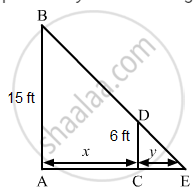
\[\text { Since the triangles ABE and CDE are similar }, \]
\[\frac{AB}{CD} = \frac{AE}{CE}\]
\[\Rightarrow \frac{15}{6} = \frac{x + y}{y}\]
\[ \Rightarrow \frac{x}{y} = \frac{15}{6} - 1\]
\[ \Rightarrow \frac{x}{y} = \frac{3}{2}\]
\[ \Rightarrow y = \frac{2}{3}x\]
\[ \Rightarrow \frac{dy}{dt} = \frac{2}{3}\left( \frac{dx}{dt} \right)\]
\[ \Rightarrow \frac{dy}{dt} = \frac{2}{3} \times 9\]
\[ \Rightarrow \frac{dy}{dt} = 6 \text { ft }/\sec\]
APPEARS IN
RELATED QUESTIONS
Find the rate of change of the area of a circle with respect to its radius r when r = 3 cm.
The radius of a circle is increasing uniformly at the rate of 3 cm/s. Find the rate at which the area of the circle is increasing when the radius is 10 cm.
The radius of a circle is increasing at the rate of 0.7 cm/s. What is the rate of increase of its circumference?
A balloon, which always remains spherical on inflation, is being inflated by pumping in 900 cubic centimetres of gas per second. Find the rate at which the radius of the balloon increases when the radius is 15 cm.
The sum of the perimeter of a circle and square is k, where k is some constant. Prove that the sum of their areas is least when the side of square is double the radius of the circle.
Find the rate of change of the volume of a sphere with respect to its diameter ?
Find the rate of change of the volume of a sphere with respect to its surface area when the radius is 2 cm ?
Find the rate of change of the volume of a cone with respect to the radius of its base ?
The total revenue received from the sale of x units of a product is given by R (x) = 13x2 + 26x + 15. Find the marginal revenue when x = 7 ?
The radius of a circle is increasing at the rate of 0.7 cm/sec. What is the rate of increase of its circumference?
A balloon which always remains spherical, is being inflated by pumping in 900 cubic centimetres of gas per second. Find the rate at which the radius of the balloon is increasing when the radius is 15 cm.
A man 2 metres high walks at a uniform speed of 5 km/hr away from a lamp-post 6 metres high. Find the rate at which the length of his shadow increases.
A stone is dropped into a quiet lake and waves move in circles at a speed of 4 cm/sec. At the instant when the radius of the circular wave is 10 cm, how fast is the enclosed area increasing?
Find an angle θ which increases twice as fast as its cosine ?
The top of a ladder 6 metres long is resting against a vertical wall on a level pavement, when the ladder begins to slide outwards. At the moment when the foot of the ladder is 4 metres from the wall, it is sliding away from the wall at the rate of 0.5 m/sec. How fast is the top-sliding downwards at this instance?
How far is the foot from the wall when it and the top are moving at the same rate?
A balloon in the form of a right circular cone surmounted by a hemisphere, having a diameter equal to the height of the cone, is being inflated. How fast is its volume changing with respect to its total height h, when h = 9 cm.
The volume of metal in a hollow sphere is constant. If the inner radius is increasing at the rate of 1 cm/sec, find the rate of increase of the outer radius when the radii are 4 cm and 8 cm respectively.
The length x of a rectangle is decreasing at the rate of 5 cm/minute and the width y is increasing at the rate of 4 cm/minute. When x = 8 cm and y = 6 cm, find the rates of change of the perimeter.
The amount of pollution content added in air in a city due to x diesel vehicles is given by P(x) = 0.005x3 + 0.02x2 + 30x. Find the marginal increase in pollution content when 3 diesel vehicles are added and write which value is indicated in the above questions ?
The radius of a sphere is changing at the rate of 0.1 cm/sec. The rate of change of its surface area when the radius is 200 cm is
The distance moved by the particle in time t is given by x = t3 − 12t2 + 6t + 8. At the instant when its acceleration is zero, the velocity is
The volume of a sphere is increasing at the rate of 4π cm3/sec. The rate of increase of the radius when the volume is 288 π cm3, is
Each side of an equilateral triangle is increasing at the rate of 8 cm/hr. The rate of increase of its area when side is 2 cm, is
The rate of change of volume of a sphere with respect to its surface area, when the radius is 2 cm, is ______.
A man, 2m tall, walks at the rate of `1 2/3` m/s towards a street light which is `5 1/3`m above the ground. At what rate is the tip of his shadow moving? At what rate is the length of the shadow changing when he is `3 1/3`m from the base of the light?
The volume of a cube increases at a constant rate. Prove that the increase in its surface area varies inversely as the length of the side
x and y are the sides of two squares such that y = x – x2. Find the rate of change of the area of second square with respect to the area of first square.
The rate of change of area of a circle with respect to its radius r at r = 6 cm is ____________.
If the rate of change of the area of the circle is equal to the rate of change of its diameter then its radius is equal to ____________.
The rate of change of volume of a sphere is equal to the rate of change of the radius than its radius equal to ____________.
Let y = f(x) be a function. If the change in one quantity 'y’ varies with another quantity x, then which of the following denote the rate of change of y with respect to x.
The radius of a circle is increasing uniformly at the rate of 3 cm per second. Find the rate at which the area of the circle is increasing when the radius is 10 cm.
A kite is being pulled down by a string that goes through a ring on the ground 8 meters away from the person pulling it. If the string is pulled in at 1 meter per second, how fast is the kite coming down when it is 15 meters high?
When \(x\) and \(y\) both vary with respect to \(t\), which formula gives the rate of change of \(y\) with respect to \(x\)?
The total cost in Rupees is \[\text{C}(x)=0.005x^3-0.02x^2+30x+5000\]. Which expression is the marginal cost?
When should a given value be substituted while finding a rate of change?
