Advertisements
Advertisements
Question
Two men A and B start with velocities v at the same time from the junction of two roads inclined at 45° to each other. If they travel by different roads, find the rate at which they are being seperated.
Advertisements
Solution
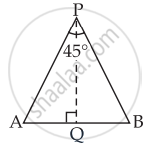
Let P be any point at which the two roads are inclined at an angle of 45°.
Two men A and B are moving along the roads PA and PB respectively with the same speed ‘V’
Let A and B be their final positions such that AB = y
∠APB = 45° and they move with the same speed.
∴ ΔAPB is an isosceles triangle.
Draw PQ ⊥ AB
AB = y
∴ AQ = `y/2` and PA = PB = x ...(Let)
∠APQ = ∠BPQ
= `45/2`
= `22 1/2^circ`
[∵ In an isosceles Δ, the altitude drawn from the vertex, bisects the base]
Now in right ΔAPQ,
`sin 22 1/2^circ = "AQ"/"AP"`
⇒ `sin 22 1/2^circ = 2/x = y/(2x)`
⇒ y = `2x * sin 22 1/2^circ`
Differentiating both sides w.r.t, t, we get
`"dy"/"dt" = 2 * "dx"/"dt" * sin 22 1/2^circ`
= `2 * "V" * sqrt(2 - sqrt(2))/2` ......`[because sin 22 1/2^circ = sqrt(2 - sqrt(2))/2]`
= `sqrt(2 - sqrt(2))` V m/s
Hence, the rate of their separation is `sqrt(2 - sqrt(2))` V unit/s.
APPEARS IN
RELATED QUESTIONS
A point source of light is hung 30 feet directly above a straight horizontal path on which a man of 6 feet in height is walking. How fast will the man’s shadow lengthen and how fast will the tip of shadow move when he is walking away from the light at the rate of 100 ft/min.
The volume of a cube is increasing at the rate of 8 cm3/s. How fast is the surface area increasing when the length of an edge is 12 cm?
The length x of a rectangle is decreasing at the rate of 5 cm/minute and the width y is increasing at the rate of 4 cm/minute. When x = 8 cm and y = 6 cm, find the rates of change of (a) the perimeter, and (b) the area of the rectangle.
Sand is pouring from a pipe at the rate of 12 cm3/s. The falling sand forms a cone on the ground in such a way that the height of the cone is always one-sixth of the radius of the base. How fast is the height of the sand cone increasing when the height is 4 cm?
The total cost C(x) in rupees associated with the production of x units of an item is given by C(x) = 0.007x3 – 0.003x2 + 15x + 4000. Find the marginal cost when 17 units are produced
Find the rate of change of the total surface area of a cylinder of radius r and height h, when the radius varies?
Find the rate of change of the volume of a cone with respect to the radius of its base ?
The money to be spent for the welfare of the employees of a firm is proportional to the rate of change of its total revenue (Marginal revenue). If the total revenue (in rupees) recieved from the sale of x units of a product is given by R(x) = 3x2 + 36x + 5, find the marginal revenue, when x = 5, and write which value does the question indicate ?
The radius of an air bubble is increasing at the rate of 0.5 cm/sec. At what rate is the volume of the bubble increasing when the radius is 1 cm?
A man 180 cm tall walks at a rate of 2 m/sec. away, from a source of light that is 9 m above the ground. How fast is the length of his shadow increasing when he is 3 m away from the base of light?
The top of a ladder 6 metres long is resting against a vertical wall on a level pavement, when the ladder begins to slide outwards. At the moment when the foot of the ladder is 4 metres from the wall, it is sliding away from the wall at the rate of 0.5 m/sec. How fast is the top-sliding downwards at this instance?
How far is the foot from the wall when it and the top are moving at the same rate?
A balloon in the form of a right circular cone surmounted by a hemisphere, having a diameter equal to the height of the cone, is being inflated. How fast is its volume changing with respect to its total height h, when h = 9 cm.
A man 2 metres high walks at a uniform speed of 6 km/h away from a lamp-post 6 metres high. Find the rate at which the length of his shadow increases ?
The surface area of a spherical bubble is increasing at the rate of 2 cm2/s. When the radius of the bubble is 6 cm, at what rate is the volume of the bubble increasing?
Find the point on the curve y2 = 8x for which the abscissa and ordinate change at the same rate ?
The volume of a spherical balloon is increasing at the rate of 25 cm3/sec. Find the rate of change of its surface area at the instant when radius is 5 cm ?
The side of an equilateral triangle is increasing at the rate of \[\frac{1}{3}\] cm/sec. Find the rate of increase of its perimeter ?
Find the surface area of a sphere when its volume is changing at the same rate as its radius ?
A ladder, 5 metre long, standing on a horizontal floor, leans against a vertical wall. If the top of the ladder slides down wards at the rate of 10 cm/sec, then find the rate at which the angle between the floor and ladder is decreasing when lower end of ladder is 2 metres from the wall ?
A cone whose height is always equal to its diameter is increasing in volume at the rate of 40 cm3/sec. At what rate is the radius increasing when its circular base area is 1 m2?
The radius of a sphere is increasing at the rate of 0.2 cm/sec. The rate at which the volume of the sphere increase when radius is 15 cm, is
The equation of motion of a particle is s = 2t2 + sin 2t, where s is in metres and t is in seconds. The velocity of the particle when its acceleration is 2 m/sec2, is
The rate of change of volume of a sphere with respect to its surface area, when the radius is 2 cm, is ______.
A swimming pool is to be drained for cleaning. If L represents the number of litres of water in the pool t seconds after the pool has been plugged off to drain and L = 200 (10 – t)2. How fast is the water running out at the end of 5 seconds? What is the average rate at which the water flows out during the first 5 seconds?
The sides of an equilateral triangle are increasing at the rate of 2 cm/sec. The rate at which the area increases, when side is 10 cm is ______.
A ladder, 5 meter long, standing on a horizontal floor, leans against a vertical wall. If the top of the ladder slides downwards at the rate of 10 cm/sec, then the rate at which the angle between the floor and the ladder is decreasing when lower end of ladder is 2 metres from the wall is ______.
If the rate of change of volume of a sphere is equal to the rate of change of its radius then the surface area of a sphere is ____________.
A man 1.6 m tall walks at the rate of 0.3 m/sec away from a street light that is 4 m above the ground. At what rate is the tip of his shadow moving? At what rate is his shadow lengthening?
A spherical balloon is being inflated at the rate of 35 cc/min. The rate of increase in the surface area (in cm2/min.) of the balloon when its diameter is 14 cm, is ______.
The median of an equilateral triangle is increasing at the ratio of `2sqrt(3)` cm/s. Find the rate at which its side is increasing.
A kite is being pulled down by a string that goes through a ring on the ground 8 meters away from the person pulling it. If the string is pulled in at 1 meter per second, how fast is the kite coming down when it is 15 meters high?
If a quantity \(y\) varies with another quantity \(x\) based on the rule \(y=f(x)\), which expression represents the rate of change of \(y\) with respect to \(x\)?
When \(x\) and \(y\) both vary with respect to \(t\), which formula gives the rate of change of \(y\) with respect to \(x\)?
For the Chain Rule for Rates \[\frac{dy}{dx}=\frac{\frac{dy}{dt}}{\frac{dx}{dt}}\], which condition is required?
For \[\text{C}(x)=0.005x^3-0.02x^2+30x+5000\], what is the marginal cost when \[x=3\]?
Which procedure is used in related rates?
