Advertisements
Advertisements
Question
A man, 2m tall, walks at the rate of `1 2/3` m/s towards a street light which is `5 1/3`m above the ground. At what rate is the tip of his shadow moving? At what rate is the length of the shadow changing when he is `3 1/3`m from the base of the light?
Advertisements
Solution
Let AB is the height of street light post and CD is the height of the man such that
AB = `5 1/3 = 16/3 "m"` and CD = 2 m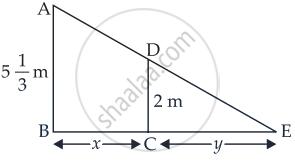
Let BC = x length (the distance of the man from the lamp post) and CE = y is the length of the shadow of the man at any instant.
From the figure, we see that
ΔABE ~ Δ DCE ......[By AAA Similarity]
∴ Taking ratio of their corresponding sides, we get
`"AB"/"CD" = "BE"/"CE"`
⇒ `"AB"/"CD" = ("BC" + "CE")/"CE"`
⇒ `(16/3)/2 = (x + y)/y`
⇒ `8/3 = (x + y)/y`
⇒ 8y = 3x + 3y
⇒ 8y – 3y = 3x
⇒ 5y = 3x
Differentiating both sides w.r.t, t, we get
`"dy"/"dt" = 3 * "dx"/dt"`
⇒ `"dy"/"dt" = 3/5 * "dx"/"dt"`
⇒ `"dy"/"dt" = 3/5 * ((-5)/3)` ......[∵ man is moving in opposite direction]
= – 1 m/s
Hence, the length of shadow is decreasing at the rate of 1 m/s.
Now let u = x + y .....(u = Distance of the tip of shadow from the light post)
Differentiating both sides w.r.t. t, we get
`"du"/"dt" = "dx"/"dt" + "dy"/dt"`
= `(- 1 2/3 - 1)`
= `-(5/3 + 1)`
= `- 8/3`
= `-2 2/3` m/s
Hence, the tip of the shadow is moving at the rate of `2 2/3` m/s towards the light post and the length of shadow decreasing at the rate of 1 m/s.
APPEARS IN
RELATED QUESTIONS
The radius of a circle is increasing at the rate of 0.7 cm/s. What is the rate of increase of its circumference?
A balloon, which always remains spherical, has a variable diameter `3/2 (2x + 1)` Find the rate of change of its volume with respect to x.
Sand is pouring from a pipe at the rate of 12 cm3/s. The falling sand forms a cone on the ground in such a way that the height of the cone is always one-sixth of the radius of the base. How fast is the height of the sand cone increasing when the height is 4 cm?
The two equal sides of an isosceles triangle with fixed base b are decreasing at the rate of 3 cm per second. How fast is the area decreasing when the two equal sides are equal to the base?
The total cost C(x) associated with the production of x units of an item is given by C(x) = 0.005x3 – 0.02x2 + 30x + 5000. Find the marginal cost when 3 units are produced, whereby marginal cost we mean the instantaneous rate of change of total cost at any level of output.
Find the rate of change of the volume of a cone with respect to the radius of its base ?
Find the rate of change of the volume of a ball with respect to its radius r. How fast is the volume changing with respect to the radius when the radius is 2 cm?
The total cost C (x) associated with the production of x units of an item is given by C (x) = 0.007x3 − 0.003x2 + 15x + 4000. Find the marginal cost when 17 units are produced ?
The side of a square is increasing at the rate of 0.2 cm/sec. Find the rate of increase of the perimeter of the square.
A man 160 cm tall, walks away from a source of light situated at the top of a pole 6 m high, at the rate of 1.1 m/sec. How fast is the length of his shadow increasing when he is 1 m away from the pole?
A ladder 13 m long leans against a wall. The foot of the ladder is pulled along the ground away from the wall, at the rate of 1.5 m/sec. How fast is the angle θ between the ladder and the ground is changing when the foot of the ladder is 12 m away from the wall.
A particle moves along the curve y = x2 + 2x. At what point(s) on the curve are the x and y coordinates of the particle changing at the same rate?
Find an angle θ whose rate of increase twice is twice the rate of decrease of its cosine ?
The top of a ladder 6 metres long is resting against a vertical wall on a level pavement, when the ladder begins to slide outwards. At the moment when the foot of the ladder is 4 metres from the wall, it is sliding away from the wall at the rate of 0.5 m/sec. How fast is the top-sliding downwards at this instance?
How far is the foot from the wall when it and the top are moving at the same rate?
A man 2 metres high walks at a uniform speed of 6 km/h away from a lamp-post 6 metres high. Find the rate at which the length of his shadow increases ?
Sand is being poured onto a conical pile at the constant rate of 50 cm3/ minute such that the height of the cone is always one half of the radius of its base. How fast is the height of the pile increasing when the sand is 5 cm deep ?
The sides of an equilateral triangle are increasing at the rate of 2 cm/sec. How far is the area increasing when the side is 10 cms?
The side of a square is increasing at the rate of 0.1 cm/sec. Find the rate of increase of its perimeter ?
If \[V = \frac{4}{3}\pi r^3\] , at what rate in cubic units is V increasing when r = 10 and \[\frac{dr}{dt} = 0 . 01\] ? _________________
Side of an equilateral triangle expands at the rate of 2 cm/sec. The rate of increase of its area when each side is 10 cm is
A cone whose height is always equal to its diameter is increasing in volume at the rate of 40 cm3/sec. At what rate is the radius increasing when its circular base area is 1 m2?
The distance moved by the particle in time t is given by x = t3 − 12t2 + 6t + 8. At the instant when its acceleration is zero, the velocity is
The coordinates of the point on the ellipse 16x2 + 9y2 = 400 where the ordinate decreases at the same rate at which the abscissa increases, are
If the rate of change of area of a circle is equal to the rate of change of its diameter, then its radius is equal to
If s = t3 − 4t2 + 5 describes the motion of a particle, then its velocity when the acceleration vanishes, is
The diameter of a circle is increasing at the rate of 1 cm/sec. When its radius is π, the rate of increase of its area is
The rate of change of volume of a sphere with respect to its surface area, when the radius is 2 cm, is ______.
A spherical ball of salt is dissolving in water in such a manner that the rate of decrease of the volume at any instant is proportional to the surface. Prove that the radius is decreasing at a constant rate
If the area of a circle increases at a uniform rate, then prove that perimeter varies inversely as the radius
The radius of a cylinder is increasing at the rate of 3 m/s and its height is decreasing at the rate of 4 m/s. The rate of change of volume when the radius is 4 m and height is 6 m, is ____________.
If the rate of change of volume of a sphere is equal to the rate of change of its radius then the surface area of a sphere is ____________.
A cylindrical tank of radius 10 feet is being filled with wheat at the rate of 3/4 cubic feet per minute. The then depth of the wheat is increasing at the rate of
If equal sides of an isosceles triangle with fixed base 10 cm are increasing at the rate of 4 cm/sec, how fast is the area of triangle increasing at an instant when all sides become equal?
If a quantity \(y\) varies with another quantity \(x\) based on the rule \(y=f(x)\), which expression represents the rate of change of \(y\) with respect to \(x\)?
When \(x\) and \(y\) both vary with respect to \(t\), which formula gives the rate of change of \(y\) with respect to \(x\)?
When should a given value be substituted while finding a rate of change?
