Advertisements
Advertisements
Question
The altitude of a cone is 20 cm and its semi-vertical angle is 30°. If the semi-vertical angle is increasing at the rate of 2° per second, then the radius of the base is increasing at the rate of
Options
30 cm/sec
\[\frac{160}{3} cm/\sec\]
10 cm/sec
160 cm/sec
Advertisements
Solution
\[\frac{160}{3} cm/\sec\]
\[\text {Let r be the radius, h be the height and } \alpha\text { be the semi - vertical angle of the cone} .\]
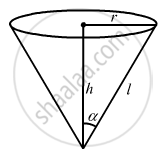
\[\text { Then }, \]
\[\tan \alpha = \frac{r}{h}\]
\[ \Rightarrow se c^2 \alpha\left( \frac{d\alpha}{dt} \right) = \frac{dr}{h dt}\]
\[ \Rightarrow \frac{dr}{dt} = h \times se c^2 \alpha\left( \frac{d\alpha}{dt} \right)\]
\[ \Rightarrow \frac{dr}{dt} = 20 \times se c^2 30 \times 2 \left[ \because h = 20 cm, \alpha = 30^\circ \text { and } \frac{d\alpha}{dt} = 2^\circ \text { per second } \right]\]
\[ \Rightarrow \frac{dr}{dt} = 40 \times \left( \frac{2}{\sqrt{3}} \right)^2 \]
\[ \Rightarrow \frac{dr}{dt} = \frac{160}{3} cm/\sec\]
APPEARS IN
RELATED QUESTIONS
The Volume of cube is increasing at the rate of 9 cm 3/s. How fast is its surfacee area increasing when the length of an edge is 10 cm?
An edge of a variable cube is increasing at the rate of 3 cm/s. How fast is the volume of the cube increasing when the edge is 10 cm long?
The total revenue in rupees received from the sale of x units of a product is given by R(x) = 3x2 + 36x + 5. The marginal revenue, when x = 15 is ______.
The volume of a sphere is increasing at the rate of 3 cubic centimeter per second. Find the rate of increase of its surface area, when the radius is 2 cm
Find the rate of change of the volume of a sphere with respect to its surface area when the radius is 2 cm ?
Find the rate of change of the area of a circle with respect to its radius r when r = 5 cm
The money to be spent for the welfare of the employees of a firm is proportional to the rate of change of its total revenue (Marginal revenue). If the total revenue (in rupees) recieved from the sale of x units of a product is given by R(x) = 3x2 + 36x + 5, find the marginal revenue, when x = 5, and write which value does the question indicate ?
The side of a square sheet is increasing at the rate of 4 cm per minute. At what rate is the area increasing when the side is 8 cm long?
The radius of a spherical soap bubble is increasing at the rate of 0.2 cm/sec. Find the rate of increase of its surface area, when the radius is 7 cm.
A balloon which always remains spherical, is being inflated by pumping in 900 cubic centimetres of gas per second. Find the rate at which the radius of the balloon is increasing when the radius is 15 cm.
A man 180 cm tall walks at a rate of 2 m/sec. away, from a source of light that is 9 m above the ground. How fast is the length of his shadow increasing when he is 3 m away from the base of light?
If y = 7x − x3 and x increases at the rate of 4 units per second, how fast is the slope of the curve changing when x = 2?
A balloon in the form of a right circular cone surmounted by a hemisphere, having a diameter equal to the height of the cone, is being inflated. How fast is its volume changing with respect to its total height h, when h = 9 cm.
Water is running into an inverted cone at the rate of π cubic metres per minute. The height of the cone is 10 metres, and the radius of its base is 5 m. How fast the water level is rising when the water stands 7.5 m below the base.
Find the point on the curve y2 = 8x for which the abscissa and ordinate change at the same rate ?
A circular disc of radius 3 cm is being heated. Due to expansion, its radius increases at the rate of 0.05 cm/sec. Find the rate at which its area is increasing when radius is 3.2 cm.
The side of an equilateral triangle is increasing at the rate of \[\frac{1}{3}\] cm/sec. Find the rate of increase of its perimeter ?
If \[V = \frac{4}{3}\pi r^3\] , at what rate in cubic units is V increasing when r = 10 and \[\frac{dr}{dt} = 0 . 01\] ? _________________
A cylindrical vessel of radius 0.5 m is filled with oil at the rate of 0.25 π m3/minute. The rate at which the surface of the oil is rising, is
The coordinates of the point on the ellipse 16x2 + 9y2 = 400 where the ordinate decreases at the same rate at which the abscissa increases, are
The radius of a sphere is increasing at the rate of 0.2 cm/sec. The rate at which the volume of the sphere increase when radius is 15 cm, is
The volume of a sphere is increasing at 3 cm3/sec. The rate at which the radius increases when radius is 2 cm, is
A cylindrical tank of radius 10 m is being filled with wheat at the rate of 314 cubic metre per hour. Then the depth of the wheat is increasing at the rate of
Evaluate: `int (x(1+x^2))/(1+x^4)dx`
For the curve y = 5x – 2x3, if x increases at the rate of 2 units/sec, then how fast is the slope of curve changing when x = 3?
Water is dripping out at a steady rate of 1 cu cm/sec through a tiny hole at the vertex of the conical vessel, whose axis is vertical. When the slant height of water in the vessel is 4 cm, find the rate of decrease of slant height, where the vertical angle of the conical vessel is `pi/6`
A kite is moving horizontally at a height of 151.5 meters. If the speed of kite is 10 m/s, how fast is the string being let out; when the kite is 250 m away from the boy who is flying the kite? The height of boy is 1.5 m.
Two men A and B start with velocities v at the same time from the junction of two roads inclined at 45° to each other. If they travel by different roads, find the rate at which they are being seperated.
x and y are the sides of two squares such that y = x – x2. Find the rate of change of the area of second square with respect to the area of first square.
If the rate of change of volume of a sphere is equal to the rate of change of its radius then the surface area of a sphere is ____________.
An edge of a variable cube is increasing at the rate of 10 cm/sec. How fast will the volume of the cube increase if the edge is 5 cm long?
Given that `1/y + 1/x = 1/12` and y decreases at a rate of 1 cms–1, find the rate of change of x when x = 5 cm and y = 1 cm.
A kite is being pulled down by a string that goes through a ring on the ground 8 meters away from the person pulling it. If the string is pulled in at 1 meter per second, how fast is the kite coming down when it is 15 meters high?
For a circle with area \[A=\pi r^2\], what is \[\frac{dA}{dr}\]?
For \[A=\pi r^2\], what is the rate of change of area with respect to radius when \[r=5\] cm?
For \[\text{C}(x)=0.005x^3-0.02x^2+30x+5000\], what is the marginal cost when \[x=3\]?
Which procedure is used in related rates?
In calculus, which expression represents the rate of change of \(y\) with respect to \(x\) and is used in geometry, motion, business mathematics, and many real-life situations?
