Advertisements
Advertisements
प्रश्न
Make a list of jobs which would give you an opportunity to help the society or serve the country. Also mention the different ways in which they can be beneficial to the people and also the country.
Advertisements
उत्तर
- Joining the defence forces:
Protect the country’s border from external threat and ensure the safety of its citizens. - Social Worker:
Help distressed and underprivileged people to cope with difficult situations and issues in their lives Connect the people who seek help with the right organisations. - Firefighter:
First responders in not just fire disasters but also for other calamities occurring around us. - Police Officer:
Enforce the law and patrol the neighbourhood to ensure the safety of the community.
APPEARS IN
संबंधित प्रश्न
Point out -
Point out two instances where you find Chaitanya's victory over his disability.
It is easy to advise others not to worry, but difficult for oneself to follow the same. Narrate an experience which made you realise the truth of this statement.
In the following items, sentence A is complete, while sentence B is not. Complete sentence B, making it as similar as possible to sentence A. Write sentence B.
(A) His attitude towards his parents has always puzzled the
(B) I have ..................................................................................
How does Sarojini Naidu allude to the patriarchal system of her times? Discuss.
Why is the poet so much against watching television? Give two reasons.
Comment on the imagery used in the poem.
It was roses, roses, all the way,
With myrtle mixed in my path like mad;
The house-roofs seemed to heave and sway,
The church-spires flamed, such flags they had,
A year ago on this very day.
Read the above lines and answer the question that follow.
By which flower was the patriot welcomed?
What does the book of gold symbolize?
The eight other runners pulled up on their heels
The ones who had trained for so long to complete
one by one they all turned around and went back to help him
And brought the young boy to his feet.
Then all the nine runners joined hands and continued
The hundred-yard dash now reduced to a walk
And a banner above that said (Special Olympics)
Could not have been more on the mark.
That's how the race ended, with nine gold medals
They came to the finish line holding hands still
And a standing ovation and nine beaming faces
Said more than these words ever will.
Read the lines given above and answer the following question:
Who gave standing ovation? Why?
Examine how cross cultural differences bring out humor in “A Horse and Two Goats.”
Discuss theme of kindness and compassion in “Hearts and Hands” by O. Henry?
(A) If you are not ready to come with me, I will not go.
(B) Unless…………………………..
The children were delighted. The exams had been cancelled.
I prefer playing a, game to watching television. (Begin: I would rather ……….)
The ailing company was taken________by the government.
You are to be awarded a Special Prize at the Annual Prize Day ceremony of your school. Write a letter to a lady relative, giving her the news. Be sure to include details of the prize that you are to receive, and tell her why you have been chosen for this honour.
Re-write the following sentence according to the instructions are given. Make other changes that may be necessary, but do not change the meaning of the sentence.
Naresh goes to a school that has over a thousand students.
(Begin: There……….)
Give an account of the incidents of racial discrimination that Braithwaite has described in the novel ‘To Sir With Love’.
I have never seen a film as bad as this. ·
(Begin: This is ........................................ )
Talk with your family members about elderly people who you have been intimately connected with and who are not there with you now.
Write a short description of someone you liked a lot.
Given below is an interesting combination of words. Explain why they have been used together.
ghostly dust devils
Name some leaves and flowers that are used as adornments in our country.
Combine the following sets of ideas to show the contrast between them.
(i) European art tries to achieve a perfect, illusionistic likeness.
(ii)Asian art tries to capture the essence of inner life and spirit.
Below is a topic for essay writing. Follow the steps listed above to write on this topic.
Human Population Grows Up
Locate the following words in the text and study their connotation.
1. gripped the imagination of
2. dawned upon
3. ushered in
4. passed into current coin
5. passport of the future
What clues did Sherlock Holmes work upon to get at the fact that the story of the three Garridebs was a ruse?
Give reasons for the following.
Satyajit attending the village wedding.
Use the phrase in a sentence of your own, after finding out its meaning.
on board
Use the phrase in a sentence of your own, after finding out its meaning.
carry on
What is a space shuttle? Name the shuttle which took Kalpana in space.
What happened to the crow in the end?
The words in the box are all words that describe movement. Use them to fill in the blank in the sentence below.
When the cobra tried to bite it, the mongoose ____________ aside.
Give your opinion: Whether we should or should not participate in adventure sports because __________________.
Look at the sentences given below. Find out which one is correct. If the sentence is wrong give reasons.
Go to your college library or surf the internet for names of various mountaineers who have successfully climbed Mt. Everest. Write in your notebook about their struggles, the interesting anecdotes they have shared, their failures, and the message that we get from their lives. Submit them to your teacher.
Imagine that Revathi’s father is abroad on business and she wishes to convey the news of her prize - winning plants. Draft an email for the above subject.
(Use an email format.)
Imagine your younger sister is not paying attention to her studies and is seen wasting time playing games on her cell-phone. Suggest some ways that will help her to concentrate on her studies and overcome her bad habit.
Write a summary of the poem with the help of the points given below:
- Title
- Introductory paragraph (about the poem/type/nature/tone)
- Main body (central idea/gist of the poem)
- Conclusion/opinions/views/appeal.
Compose a poem in an imaginary village. Try to maintain the rhyme scheme in the poem. You may begin like this….
Settled on the bank of a river
Like a queen
Is my beautiful village
Full of bushes green.
Discuss with your partner on the following topic. Express your views and opinions in favour of and against the topic.
Are sports essential in Jr. Colleges?
‘Live as if you were to die tomorrow. Learn as if you were to live forever.’ Mahatma Gandhi
Collect some more quotes on education by famous thinkers.
Imagine that you are a compere of a ‘Prize Distribution Ceremony’ of your college. Write a script for the same.
You can take the help of the following points.
- Introduction – A brief introduction of the programme / function / show
- Welcome speech – Welcome to all guests. Felicitation – felicitation of the guests (the principal, vice-principal, etc.).
- Lighting the lamp
- Welcome song
- Main events
- Vote of thanks
Given in a mixed order below are some good human attributes of the family. Pick out from the box and write it against the line that reflects it.
Ten years had passed and the young boys grew to be young men and their parents were proud of them.
Write a few lines about yourself - your name, appearance, family, the place where you live, your school, your friends, neighbours, relatives, your likes, dislikes, hobbies, what you are good at, etc.
Now create an imaginary ‘persona’ for yourself. It can be quite different from your real self. Or, you may choose a fictional character - a character from a novel, story, etc. Write a few lines about this imaginary persona and introduce yourself in that role.
| Real Self | Imaginary Persona |
|
Hi, I am ____________________ ____________________________ ____________________________ |
Hi, I am ____________________ ____________________________ ____________________________ |
In the play, two devices that make use of wheels are given. The devices are:
- _______________
- _______________
From the internet or other sources, trace the history of the use of the wheel. Write ‘An Autobiography of a Wheel’.
Write a character-sketch of the ‘Stranger-man’ using examples from the story to support the following attributes.
- ignorant, innocent, and polite
- calm and cool
- jumps to wrong conclusions
- hasty and unwise at times
Answer the following question :
If an opinion contrary to your own makes you angry, what does it indicate?
Answer the following question :
What are the advantages of an imaginary argument with a person having a different bias?
Go through the following steps and discuss in pairs about the facts mentioned in it. Write a paragraph using the points. Give another interesting title.
| Living A Better Life |
| ↓ |
| Get rid of one bad habit at a time. |
| ↓ |
| Avoid negative thoughts. Be positive. |
| ↓ |
| Trust yourself. Love what you do. |
| ↓ |
| Try to enrich your mind by becoming a life long learner. |
| ↓ |
| Sharing and Caring makes life enjoyable. |
| ↓ |
| Be humble. Respect and welcome/accept each day with a smile. |
Write an article for the following.
The service provided by the conservancy workers in your city is very poor. You find all the street corners dumped with garbage thrown by the residents of the locality. It causes a menace for the public at large. You are Ramya/Rajan of Class X, studying in TM Model School, Dharmapuri. Write an article in about 150-200 words to the editor of The Indian Express, about this and suggest ways by which the situation could be improved.
Write a letter of enquiry for the following.
Write a letter to the head of the BSNL office enquiring regarding the internet broadband scheme launched recently.
Imagine that you are the sports captain of your school. Write a formal letter to the sports captain of another school inviting her/ his team for a friendly match. You may choose any sport. Give details of time and place
______ is your birthday?
Do you want to try to write your own paragraph now?
Write a paragraph on Palm tree.

- ______
- ______
- ______
- ______
- ______
Use the option to fill in the blank.
The cows ______ grazing in the field.
In the sentence below the capital letter, comma, full stop and question mark are missing. Put these in the correct place.
rahim ravi and raju are going to see the circus
Tina goes to her school library to borrow a book. Complete her dialogue with the librarian by using and or or in the blanks.
| Tina | Ma’am, I want to borrow a book. |
| Librarian | Do you want a story book ______a book of poems? |
| Tina | I want a story book. |
| Librarian | Do you like stories about animals ______adventure stories? |
| Tina | I like both. |
| Librarian | Go to the second cupboard. On the first shelf, you will find animal stories ______ on the second, adventure stories. |
| Tina | Ma’am, I want Black Beauty______ Panchantantra Stories |
| Librarian | You can have either Black Beauty______Panchantantra Stories |
Make opposites with the words –
| dis ______ in______ |
| respect | |
| able | |
| efficient | |
| own | |
| capable | |
| secure |
See the picture Travel Time below. Answer the questions that follow.
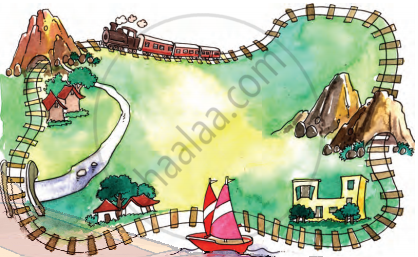
- Where did you go for an excursion/holiday?
- With whom did you go?
- What did you take with you?
- What was the first thing you saw when you reached your destination?
- What did you like best about the place?
- How long did you stay there?
- What did you miss about home?
Which do you think would be more fun — travelling by aeroplane or sailing on a ship? Write why you think so.
The girl looked up at the ______of stars.
What made the dogs follow the grandmother after school hours?
The grandmother played a vital role in the author’s formative years. Give your own example of how elders have a positive influence on the younger generation. Include examples from the story also.
What did he keep doing while on his rounds?
State whether the following statement are true or false
Bob realised that the tall man was not Jimmy Wells from the shape of his nose.
Why did Philip Sletherby visit Brill Manor?
Explain the following phrase selected from the story in your own word and work with a partner to make sentence using these phrase:
making up for lost time
Read the information in the table below and answer the following questions.
| Sl. No | Event | Year | Affected Area |
| 1. | Earthquake | 2001 | Bhuj, Gujarat |
| 2. | Tsunami | 2004 | Coastline TN, Kerala, A.P., A&N Islands, Pondicherry |
| 3. | Floods | July 2005 | Maharashtra |
| 4. | Earthquake | 2008 | Kashmir |
| 5. | Floods | 2008 | North Bihar |
| 6. | Cyclone | 2008 | Tamil Nadu |
| 7. | Floods | 2009 | Andhra Pradesh & Karnataka |
| 8. | Cyclone | 2011 | Tamil Nadu/Cuddalore |
| 9. | Flash floods | June 2013 | Uttarkhand |
| 10. | Cyclone | Oct. 2013 | Coastline of Orissa & Jharkhand |
| 11. | Floods | Dec. 2015 | Tamil Nadu/Chennai |
| 12. | Cyclone | Dec. 2016 | Tamil Nadu/Chennai |
- What kinds of natural disasters have occurred before 2005?
- Name the disasters that are common in India.
- Mention the states often affected by disasters.
- List out the disasters that are common in North India
- Write three sentences on your inference about the data given.
He was called on Saturday to ______.
Why had Miss Meadows chosen 'A Lament' as the lesson that particular day?
Attempt a description of the following process, in about 100 word each, either using the imperative or the passive.
Obtaining a demand draft from a bank
Write a composition (300 - 350 words) on the following:
Study the picture given below. Write a short story or description or an account of what the picture suggests to you. Your composition may be about the subject of the picture or you may take suggestions from it.

Write the contraction for the following phrase.
are not - ______.
It is widely believed that people do their best work when they are promised rewards for their achievements. Our schools and workplaces operate on the assumption that good work occurs when people are competing for grades, money, or recognition from others. In truth, the prospect of rewards provided by others can inhibit and limit people’s drive and creativity. People do their best work when motivated from within by their enjoyment of a particular challenge and their satisfaction in doing something well.
What do you think motivates people to do their best? Plan and write an essay in which you develop your point of view on this issue. Support your position with reasoning and examples taken from your reading, studies, experience, or observation.
Write a dialogue between a student and teacher on 'Importance of Yoga'.
Write letter to your father asking permission to go on a educational tour.
You must have seen and liked a play (in any language) on the stage. Write down the following details about it.
- Name of the play
- Important Characters
- Its main theme
- Whether it was a Comedy/Tragedy /Social Theme or any other
- Why you liked it
- The message of the play
- Any other information about the play
Write a composition (in approximately 400-450 words) on the following subject:
Music
How do Prospero, Ferdinand and Caliban perceive Miranda? Give one example of each of their perceptions, from the Acts studied, to support your answer. Write your answer in a short paragraph of about 100-150 words.
What leads Mathew Arnold to tell his beloved, “Ah, love, let us be true’, in the last stanza of the poem, The Dover Beach? Write your answer in a short paragraph of 100-150 words.
