Topics
Units and Measurements
- Quantitative Science
- System of Units
- Derived Quantities and Units
- Rules and Conventions for Writing SI Units and Their Symbols
- Measurement of Length
- Measurement of Mass
- Measurement of Time
- Dimensions and Dimensional Analysis
- Accuracy, Precision and Uncertainty in Measurement
- Errors in Measurements>Systematic Errors
- Errors in Measurements>Random Errors
- Estimation of Errors
- Combination of Errors
- Significant Figures
- Definitions of SI Units and Constants
Mathematical Methods
- Vector Analysis
- Scalar
- Vector
- Vector Operations>Multiplication of a Vector by a Scalar
- Vector Operations>Addition and Subtraction of Vectors
- Vector Operations>Triangle Law for Vector Addition
- Vector Operations>Law of parallelogram of vectors
- Resolution of Vectors
- Multiplication of Vectors>Scalar Product(Dot Product)
- Multiplication of Vectors>Vector Product (Cross Product)
- Concept of Calculus
- Differential Calculus
- Integral Calculus
Motion in a Plane
- Concept of Motion
- Rectilinear Motion
- Displacement
- Path Length
- Average Velocity
- Average Speed
- Instantaneous Velocity
- Instantaneous Speed
- Acceleration in Linear Motion
- Relative Velocity
- Motion in Two Dimensions - Motion in a Plane
- Average and Instantaneous Velocities
- Acceleration in a Plane
- Equations of Motion in a Plane with Constant Acceleration
- Relative Velocity in Two Dimensions
- Projectile Motion
- Uniform Circular Motion (UCM)
- Key Parameters of Circular Motion
- Centripetal Acceleration
- Conical Pendulum
Laws of Motion
- Fundamental Principles of Motion and Mechanics
- Types of Motion
- Aristotle’s Fallacy
- Newton’s Laws of Motion
- Newton's First Law of Motion
- Newton’s Second Law of Motion
- Newton's Third Law of Motion
- Inertial and Non-inertial Frames of Reference
- Types of Forces>Fundamental Forces in Nature
- Types of Forces>Contact and Non-Contact Forces
- Types of Forces>Real and Pseudo Forces
- Types of Forces>Conservative and Non-Conservative Forces
- Types of Forces>Work Done by a Variable Force
- Work Energy Theorem
- Principle of Conservation of Linear Momentum
- Collisions
- Elastic and Inelastic Collisions
- Perfectly Inelastic Collision
- Coefficient of Restitution e
- Expressions for Final Velocities in Elastic Head-On Collision
- Loss of Kinetic Energy in Perfectly Inelastic Head-On Collision
- Collision in Two Dimensions
- Impulse of a Force
- Necessity of Defining Impulse
- Rotational Analogue of a Force: Moment of a Force Or Torque
- Couple and Its Torque
- Proof of Independence of the Axis of Rotation
- Mechanical Equilibrium
- States of Equilibrium
- Centre of Mass>Mathematical Understanding of Centre of Mass
- Centre of Mass>Velocity of Centre of Mass
- Centre of Mass>Acceleration of Centre of Mass
- Centre of Mass>Characteristics of Centre of Mass
- Centre of Gravity
Gravitation
- Concept of Gravitation
- Kepler’s Laws
- Law of Orbit or Kepler's First Law
- Law of Areas or Kepler's Second Law
- Law of Periods or Kepler's Third Law
- Newton's Universal Law of Gravitation
- Measurement of the Gravitational Constant (G)
- Acceleration Due to Gravity (Earth’s Gravitational Acceleration)
- Variation in the Acceleration>Variation in Gravity with Altitude
- Variation in the Acceleration>Variation in Gravity with Depth
- Variation in the Acceleration>Variation in Gravity with Latitude and Rotation of the Earth
- Variation in the Acceleration>Effect of the Shape of the Earth
- Gravitational Potential Energy
- Expression for Gravitational Potential Energy
- Connection of Potential Energy Formula with mgh
- Potential Difference
- Escape Velocity
- Earth Satellites
- Projection of Satellite
- Weightlessness in a Satellite
- Time Period of Satellite
- Binding Energy of an Orbiting Satellite
Mechanical Properties of Solids
- Understanding Mechanical Properties of Solids
- Elastic Behavior of Solids
- Stress and Strain
- Types of Stress and Corresponding Strain
- Hooke’s Law
- Elastic Modulus>Young’s Modulus
- Elastic Modulus>Bulk Modulus
- Elastic Modulus>Shear Modulus (Modulus of Rigidity)
- Elastic Modulus>Poisson’s Ratio
- Stress-strain Curve
- Strain Energy
- Hardness of Material
- Friction in Solids
- Origin of Friction
- Types of Friction>Static Friction
- Types of Friction>Kinetic Friction
- Types of Friction>Rolling Friction
Thermal Properties of Matter
- Understanding Thermal Properties of Matter
- Temperature and Heat
- Measurement of Temperature
- Absolute Zero and Absolute Temperature
- Ideal Gas Equation
- Thermal Expansion
- Linear Expansion
- Areal Expansion
- Volume Expansion
- Specific Heat Capacity of Solids and Liquids
- Relation Between Coefficient of Expansion
- Specific Heat Capacity of Gas
- Heat Equation
- Thermal Capacity
- Calorimetry
- Change of State
- Analysis of Observation>From Point A to B
- Analysis of Observation>From Point B to D
- Evaporation vs Boiling
- Boiling Point and Pressure
- Sublimation
- Phase Diagram
- Gas and Vapour
- Latent Heat
- Heat Transfer
- Conduction
- Thermal Conductivity
- Coefficient of Thermal Conductivity
- Thermal Resistance
- Applications of Thermal conductivity
- Convection
- Application of Convection
- Free and Forced Convection
- Radiation
- Newton’s Law of Cooling
Sound
- Sound Waves
- Common Properties of All Waves
- Transverse Waves
- Longitudinal Waves
- Mathematical Expression of a Wave
- The Speed of Travelling Waves
- The Speed of Transverse Waves
- The Speed of Longitudinal Waves
- Newton's Formula for Velocity of Sound
- Laplace’s Correction
- Factors Affecting Speed of Sound
- Principle of Superposition of Waves
- Echo
- Reverberation
- Acoustics
- Qualities of Sound
- Doppler Effect
- Source Moving and Listener Stationary
- Listener Approaching a Stationary Source with Velocity
- Both Source and Listener are Moving
- Common Properties between Doppler Effect of Sound and Light
- Major Differences between Doppler Effects of Sound and Light
Optics
- Fundamental Concepts of Light
- Nature of Light
- Ray Optics Or Geometrical Optics
- Cartesian Sign Convention
- Reflection>Reflection from a Plane Surface
- Reflection>Reflection from Curved Mirrors
- Total Internal Reflection
- Refraction of Light
- Applications of Total Internal Reflection
- Refraction at a Spherical Surface and Lenses
- Thin Lenses and Their Combination
- Refraction at a Single Spherical Surface
- Lens Makers' Equation
- Dispersion of Light Through a Prism
- Analysis of Prism
- Thin Prisms
- Some Natural Phenomena Due to Sunlight
- Defects of Lenses
- Introduction to Optical Instruments
- Simple Microscope or a Reading Glass
- Compound Microscope
- Telescope
Electrostatics
- Concept of Electrostatics
- Electric Charges
- Properties of Electric Charge
- Additive Nature of Charge
- Quantization of Charge
- Conservation of Charge
- Force between Charges
- Coulomb’s Law
- Coulomb's Law (Scalar Form): Force Between Two Point-Charges
- Relative Permittivity or Dielectric Constant
- Definition of Unit Charge from the Coulomb’s Law
- Coulomb's Law in Vector Form
- Forces Between Multiple Charges: Superposition Principle
- Electric Field
- Electric Field Intensity Due to a Point-Charge
- Practical Way of Calculating Electric Field
- Electric Lines of Force
- Electric Flux
- Gauss’s Law
- Electric Dipole
- Couple Acting on an Electric Dipole in a Uniform Electric Field
- Electric Intensity at a Point Due to an Electric Dipole
- Continuous Charge Distribution
Electric Current Through Conductors
- Electric Current and Its Related Concepts
- Electric Current
- Flow of Current Through a Conductor
- Drift Speed
- Ohm's Law
- Limitations of Ohm’s Law
- Electrical Power
- Resistors
- Rheostat
- Resistors in Parallel
- Specific Resistance or Electrical Resistivity
- Variation of Resistance with Temperature
- Electromotive Force of a Cell
- Cells in Series
- Cells in Parallel
- Types of Cells
Magnetism
- Concept of Magnetism
- Magnetic Lines of Force
- Bar Magnet and Solenoid Analogy
- Magnetic Field due to a Bar Magnet
- Magnetic Field Due to a Bar Magnet at an Arbitrary Point
- Gauss' Law of Magnetism
- The Earth’s Magnetism
Electromagnetic Waves and Communication System
- Foundations of Electromagnetic Theory
- Nature of Electromagnetic Waves
- Introduction to Electromagnetic Waves
- Characteristics of EM Waves
- Electromagnetic Spectrum
- Radio Waves
- Microwaves
- Infrared waves
- Visible Light
- Ultraviolet rays
- X-rays
- Gamma Rays
- Propagation of EM Waves
- Ground (surface) Wave
- Space wave
- Sky wave propagation
- Communication System
- Elements of a Communication System
- Commonly Used Terms in Electronic Communication System
- Modulation
Semiconductors
- Concept of Semiconductors
- Electrical Conduction in Solids
- Band Theory of Solids
- Intrinsic Semiconductor
- Extrinsic Semiconductor
- n-type Semiconductor
- p-type Semiconductor
- Charge neutrality of extrinsic semiconductors
- Diode or p-n Junction
- Basics of Semiconductor Devices
- Applications of Semiconductors and P-n Junction Diode
- Thermistor
Introduction
A collision in two dimensions, also called an oblique or non-head-on collision, occurs when at least one object's initial velocity is NOT along the line connecting the centers of the two objects at impact. In such collisions, we need to carefully analyze the motion using two perpendicular directions. The first direction is along the line of impact (where forces act during collision), and the second is along the common tangent (where no force acts). By studying these collisions, we can predict how objects will move after impact, which is important in understanding real-world phenomena like ball sports, vehicle crashes, and particle physics. These types of collisions follow the same fundamental principles as head-on collisions but require mathematical treatment in two dimensions.
Definition: Oblique Collision
A collision in two dimensions (oblique collision) is defined as: a collision where the direction of at least one initial velocity is NOT along the line of impact, requiring analysis using two mutually perpendicular directions—the line of impact and the common tangent at the point of contact.
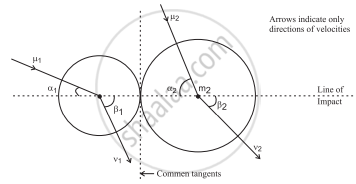
Oblique or non-head-on collision.
Characteristics
| Feature | Description | Example |
|---|---|---|
| Line of Impact | The direction perpendicular to the common tangent at the point of impact, along which internal mutual forces act during collision | The direction connecting the centers of two billiard balls at the moment they touch |
| Common Tangent | The direction along which there is no force during impact and no change in momentum | The tangent line at the touching point between two billiard balls |
| Angles of Incidence | Initial velocities make angles α₁ and α₂ with the line of impact | Ball 1 is approaching at 30° to the line of impact |
| Angles of Reflection | Final velocities make angles β₁ and β₂ with the line of impact | After the collision, ball 1 moves at 45° to the line of impact |
| Component Motion | Motion can be decomposed along two independent directions | Velocity component along the impact line and component along the tangent |
| Four Unknowns | The final state has four unknowns: v₁, v₂, β₁, and β₂ | These must be calculated using conservation laws |
Mathematical Analysis Steps
To solve for the unknowns in a two-dimensional collision, the following equations are used and solved simultaneously:
-
Apply Conservation of Linear Momentum along the Line of Impact: This provides the first equation relating the components of the initial and final velocities along this line
m1u1cosα1 + m2u2cosα2 = m1v1cosβ1 + m2v2cosβ2 ---(4.12) -
Apply Conservation of Momentum along the Common Tangent: Since there is no force along the common tangent (perpendicular to the line of impact), the momentum of each individual body is conserved along this line
m1u1sinα1 = m1v1sinβ1 ---(4.13)
and m2u2sinα2 = m2v2sinβ2 ---(4.14) -
Apply the Coefficient of Restitution (e): The coefficient of restitution is applied along the line of impact, providing a fourth equation
e = -\[\left(\frac{\mathrm{v}_2\mathrm{cos}\beta_2-\mathrm{v}_1\mathrm{cos}\beta_1}{u_2\mathrm{cos}\alpha_2-u_1\mathrm{cos}\alpha_1}\right)=\frac{\mathrm{v}_2\mathrm{cos}\beta_2-\mathrm{v}_1\mathrm{cos}\beta_1}{u_1\mathrm{cos}\alpha_1-u_2\mathrm{cos}\alpha_2}\] ---(4.15) -
Solve the System of Equations: Equations (4.12), (4.13), (4.14), and (4.15) are then solved for the four unknowns: $v_1$, $v_2$, $\beta_1$, and $\beta_2$.
Example 1
Shell Explosion During Free Fall
Problem: A shell of mass 3 kg is dropped from some height. After falling freely for 2 seconds, it explodes into two fragments of masses 2 kg and 1 kg. Kinetic energy provided by the explosion is 300 J. Using g = 10 m/s², calculate the velocities of the fragments.
Solution:
Step 1: Calculate velocity just before explosion
- After 2 seconds of free fall: v = u + at = 0 + 10(2) = 20 m/s
- So: u1 = u2 = 20 m/s
Step 2: Apply conservation of momentum
3 × 20 = 2v1 + 1v2
60 = 2v1 + v2
v2 = 60 − 2v1 ...(I)
Step 3: Use the kinetic energy equation
K.E. provided = \[\frac{1}{2}m_1v_1^2+\frac{1}{2}m_2v_2^2-\frac{1}{2}(m_1+m_2)u^2\]
300 = \[\frac{1}{2}(2)v_1^2+\frac{1}{2}(1)v_2^2-\frac{1}{2}(3)(20)^2\]
300 = \[v_1^2+\frac{1}{2}v_2^2-600\]
2v12 + v22 = 1800
Step 4: Substitute equation (I) into energy equation
\[2v_1^2+(60-2v_1)^2=1800\]
\[2v_1^2+3600-240v_1+4v_1^2=1800\]
\[6v_1^2-240v_1+1800=0\]
\[v_1^2-40v_1+300=0\]
Step 5: Solve using the quadratic formula
v1 = 30 m/s or 10 m/s
Step 6: Find corresponding v₂ values
- If v1 = 30 m/s then v2 = 60 − 2(30) = 0 m/s
- If v1 = 10 m/s, then v2 = 60 − 2(10) = 40 m/s
Answer: Two possible answers exist:
- Option 1: v1 = 30 m/s, v2 = 0 m/s (heavier fragment moves faster; lighter stays at original velocity)
- Option 2: v1 = 10 m/s, v2 = 40 m/s (lighter fragment moves faster downward; both move downward but at different speeds)
Example 2
Bullets Hitting a Fixed Surface
Problem: Bullets of mass 40 g each are fired from a machine gun at a rate of 5 per second towards a firmly fixed hard surface of area 10 cm². Each bullet hits normal to the surface at 400 m/s. The coefficient of restitution for the collision is 0.75. Calculate the average force and average pressure experienced by the surface.
Solution:
Step 1: Identify given values
- Mass per bullet: m = 40 g = 0.04 kg
- Initial velocity: u₁ = 400 m/s
- Coefficient of restitution: e = 0.75
- For fixed surface: u₂ = v₂ = 0
- Area: A = 10 cm² = 10⁻³ m²
- Firing rate: 5 bullets/second
Step 2: Calculate final velocity using the coefficient of restitution
e = \[\frac{v_1-v_2}{u_2-u_1}=\frac{v_1-0}{0-400}\]
0.75 = \[\frac{v_{1}}{-400}\]
v1 = −300 m/s
(Negative sign indicates bullet rebounds in the opposite direction)
Step 3: Calculate momentum change per bullet
Momentum transferred to surface per collision (u1−v1)
p = 0.04(400 − (−300)) = 0.04 × 700 = 28 N
Step 4: Calculate momentum received per second
\[\frac {dp}{dt}\] = 28 × 5 = 140 N
This equals the average force experienced by the surface.
Step 5: Calculate average pressure
P = \[\frac {F}{A}\] = \[\frac {140}{10^-3}\] = 1.4 × 10⁵ N/m2
Answer:
- Average Force: 140 N
- Average Pressure: 1.4 × 10⁵ N/m² (approximately 1.4 times atmospheric pressure)
Test Yourself
Related concepts
- Collisions - Activated Complex Formation
- Collisions - Condition for a Chemical change
- Collisions - Difference in Energy of the Reactant and the Product
