Topics
Force, Work, Power and Energy
Force
Light
Work, Energy and Power
- Concept of Work
- Measurement of Work
- Expression for Work (W = F S cosθ)
- Work Done by the Force of Gravity (W = mgh)
- Concept of Power
- Work vs Power
- Concept of Energy
- Energy vs Power
- Mechanical Energy > Potential Energy (U)
- Mechanical Energy > Kinetic Energy (K)
- Potential vs Kinetic Energy
- Conversion of Potential Energy into Kinetic Energy
- Forms of Energy > Solar Energy
- Forms of Energy > Heat Energy
- Forms of Energy > Light Energy
- Forms of Energy > Chemical Energy
- Forms of Energy > Hydro Energy
- Forms of Energy > Electrical Energy
- Forms of Energy > Nuclear Energy
- Forms of Energy > Geo Thermal Energy
- Forms of Energy > Wind Energy
- Forms of Energy > Sound Energy
- Forms of Energy > Magnetic Energy
- Forms of Energy > Mechanical Energy
- Conversion of Energies
- Principle of Conservation of Energy
- Proof: Kinetic + Potential Energy = Constant for Free Fall
- Application of the Principle of Conservation of Energy
Machines
- Concept of Machines
- Technical Terms Related to a Machine
- Principle of a Machine
- Efficiency, Mechanical Advantage, and Velocity Ratio
- Levers
- Types of Levers
- Pulley
- Single Fixed Pulley
- A Single Movable Pulley
- Single Pulley vs Single Movable Pulley
- Combination of Pulleys
- Using one fixed pulley and other movable pulleys
- Using several pulleys in two blocks (block and tackle system)
Sound
Electricity and Magnetism
Refraction of Light at Plane Surfaces
- Light: Reflection and Refraction
- Refraction of Light
- Laws of Refraction
- Speed of Light in Different Media
- Principle of Reversibility of the Path of Light
- Refraction Laws & Glass Index
- Refraction of Light Through a Rectangular Glass Block
- Multiple Images in a Thick Mirror
- Prism
- Refraction of Light through a Prism
- Real and Apparent Depth
- Apparent Bending of a Stick Under Water
- Consequences of Refraction of Light
- Transmission of Light From a Denser Medium to a Rarer Medium
- Critical Angle
- Relationship between Critical Angle and Refractive Index
- Total Internal Reflection
- Total Internal Reflection in a Prism
- Total Internal Reflection Through a Right-Angled Isosceles Prism
- Total Internal Reflection Through an Equilateral Prism
- Total Internal Reflection Through Right-angled prism
- Use of a Total Internal Reflecting Prism in Place of a Plane Mirror
- Total Internal Reflection vs Reflecting from a Plane Mirror
- Consequences of Total Internal Refraction
Heat
Refraction Through a Lens
- Concept of Lenses
- Action of a Lens as a Set of Prisms
- Technical Terms Related to a Lens
- Convex Lens vs Concave Lens
- Refraction of Light Through an Equi-Convex Lens and an Equi-Concave Lens
- Principal Rays for Ray Diagrams
- Real Image vs Virtual Image
- Construction of a Ray Diagram for a Lens
- Images Formed by Convex Lenses
- Images Formed by Concave Lenses
- Sign Convention
- Lens Formula and Magnification
- Linear Magnification
- Power of a Lens
- Magnifying Glass Or Simple Microscope
- Application of Lenses
- Experimental Determination of Focal Length of Convex Lens
- Convex Lens vs Concave Lens
Spectrum
- Deviation Produced by a Triangular Prism
- Colour in White Light with Their Wavelength and Frequency Range
- Dispersion of Light Through a Prism
- Electromagnetic Spectrum
- Properties and Uses of Different Radiations of the Electromagnetic Spectrum
- Distinction between Ultraviolet, Visible, and Infrared Radiations
- Scattering of Light-Rayleigh's Law
- Applications of Scattering of Light
Modern Physics
Sound
- Sound Waves
- Light Waves vs Sound Waves
- Reflection of Sound Waves
- Echo
- Determination of Speed of Sound by the Method of Echo
- Use of Echoes
- Natural Vibrations
- Damped Vibrations
- Natural Vibrations vs Damped Vibrations
- Forced Vibrations
- Natural Vibrations vs Forced Vibrations
- Resonance (a special case of forced vibrations)
- Demonstration of Resonance
- Forced Vibrations vs Resonant Vibrations
- Examples of Resonance
- Characteristics of Sound
- Loudness and Intensity
- Pitch and frequency
- Quality and Wave Form
- Music and Noise
Current Electricity
- Electric Charges
- Electric Current
- Potential Difference
- Electric Resistance
- Ohm's Law
- Experimental Verification of Ohm’s Law and Ohmic Resistors
- Ohmic and Non-ohmic Resistors
- Specific Resistance or Electrical Resistivity
- Choice of Material of a Wire
- Superconductors
- Electromotive Force of a Cell
- Terminal Voltage of a Cell
- Internal Resistance of a Cell
- Resistance of a System of Resistors
- Resistors in Series
- Resistors in Parallel
- Forms of Energy > Electrical Energy
- Measurement of Electrical Energy
- Electrical Power
- Commercial Unit of Electrical Energy
- Power Rating of Common Electrical Appliances
- Household Consumption of Electric Energy
- Heating Effect of Electric Current
Household Circuits
- Transmission of Power from the Power Generating Station to the Consumer
- Power Distribution to a House
- House Wiring (Ring System)
- Fuse
- Reason for connecting the fuse in the live wire
- Current Rating of a Fuse
- Switches
- Circuits with Dual Control Switches (Staircase Wire)
- Earthing
- Three-pin Plug and Socket
- Colour Coding of Wires in a Cable
- High Tension Wires
- Precautions to Be Taken While Using Electricity
Electro-Magnetism
- Oersted's Experiment
- Applications of Biot-Savart's Law > Magnetic Field Due to a Straight Current-carrying Conductor of Finite Size
- Right-hand Thumb Rule
- Applications of Biot-Savart's Law > Magnetic Field at the Axis of a Circular Current-carrying Loop
- Applications of Ampere’s Circuital Law > Magnetic Field of a Long Straight Solenoid
- Electromagnet
- Permanent Magnet
- Comparison of an Electro Magnet with a Permanent Magnet
- Advantages of an Electromagnet over a Permanent Magnet
- Uses of Electromagnet
- Force on a Current-Carrying Conductor Placed in a Uniform Magnetic Field
- Simple D.C. Motor
- Introduction to Electromagnetic Induction
- Electromagnetic Induction: Experimental Demonstration
- Faraday's Explanation
- Faraday's Laws of Electromagnetic Induction
- Alternating-Current Generator
- Frequency of an a.c. in Household Supplies
- Comparison Between A.C. Generator and D.C. Motor
- Transformers
Calorimetry
- Heat
- The Temperature and a Thermometer
- Factors Affecting the Quantity of Heat Absorbed to Increase the Temperature of a Body
- Heat vs Temperature
- Thermal or Heat Capacity
- Specific Heat Capacity
- Heat Capacity vs Specific Heat Capacity
- Specific Heat Capacity of Some Common Substances
- Calorimetry
- Principle of Method of Mixtures or Principle of Calorimetry
- Natural Phenomena and Consequences of High Specific Heat Capacity of Water
- Examples of High and Low Heat Capacity
- Change of State
- Melting and Freezing
- Melting Point and Its Effects
- Vaporisation or Boiling
- Boiling Point and Its Effects
- Latent Heat
- Specific Latent Heat of Fusion of Ice
- Explanation of Latent Heat of Melting based on Kinetic Model
- Natural Consequences of High Specific Latent Heat of Fusion of Ice
Radioactivity
- Structure of the Atom and Nucleus
- Atomic Models
- Isotopes
- Isobars
- Isotones
- Radioactivity
- Radioactivity as emission of Alpha, Beta, and Gamma Radiations
- Properties of Alpha Particles
- Properties of Beta Particles
- Properties of Gamma Radiations
- Distinction between the Properties of α, β, and γ Radiations
- Changes Within the Nucleus in Alpha, Beta and Gamma Emission
- Uses of Radioactive Isotopes
- Sources of Harmful Radiations
- Harmful Effects of Radiation
- Safety Precautions While Using Nuclear Energy
- Background Radiations
- Forms of Energy > Nuclear Energy
- Nuclear Fission
- Differences Between Radioactive Decay and Nuclear Fission
- Nuclear Fusion
- Difference between Nuclear Fusion and Neclear Fission
Introduction
The concept of the Centre of Gravity (c.g.) is important for understanding how a body balances. It is a specific point related to the effect of gravity on all parts of an object. The c.g. is analogous to the Centre of Mass (c.m.), as it represents a weighted average of the gravitational forces on individual particles. For most objects we deal with daily on Earth, the c.g. and the c.m. are considered the same point. This point is useful for analyzing the motion and stability of an object.
Maharashtra State Board: Class 11
CISCE: Class 10
Definition: Centre of Gravity
The Centre of Gravity (c.g.) of a body is the point around which the resultant torque due to the force of gravity on the body is zero.
or
The centre of gravity (C.G.) of a body is the point about which the algebraic sum of moments of the weights of all the particles constituting the body is zero. The entire weight of the body can be considered to act at this point, howsoever the body is placed.
OR
The point about which the resultant torque due to force of gravity on the body is zero is called the centre of gravity.
Characteristics
| Feature | Description | Example |
|---|---|---|
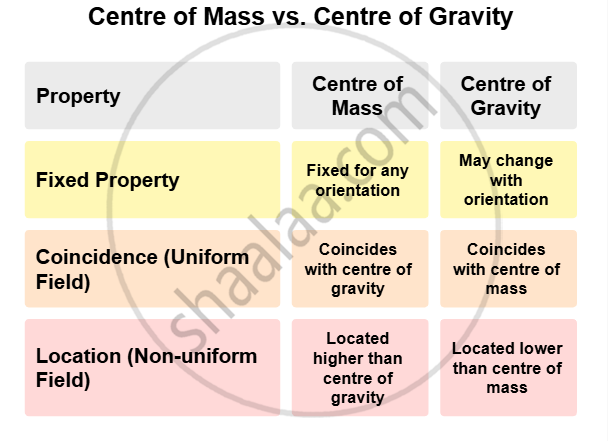
| Gravitational Field | For a uniform gravitational field (if g is constant), the c.g. always coincides with the c.m. | All objects on the Earth are in our daily lives. |
| Common Usage | In common usage, the terms c.g. and c.m. are used for the same purpose. | Finding the balance point of a small object. |
| Non-Uniform Field | The c.g. may depend upon non-uniformity of the gravitational field, which in turn depends upon the orientation. | An object whose size is comparable to that of the Earth (size at least a few thousand km). |
| C.g. vs. C.m. (Non-uniform) | If the gravitational field is non-uniform, the c.g. will be slightly lower than the c.m. because the gravitational field is stronger on the lower side of the object. | An extremely large hypothetical object. |
Process: Determining the c.g. of a Laminar Object
This process is used to determine the c.g. (or c.m.) of a laminar (two-dimensional, like a leaf) object.
Step-by-Step Procedure:
- Suspend the object: A laminar object is suspended from a rigid support.
- Use two orientations: The object must be suspended at at least two different orientations.
- Draw lines: Lines are to be drawn on the object parallel to the plumb line shown at the point of suspension.
- Identify the intersection: The intersection of the lines drawn gives the location of the c.g. or c.m.
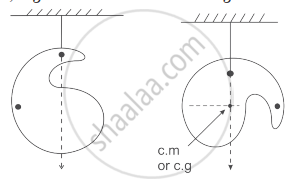
Explanation of tools:
- A plumb line is always vertical, meaning it is parallel to the line of action of the gravitational force.
- The intersection point is the point through which the line of action of the gravitational force passes for any orientation.
Centre of Mass (c.m.) vs. Centre of Gravity (c.g.)
Real-Life Examples
- Balancing a Ruler: The point where you can balance a ruler on your finger is its Centre of Gravity (which coincides with its Centre of Mass).
- Stability of Buildings: Engineers design tall structures so their c.g. is kept as low as possible to increase stability.
- Sports: A gymnast makes adjustments during a routine to keep her body's Centre of Gravity over her base of support for balance.

Key Points: Centre of Gravity
- The weight of a body acts through a single point called the centre of gravity (C.G.), where the sum of moments of all particles' weights is zero.
- The position of the C.G. depends on the shape and mass distribution of the body and changes if the body is deformed.
- The C.G. may lie outside the material of the body (e.g., a ring or hollow sphere).
- A body balances when supported exactly at its centre of gravity, as seen in a metre rule or square lamina.
- The C.G. of an irregular lamina can be found by suspending it from multiple points and tracing the intersection of plumb line paths.