Advertisements
Advertisements
प्रश्न
Why have the words, 'pretended' and 'seemed' been used in the lines:
...Pretended to believe every single word
of what the tiger king said.
And seemed to be taken in by all the lies.
How does the sense of these lines connect with the line 'Ajamil wasn't a fool'?
Advertisements
उत्तर
Ajamil, the good shepherd, was not a fool. The Tigers' king requested him to set all the tigers free; the sheepdog tried to convince Ajamil that the tigers had come to him to offer a friendly hand. Ajamil though agreed to him and cut them all loose and even offered them a feast and signed a pact with the king of tigers that they were friends thenceforth. Ajamil was a fine politician and did not want to mess up with the lot and believed it best to maintain cordial relations with them. So, though he knew inside that, today or tomorrow, the tigers would attack the sheep again. He pretended that he believed all that the king told him and accepted the friendship offered by the tiger. He portrayed it so well that Ajamil seemed taken in by all the lies of the tiger, but in heart, he knew that they will return to hunt. So, he felt it better to sacrifice a few sheep every time rather than losing them all in a possible fierce battle where he might lose his reign absolutely. It is also a little disheartening, his lack of confidence in his sheepdog. However, he played it safe and avoided the risk that was hovering over his kingdom.
APPEARS IN
संबंधित प्रश्न
He asked. Boy, did he ask! First he asked me for a chance, then he asked nearly all the people he came across if they wanted to buy a telephone system from him. And his asking paid off. As he likes to put it, “Even a blind hog finds an acorn every once in a while.” That simply means that if you ask enough, eventually someone will say ‘yes’.
He cared. He cared about me and his customers. He discovered that when he cared more about taking care of his customers than he cared about taking care of himself, it wasn’t long before he didn’t have to worry about taking care of himself.
Most of all, Cowboy started every day as a winner! He hit the front door expecting something good to happen. He believed that things were going to go his way regardless of what happened. He had no expectation of failure, only an expectation of success. And I’ve found that when you expect success and take action on that expectation, you almost always get success.
Cowboy has made millions of dollars. He has also lost it all, only to get it all back again. In his life as in mine, it has been that once you know and practice the principles of success, they will work for you again and again.
He can also be an inspiration to you. He is proof that it’s not environment or education or technical skills and ability that make you success. He proves that it takes more: it takes the principles we so often overlook or take for granted. These are the principles of that Ya Gotta’s for success.
Question:
(1) What was the cowboy’s motto?
(2) What did the cowboy learn after he lost millions of dollars?
(3) Why did the cowboy firmly believe that asking would pay off?
(4) When you expect success and take action on that expectation you almost always succeed. [Name the part of speech of the underlined words]
(5)
(a) He cared about me and his customers. [Rewrite using ‘not only ……………….but also’’]
(b) Cowboy has made millions of dollars [Add a question tag]
(6) In what way is the cowboy a source of inspiration for you?
Answer the following in 30-40 words each:
(a) Why do you think the booking clerk refused to accept the money? Why did the narrator get out so fast?
(b) Why could the Russian research vessel, ‘The Akademik Shokaskiy’ not move any further? What did the captain decide then?
(c) What sort of hunts did the Maharaja offer to organize for the high-ranking British officer? What trait of the officer does it reveal?
(d) What did Jo want the wizard to do when Mommy Skunk approached him?
Attempt the following in 150-200 words.
Write a character sketch of Bishop Brooks as he appears in Helen Keller's − The Story of My Life.
Answer any four of the following in 30–40 words each :
(a) Describe the irony in Saheb's name.
(b) Why was Gandhiji opposed to C.F. Andrews helping him in Champaran?
(c) Aunt Jennifer's efforts to get rid of her fear proved to be futile. Comment.
(d) What does Stephen Spender want to be done for the children of the school in a slum?
(e) When he was only ten days old, a prediction was made about the future of the Tiger King. What was ironic about it?
(f) What was his father's chief concern about Dr. Sadao?
Answer the following in 200-250 words :
Describe the relationship between Anne and Margot?
Answer the following question in 30-40 words:
“The sight of the food maddened him.” What does this suggest? (His First Fight)
Notice these expression in the text. Infer their meaning from the context.
cairn of rocks
Tick the statement that is true.
The story is an account of real events.
Discuss in small groups.
‘On reading Shelley’s A Defence of Poetry, the question insistently occurs why there is no similar A Defence of Science written by a scientist of equal endowment.’
How does Kumudini Lakhia describe her guru Ramgopal's influence on her?
What strong qualities possessed by them, could have helped them achieve success and fame, all over?
Make sentence of your own using the following expression.
overcome:
Answer in your own words.
How did the plants react to the fast rhythmic music?
Read the poem and fill in the table.
| Time of the day | Location | Poet’s Activity | Hawker’s Activities | Gardener’s Activities | Watchman’s Activities |
| Morning | __________ | __________ | __________ | __________ | __________ |
| Afternoon | __________ | __________ | __________ | __________ | __________ |
| Night | __________ | __________ | __________ | __________ | __________ |
Think and answer in your own words.
What is the difference between a hawker and a shopkeeper?
State whether the following statement is True or False. Correct the false statement by finding evidence from the poem to support your remark.
The poem has an underlying message about the importance of trees.
The poem expresses feelings of serenity. Pick out expressions from the above poem that express the same.
Answer the following question in short.
What do you learn about Pundits of Vijaynagar?
The word 'Review' is different from summarizing and appeal writing. Choose the correct statements of the following.
The description of the character is given below. Identify the character from the play. Find some sentences which support your choice.
He is a brave but irresponsible person.
Correct the given sentence with justification.
The play is restricted to only a part of the woods.
Correct the given sentence with justification.
Since there is a reference to the Indian boy, there are some scenes from India too.
Read the passage and find the verbs used with the following nouns and phrases:
- volcano
- molten rock
- volcanic mountain
- dust
- 165 village and towns
- the wind and the sea
- seeds
- bird
Portia had many brothers and sisters.
Hold a mock trial for the following offence. There should be a complainant, a defendant, and lawyers to argue the case on behalf of them. The whole class can vote to pass the judgment. On what occasions will you plead for justice? What punishment will you suggest? When will you plead for mercy?
A very poor and honest servant has broken a vase while cleaning it. The vase was valuable and the employer liked it very much.
Complete the following sentence with reference to the passage:
He realised that making the body suffer was not ____________.
Write the following:
The sights mentioned in the third stanza.
What do you like better - the original poem or the parody? Why?
Choose the appropriate phrase to insert in the gap, to make the sentence meaningful. Use the appropriate form of the verb.
Sorrowful times are ______ darkness.
The table-tennis set was gifted by ______.
What is the difference between a 'dream' and a 'daydream'?
Guess the meaning of the following word.
pounced
Find out how the following game is played.
Kabaddi
Form a group of 4 or 5. Make a ‘storyboard’ for the story ‘Three Sacks of Rice’.
Arrange the story in the form of a sequence of pictures.
Decide what you will show in each picture; what words/lines you will write with each picture to explain what happens in it.
You can also add ‘speech balloons’ for the people in the pictures.
Would you like to be a netizen?
Read the following lines from the poem and answer the question that follow.
Let me but live my life from year to year,
With forward face and unreluctant soul;
- Whom does the word ‘me’ refer to?
- What kind of life does the poet want to lead?
Identify the character or speaker.
What a trouble must I have been to you then!
Who was Caliban? What was he employed for?
Mention the things that the grandfather imagined.
What game did Anne choose to play?
Read the data below and answer the following question.
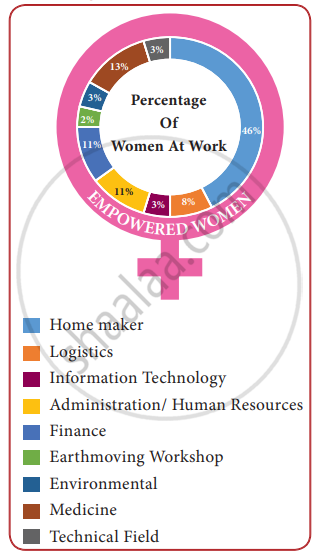
Choose the correct answer.
What is the data about?
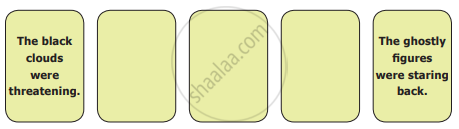
Two scary events from this section are listed here. Write the events that take place in between in the correct order.
Pick out the rhyming words from the first stanza of the poem.
When Amma said,'Don’t upset our foreign visitor' she meant______.
Where did Raj’s mother send him?
Mithali’s mother tongue is Telugu.
Narrate the story based on the story map
Find the rhyming word from the poem.
alike – _________
Read scene I of the play carefully and answer the question below.
Who is about to go on a hunt? Do the wolves panic on his arrival? Explain.
Where did Anitha go?
Why did the bird catcher need fire?
Try your own.
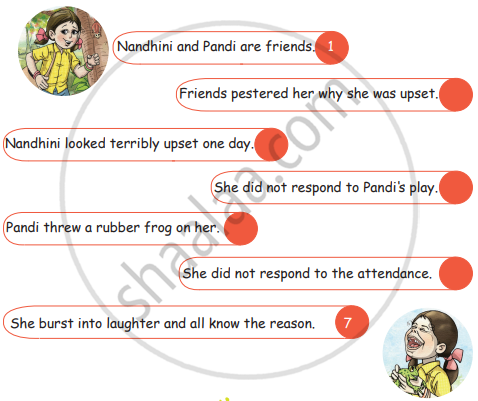
Number the actions of Pandi and Nandhini in order.
Humans give importance to save______.
Why did Jana chase the squirrel?
Pick out the rhyming words and write.
| green | |
| human | |
| will | |
| welfare |
Why did everyone support Megala?
Match with the opposite gender.
| 1. | prince | bridegroom |
| 2. | hero | princess |
| 3. | bride | heroine |
How did he challenge everybody?
What did the carpenter buy?
