Topics
Variations in Psychological Attributes
- Individual Differences in Human Functioning
- Assessment of Psychological Attributes
- Concept of Intelligence
- Theories of Intelligence
- Binet's One-Factor Theory
- Charles Spearman's Two Factor Theory
- Louis Thurstone’s Multifactor Theory
- Jensen's Hierarchical Theory of Intelligence
- Guilford's Structural Model Theory
- Howard Gardner's Multiple Intelligence Theory
- Sternberg’s Triarchic Theory
- PASS Model of Intelligence
- Individual Differences in Intelligence
- Assessment of Intelligence
- Mental Age
- Intelligence Quotient
- Variations of Intelligence
- Types of Intelligence Tests
- Individual Test
- Group Test
- Verbal Test
- Non-Verbal Test
- Performance Test
- Culture Bias and Culture Fair Tests
- Misuses of Intelligence Tests
- Intelligence Testing in India
- Culture and Intelligence
- New Trends in Intelligence> Emotional Intelligence
- Special Abilities
- Creativity
- Creativity and Intelligence
Self and Personality
- Self and Personality
- Concept of Self
- Cognitive and Behavioural Aspects of Self
- Concept of Personality
- Culture and Self
- Characteristics of Personality
- Personality Related Terms
- Descriptive Personality Theories
- Type Theories
- Trait Theories
- Trait Theory> Trait Theory of G. Allport
- Trait Theory> Cattell’s Concept of Personality
- Type Theory> Eysenck Concept of Personality
- Psychodynamic Approach
- Freud's Psychoanalytic Theory of Personality> Stages of Personality Development
- Neo-Freudian Theory of Personality
- Carl Jung’s Theory of Personality
- Karen Horney (1950)
- Psychodynamic Therapies> Alfred Adler's Psychodynamic Therapy
- Erich Fromm's Theory
- Erik Erikson's Theory of Psycho-Social Development
- Behavioural Approach
- Cultural Approach
- Humanistic Approach
- Measurement of Personality
- Self Report Inventories
- Projective Techniques
- Behavioural Analysis
Meeting Life Challenges
Psychological Disorders
- Concept of Psychological Disorders
- Concept of Abnormal Behaviour
- Classification of Psychological Disorders
- Factors Underlying Abnormal Behaviour
- Major Psychological Disorder> Anxiety Disorders
- Major Psychological Disorder> Obsessive Compulsive Disorder (OCD)
- Major Psychological Disorder> Trauma and Stress Related Disorders
- Major Psychological Disorder> Somatic Symptom and Related Disorders
- Major Psychological Disorder> Dissociative Disorders
- Depressive Disorders
- Major Psychological Disorder> Bipolar Disorder
- Major Psychological Disorder> Schizophrenia
- Major Psychological Disorder> Neurodevelopmental Disorders
- Major Psychological Disorder> Disruptive, Impulse-Control and Conduct Disorders
- Major Psychological Disorder> Eating Disorders
- Major Psychological Disorder> Substance-Related and Addictive Disorders
Therapeutic Approaches
- Therapeutic Approaches in Psychology
- Concept of Psychotherapy
- Forms of Psychotherapy
- Behaviour Therapies
- Cognitive Therapy
- Humanistic-existential Therapy
- Humanistic-existential Therapy> Client Centred Therapy
- Healing Factors in Psychotherapy
- Ethics in Psychotherapy
- Alternative Therapies
- Rehabilitation of the Mentally Ill
Attitude and Social Cognition
Social Influence and Group Processes
Psychology and Life
- Introduction to Psychology and Life
- Human-environment Relationship
- Environmental Effects on Human Behaviour
- Promoting Pro-environmental Behaviour
- Psychology and Social Concerns
Developing Psychological Skills
- Introduction to Developing Psychological Skills
- Developing as an Effective Psychologist
- General Skills
- Observational Skills
- Specific Skills
- Interviewing Skills
- Counselling Skills
Estimated time: 39 minutes
- Introduction
- Definition: Personality
- Cattell’s Approach to Personality
- Types of Traits
- Sixteen Personality Factors (16PF)
- Big Five Global Factors
- Applications of Cattell’s Theory
- Criticisms
- Key Points: Cattell’s Concept of Personality
CISCE: Class 12
Introduction
Raymond B. Cattell, a British-American psychologist, emphasized that personality is what allows us to predict what a person will do in a given situation. His trait theory aimed to identify, measure, and analyze the core traits that make up personality scientifically using factor analysis, a statistical tool.
CISCE: Class 12
Definition: Personality
Raymond Cattell defined personality as follows: "Personality is that which permits a prediction of what a person will do in a given situation."
CISCE: Class 12
Cattell’s Approach to Personality
| Concept | Description |
|---|---|
| Scientific Goal | To make the study of personality objective through mathematical analysis of traits. |
| Method Used | Factor Analysis – identifies clusters of related traits that tend to occur together. |
| Outcome | The discovery of 16 core or source traits, which act as the building blocks of personality. |
CISCE: Class 12
Types of Traits
| Trait Type | Definition | Example |
|---|---|---|
| Surface Traits | Observable behavior patterns | Talkative, worried |
| Source Traits | Core personality structures that determine behavior | Warmth, dominance |
| Ability Traits | Enable achieving goals effectively | Intelligence |
| Temperament Traits | Show emotional reactions and response styles | Calmness, impulsivity |
| Dynamic Traits | Drive motivation and goal-oriented behavior | Ambition, competitiveness |
| Common Traits | Shared by many people in a population | Sociability |
| Unique Traits | Individualized patterns | Artistic interest |
| Constitutional Traits | Biological bases | Energy level, drive |
| Environmental-Mold Traits | Shaped by learning and experience | Cultural attitudes |
CISCE: Class 12
Sixteen Personality Factors (16PF)
| No. | Trait | Opposite Poles | Interpretation |
|---|---|---|---|
| 1 | Warmth | Reserved ↔ Outgoing | Social involvement |
| 2 | Reasoning | Concrete ↔ Abstract | Intellectual processing |
| 3 | Emotional Stability | Reactive ↔ Calm | Emotional control |
| 4 | Dominance | Submissive ↔ Assertive | Authority or compliance |
| 5 | Liveliness | Restrained ↔ Enthusiastic | Activity energy |
| 6 | Rule-Consciousness | Non-conforming ↔ Dutiful | Moral awareness |
| 7 | Social Boldness | Shy ↔ Bold | Confidence level |
| 8 | Sensitivity | Tough-minded ↔ Soft-hearted | Empathy factor |
| 9 | Vigilance | Trusting ↔ Suspicious | Judgment trust |
| 10 | Abstractedness | Practical ↔ Imaginative | Creative inclinations |
| 11 | Privateness | Open ↔ Reserved | Expression control |
| 12 | Apprehension | Confident ↔ Worried | Self-assurance |
| 13 | Openness to Change | Traditional ↔ Open | Adaptability |
| 14 | Self-Reliance | Group-oriented ↔ Independent | Dependence balance |
| 15 | Perfectionism | Carefree ↔ Organized | Achievement drive |
| 16 | Tension | Relaxed ↔ Frustrated | Stress tolerance |
CISCE: Class 12
Big Five Global Factors
Cattell’s 16 source traits were later summarized into five global (second-order) factors, forming the Big Five Model:
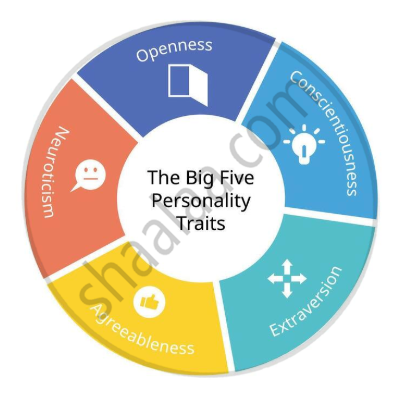
- Openness: Creative and imaginative.
- Conscientiousness: Organized and responsible.
- Extraversion: Outgoing and energetic.
- Agreeableness: Cooperative and kind.
- Neuroticism: Emotionally reactive and anxious.
Applications of Cattell’s Theory
Cattell’s framework is widely used in:
- Educational settings: To predict learning styles and achievement motivation.
- Workplace: For career selection, leadership style, and teamwork analysis.
- Clinical psychology: Assessing self-esteem, emotional stability, and adaptability.
- Research: Exploring aggression, creativity, and conformity.
CISCE: Class 12
Criticisms
- Descriptive rather than explanatory.
- Limited in accounting for personality change over time.
- The complex statistical base makes replication difficult.
CBSE: Class 12
CISCE: Class 12
CISCE: Class 12
Key Points: Cattell’s Concept of Personality
- Cattell defined personality as the ability to predict behavior in different situations.
- He used factor analysis to identify 16 source traits, which are the core building blocks of personality.
- Traits were grouped into types like surface vs. source, ability, temperament, and dynamic traits.
- The Big Five model (OCEAN) summarizes his work into the following: Openness, Conscientiousness, Extraversion, Agreeableness, and Neuroticism.
- Cattell’s theory is used in education, career guidance, clinical psychology, and personality research.
