Topics
Variations in Psychological Attributes
- Individual Differences in Human Functioning
- Assessment of Psychological Attributes
- Concept of Intelligence
- Theories of Intelligence
- Binet's One-Factor Theory
- Charles Spearman's Two Factor Theory
- Louis Thurstone’s Multifactor Theory
- Jensen's Hierarchical Theory of Intelligence
- Guilford's Structural Model Theory
- Howard Gardner's Multiple Intelligence Theory
- Sternberg’s Triarchic Theory
- PASS Model of Intelligence
- Individual Differences in Intelligence
- Assessment of Intelligence
- Mental Age
- Intelligence Quotient
- Variations of Intelligence
- Types of Intelligence Tests
- Individual Test
- Group Test
- Verbal Test
- Non-Verbal Test
- Performance Test
- Culture Bias and Culture Fair Tests
- Misuses of Intelligence Tests
- Intelligence Testing in India
- Culture and Intelligence
- New Trends in Intelligence> Emotional Intelligence
- Special Abilities
- Creativity
- Creativity and Intelligence
Self and Personality
- Self and Personality
- Concept of Self
- Cognitive and Behavioural Aspects of Self
- Concept of Personality
- Culture and Self
- Characteristics of Personality
- Personality Related Terms
- Descriptive Personality Theories
- Type Theories
- Trait Theories
- Trait Theory> Trait Theory of G. Allport
- Trait Theory> Cattell’s Concept of Personality
- Type Theory> Eysenck Concept of Personality
- Psychodynamic Approach
- Freud's Psychoanalytic Theory of Personality> Stages of Personality Development
- Neo-Freudian Theory of Personality
- Carl Jung’s Theory of Personality
- Karen Horney (1950)
- Psychodynamic Therapies> Alfred Adler's Psychodynamic Therapy
- Erich Fromm's Theory
- Erik Erikson's Theory of Psycho-Social Development
- Behavioural Approach
- Cultural Approach
- Humanistic Approach
- Measurement of Personality
- Self Report Inventories
- Projective Techniques
- Behavioural Analysis
Meeting Life Challenges
Psychological Disorders
- Concept of Psychological Disorders
- Concept of Abnormal Behaviour
- Classification of Psychological Disorders
- Factors Underlying Abnormal Behaviour
- Major Psychological Disorder> Anxiety Disorders
- Major Psychological Disorder> Obsessive Compulsive Disorder (OCD)
- Major Psychological Disorder> Trauma and Stress Related Disorders
- Major Psychological Disorder> Somatic Symptom and Related Disorders
- Major Psychological Disorder> Dissociative Disorders
- Depressive Disorders
- Major Psychological Disorder> Bipolar Disorder
- Major Psychological Disorder> Schizophrenia
- Major Psychological Disorder> Neurodevelopmental Disorders
- Major Psychological Disorder> Disruptive, Impulse-Control and Conduct Disorders
- Major Psychological Disorder> Eating Disorders
- Major Psychological Disorder> Substance-Related and Addictive Disorders
Therapeutic Approaches
- Therapeutic Approaches in Psychology
- Concept of Psychotherapy
- Forms of Psychotherapy
- Behaviour Therapies
- Cognitive Therapy
- Humanistic-existential Therapy
- Humanistic-existential Therapy> Client Centred Therapy
- Healing Factors in Psychotherapy
- Ethics in Psychotherapy
- Alternative Therapies
- Rehabilitation of the Mentally Ill
Attitude and Social Cognition
Social Influence and Group Processes
Psychology and Life
- Introduction to Psychology and Life
- Human-environment Relationship
- Environmental Effects on Human Behaviour
- Promoting Pro-environmental Behaviour
- Psychology and Social Concerns
Developing Psychological Skills
- Introduction to Developing Psychological Skills
- Developing as an Effective Psychologist
- General Skills
- Observational Skills
- Specific Skills
- Interviewing Skills
- Counselling Skills
Estimated time: 19 minutes
- Introduction
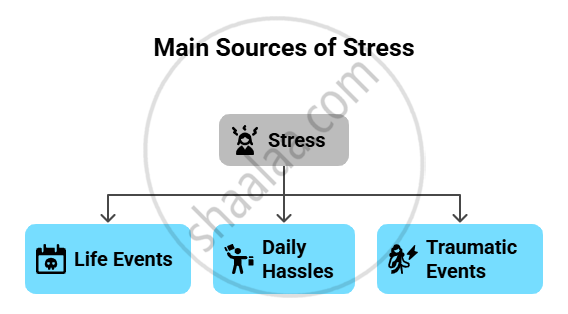
- Main Sources of Stress
- Life Events
- Daily Hassles
- Traumatic Events
- Key Points: Sources of Stress
CBSE: Class 12
CISCE: Class 12
CISCE: Class 12
Introduction
Sources/causes of stress = factors or situations that produce stress. They may be: trivial, external/situational, or physical. Small events can cause stress if the person perceives them as important. Examples: delay of a plane/train, quarrel with a friend, loss/theft of money, share‑market changes, income‑tax problems, no call from a close friend. A stressful lifestyle can come from daily problems of money, family, work, and insecurity.
CBSE: Class 12
Main Sources of Stress
CBSE: Class 12
Life Events
- Major life changes that disturb routine and create upheaval.
- Can be:
- Planned: moving to a new house
- Unpredictable: break‑up of a long relationship.
- Many life events in a short time → more difficulty in coping and higher stress.
Measure of stressful life events
Holmes and Rahe gave a life event scale.
Singh, Kaur, and Kaur made an Indian version: Presumptive Stressful Life Events Scale.
Features:
- Self‑rating questionnaire
- 51 life changes
- Each event has a mean stress score.
- Both positive and negative events are included.
- Total stress score = sum of scores of all events in the last 1 year.
Sample life events and scores
| Life Events | Mean Stress Score |
|---|---|
| Death of a close family member | 66 |
| Unexpected accident or trauma | 53 |
| Illness of a family member | 52 |
| Break-up with a friend | 47 |
| Appearing for examinations | 43 |
| Change in eating habits | 27 |
Life events and illness
- On average, about two life events in a year can occur without clear physical or mental illness.
- Correlation between the number of life events and illness is low (weak link).
- Not clear whether:
- Life events → stress and illness, or
- Stress/illness → life events.
- Impact varies with age, frequency, duration, and social support.
CBSE: Class 12
Daily Hassles
- Small, frequent, everyday irritations.
- Examples: Noisy surroundings, commuting problems, Quarrelsome neighbours, Electricity and water shortages, Traffic jams, and many household emergencies.
- Some jobs have frequent hassles every day.
- More stress from hassles → poorer psychological well‑being.
CBSE: Class 12
Traumatic Events
- Extreme events, beyond normal daily experience.
- Examples: fire, serious road/train accident, robbery, earthquake, tsunami.
- Effects may appear over time and last for a long time: Anxiety, Flashbacks, Disturbing dreams, and Intrusive thoughts.
- Severe trauma can damage relationships.
- If symptoms last for months, professional help is needed.
CBSE: Class 12
CISCE: Class 12
CISCE: Class 12
Key Points: Sources of Stress
- Stress Sources: Daily issues (like delays, fights, money) can cause stress if seen as important.
- Life Events: Big changes (e.g., moving, breakups) disturb life. Stress is measured using event scales such as the Holmes-Rahe and Indian PSLES.
- Life Events & Illness: More events may link to illness, but the connection is weak and depends on support and other factors.
- Daily Hassles: Small, frequent problems (e.g., traffic, noise) often affect mental health more than big events.
- Trauma: Serious events (e.g., accidents, disasters) can cause lasting stress like anxiety and flashbacks; long-term effects need help.
