- Delay in Action: Centralized control leads to delays.
- Red Tape and Bureaucracy: Bureaucratic issues reduce trust.
- Less Scope for Initiative: Limited initiative due to policy criticism.
- Lack of Flexibility: Excessive government control reduces flexibility.
- Delayed Decisions: Decisions require approval from top executives.
- Absence of Professionalism: Frequent staff transfers and public criticism affect efficiency.
Topics
Introduction of Commerce and Business
Trade
- Concept of Trade
- Internal Trade
- Wholesale Trade
- Retail Trade
- Types of Retailers> Itinerant Retailers
- Types of Retailers> Fixed Shop Retailer
- Small Scale Fixed Retailer
- Large Scale Fixed Retailers
- Departmental Stores
- Super Market Shop
- Chain Stores or Multiple Shops
- One Price Shop
- Concept of Mall
- International Trade
- Export Trade
- Procedure of Export Trade
- Import Trade
- Procedure of Import Trade
- Entrepot Trade
- Comparison of Different Types of Retailers and Trade Practices
Small Scale Industry and Business
Forms of Business Organisation - 1
- Private Sector Organisations
- Sole Trading Concern
- Partnership Firm
- Types of Partners
- Types of Partnerships Firms
- Hindu Undivided Family Business Or Joint Hindu Family Business
- Co-operative Society
- Types of Cooperative Societies
- Joint Stock Company
- Amul: A Successful Co-operative Movement in India
- Private Limited Company
- Public Limited Company
- Comparison of Different Forms of Business Organization
Forms of Business Organisation - 2
Institutes Supporting Business
Business Environment
- Concept of Business Environment
- Importance of Business Environment
- Dimensions of Business Environment
- Internal Factors
- External Factors> Natural Environment
- External Factors> Social Environment
- External Factors> Political Environment
- External Factors> Economic Environment
- External Factors> Technological Environment
- External Factors> Legal Environment
- New Economic Policy and Business
- Liberalisation
- Privatisation
- Globalisation
- Impact of New Economic Policy on Business
Introduction to Management
- Introduction
- Features
- Merits
- Demerits
- Real-Life Application
- Key Point Summary
Maharashtra State Board: Class 11
Introduction
A departmental organisation is a business unit fully owned, managed, and financed by the government, operating as part of a specific government ministry or department, without any separate legal status.
Maharashtra State Board: Class 11
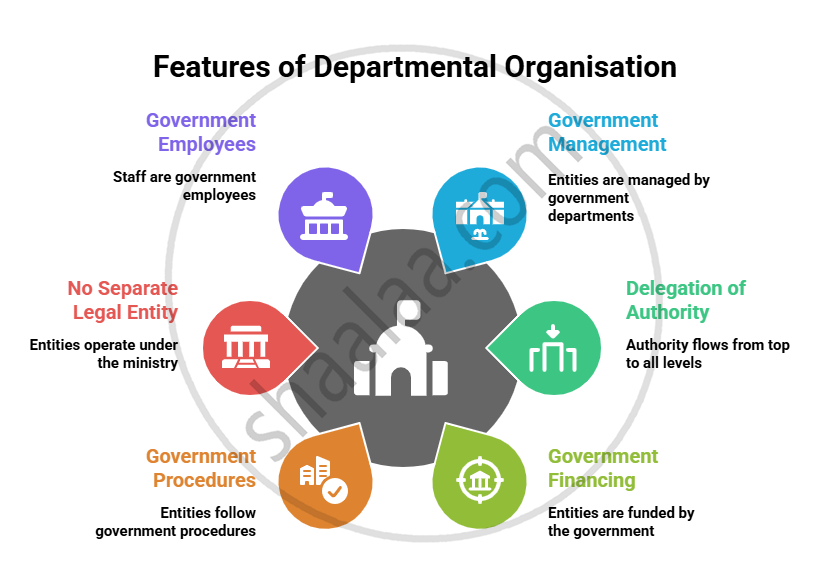
Features
Maharashtra State Board: Class 11
Merits
- Direct Control: The Government has full control over the enterprise.
- Direct Revenue to the Government: Revenues go directly to the government.
- Less Overheads: Lower administrative costs.
- Proper use of Funds: Strict supervision reduces misuse of funds.
- Qualified Staff: Managed by skilled staff.
- Maintains Secrecy: Keeps policy matters and essentials confidential.
Maharashtra State Board: Class 11
Demerits
Maharashtra State Board: Class 11
Real-Life Application
Indian Railways, managed by the Ministry of Railways, is funded through the Union Budget, with all revenues and expenses accounted for. Every employee is a government servant. Policy decisions are made by the Railway Board and implemented across the government. This ensures public accountability and efficient coordination for nationwide services.
Maharashtra State Board: Class 11
Key Point Summary
- Government-run with high control and accountability.
- Ideal for sectors such as defense and Railways.
- Lacks flexibility, not suited for dynamic industries.
