Topics
Introduction of Commerce and Business
Trade
- Concept of Trade
- Internal Trade
- Wholesale Trade
- Retail Trade
- Types of Retailers> Itinerant Retailers
- Types of Retailers> Fixed Shop Retailer
- Small Scale Fixed Retailer
- Large Scale Fixed Retailers
- Departmental Stores
- Super Market Shop
- Chain Stores or Multiple Shops
- One Price Shop
- Concept of Mall
- International Trade
- Export Trade
- Procedure of Export Trade
- Import Trade
- Procedure of Import Trade
- Entrepot Trade
- Comparison of Different Types of Retailers and Trade Practices
Small Scale Industry and Business
Forms of Business Organisation - 1
- Private Sector Organisations
- Sole Trading Concern
- Partnership Firm
- Types of Partners
- Types of Partnerships Firms
- Hindu Undivided Family Business Or Joint Hindu Family Business
- Co-operative Society
- Types of Cooperative Societies
- Joint Stock Company
- Amul: A Successful Co-operative Movement in India
- Private Limited Company
- Public Limited Company
- Comparison of Different Forms of Business Organization
Forms of Business Organisation - 2
Institutes Supporting Business
Business Environment
- Concept of Business Environment
- Importance of Business Environment
- Dimensions of Business Environment
- Internal Factors
- External Factors> Natural Environment
- External Factors> Social Environment
- External Factors> Political Environment
- External Factors> Economic Environment
- External Factors> Technological Environment
- External Factors> Legal Environment
- New Economic Policy and Business
- Liberalisation
- Privatisation
- Globalisation
- Impact of New Economic Policy on Business
Introduction to Management
- Introduction
- Definition: Small Scale Industry
- Features
- Importance
- Types of Business According to MSMED Act
- Real-Life Application
- Key Point Summary
Introduction
India has a large population and a persistent challenge: generating sufficient employment opportunities for all its citizens. Small-scale industries (SSIs) play a crucial role by offering employment opportunities, especially in rural and semi-urban areas, while utilizing limited capital resources efficiently.
Definition: Small Scale Industry
Any Industrial Unit is regarded as Small Scale Industry, if the following condition is satisfied.
- ‘‘Investment in fixed assets like plant and equipment, either held on ownership terms or on lease or hire purchase, should not be more than one crore. However, the unit in no way can be owned or controlled or auxiliary for any other industrial unit.’’
Features
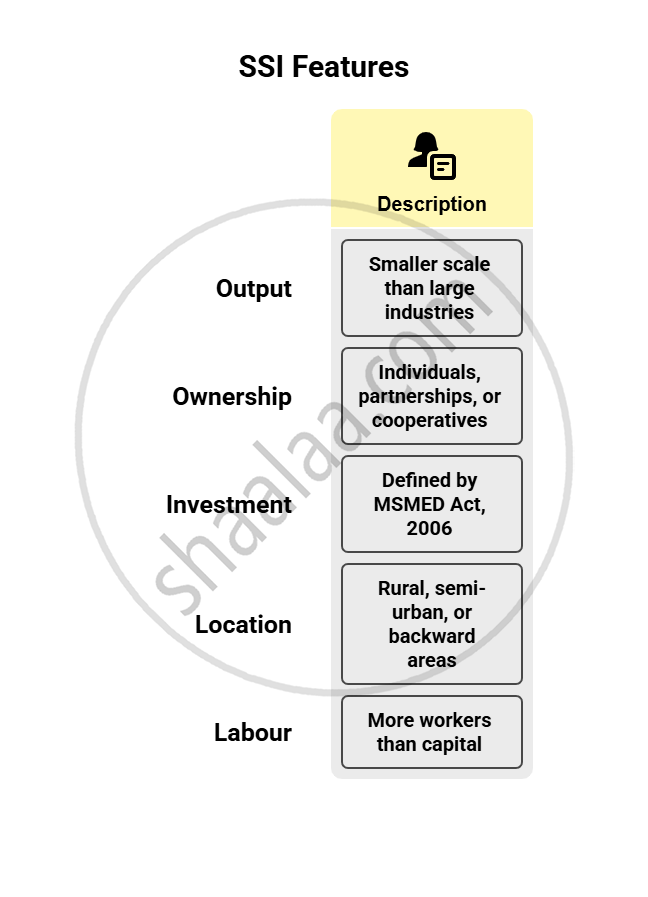
Importance
- Generates large-scale employment for unskilled & semi-skilled workers.
- Supports balanced regional development by promoting industries across regions.
- Enhances entrepreneurial skills and local talent.
- Requires less initial capital, enabling easy entry for small entrepreneurs.
- Promotes export by producing goods for both local and international markets.
Types of Business According to MSMED Act
Business is divided into two main sectors:
-
Manufacturing Sector – Makes physical goods.
-
Services Sector – Provides services (like transport, banking, etc.).
Classification by Investment (As per MSMED Act)
|
Type of Business |
Manufacturing Sector | Services Sector |
|---|---|---|
| Micro | Investment does not exceed ₹25 lakhs | Investment does not exceed ₹10 lakhs |
| Small | Investment above ₹25 lakhs to ₹5 crores | Investment above ₹10 lakhs to ₹2 crores |
| Medium | Investment above ₹5 crores to ₹10 crores | Investment above ₹2 crores to ₹5 crores |
Real-Life Application
Case: Mr. Ram’s Bicycle Parts Business
Mr. Ram wants to start a small factory making bicycle parts:
- Step 1: He registers his SSI with the District Industries Centre (DIC).
- Step 2: He uses his savings and gets a small loan from a bank under a government program (like SIDBI).
- Step 3: He hires five staff from his village and starts production.
- Step 4: To promote his business, Ram sells to local bicycle shops and online marketplaces.
Challenges faced:
- Difficulty in getting loans and skilled workers.
- Competition from large companies.
- Solution: He joins a local SSI association to access group marketing and skill development programs.
Key Point Summary
- Defined by Investment: SSIs are identified by the amount invested, not by employee count or power usage.
- Covers Both Sectors: Includes both manufacturing and service industries.
- Boosts Economy: Creates jobs and supports local businesses.
Test Yourself
Related QuestionsVIEW ALL [61]
Select the correct option.
| A | B |
| _____________ | Does not exceed ₹ 25 lakhs |
Match the pairs.
| Group ‘A’ | Group ‘B' |
| A) Micro-Manufacturing sector | 1) Handloom |
| B) Traditional Small Scale business | 2) Unskilled |
| C) Registration | 3) Does not exceed ₹ 25 lakhs |
| D) Labour | 4) 40% of exports of India |
| E) Bicycle | 5) Does not exceeds ₹ 1 lakhs |
| 6) DIC | |
| 7) Marketing Problem | |
| 8) Modern Small Scale business | |
| 9) Project Appraisal | |
| 10) Cost-efficiency |
Select the correct option.
| A | B |
| More than ₹ 5 crores but does not exceed ₹ 10 crores | ____________ |
Select the correct option.
| A | B |
| ___________ | Does not exceed ₹ 10 lakhs |
