Topics
Introduction to Partnership and Partnership Final Accounts
- Concept of Partnership
- Partnership Deed
- Provisions of the Indian Partnership Act, 1932
- Special Aspects of Partnership Accounts> Partner's Capital Account
- Partner's Capital Account> Fixed Capital Account
- Partner's Current Account
- Partner's Capital Account> Fluctuating Capital Account
- Examples on Partners’ Capital Accounts
- Partnership Final Accounts
- Trading Account
- Profit and Loss Account
- Balance Sheet
- Adjustments in Final Account
- Examples on Partnership Final Accounts
Introduction to Partnership
Accounts of ‘Not for Profit’ Concerns
Partnership Final Accounts
- Partnership Final Accounts
- Adjustments - Income Receivable
- Interest on Capital and Current Accounts
- Adjustments - Interest on Investment and Loans
- Adjustments - Goods Destroyed by Fire Or Accident (Insured Or Uninsured)
- Adjustments - Goods Stolen
- Adjustments of Financial Statements - Goods Distributed as Free Samples and Manager's Commission
- Adjustments - Goods Withdrawn by Partners
- Adjustments - Unrecorded Purchases and Sales
- Adjustments - Capital Expenditure Included in Revenue Expenses and Vice-versa
- Adjustments - Bills Receivable Dishonoured
- Adjustments - Bills Payable Dishonoured
- Adjustments - Deferred Expenses
- Adjustments - Capital Receipts Included in Revenue Receipts and Vice-versa
- Adjustments - Commission to Working Partner Managers on the Basis of Gross Profit Net Profit, Sales, Etc
Reconstitution of Partnership
- Modes of Reconstitution of a Partnership Firm
- Admission of Partner
- New Profit Sharing Ratio
- Methods of Valuation of Goodwill
- Admission of Partner> Adjustment of Capital
- Admission of Partner> Revaluation of Assets and Liabilities
- Admission of Partner> Accounting Treatment of Goodwill
- Retirement of Partner
- Needs of Retirement Or Death of a Partner
- Retirement/Death of a Partner> Treatment of Goodwill
- Retirement/Death of a Partner> Revaluation of Assets and Liabilities
- Retirement/Death of a Partner> New Profit Sharing Ratio
Reconstitution of Partnership (Admission of Partner)
- Reconstitution of Partnership
- Admission of Partner
- New Profit Sharing Ratio
- Sacrificing Ratio
- Admission of Partner> Accounting Treatment of Goodwill
- Average Profit Method
- Super Profit Method
- Admission of Partner> Reserves and Accumulated Profit/Losses
- Admission of Partner> Revaluation of Assets and Liabilities
- Admission of Partner> Adjustment of Capital
- Examples on Admission of Partner
Reconstitution of Partnership (Retirement of Partner)
- Retirement of Partner
- Retirement/Death of a Partner> New Profit Sharing Ratio
- Retirement/Death of a Partner> Gaining Ratio
- Retirement/Death of a Partner> Treatment of Goodwill
- Hidden Goodwill
- Retirement/Death of a Partner> Reserves and Accumulated Profits/Losses
- Retirement/Death of a Partner> Revaluation of Assets and Liabilities
- Retirement/Death of a Partner> Adjustment of Capitals
- Computation of Amount Due to the Retiring Partner
- Payment of Amount due to Retiring Partner
- Examples on Retirement of Partner
Dissolution of Partnership Firm
Accounts of “Not for Profit” concerns
- Concept of Non-Profit Concerns
- Receipts and Payments Account
- Additional Information - Prepaid Expenses of the Current and Previous Year
- Additional Information - Subscription Received in Advance
- Additional Information - Subscription Outstanding of the Current and Previous Year
- Additional Information - Capitalisation of Entrance Fees
- Additional Information - Creation of Special Funds Out of Donations
- Additional Information - Stock of Stationery
- Additional Information - Opening Balances of Assets and Liabilities
- Income and Expenditure Account
Reconstitution of Partnership (Death of Partner)
- Death of Partner
- Retirement/Death of a Partner> New Profit Sharing Ratio
- Retirement/Death of a Partner> Gaining Ratio
- Retirement/Death of a Partner> Revaluation of Assets and Liabilities
- Determination of Amount due to the Deceased Partner
- Settlement of Amount Payable to the Deceased Partner
- Examples on Death of Partner
Single Entry System
- Concept of Single Entry System
- Statements of Affairs
- Additional Information - Additional Capital
- Effects of Adjustments-Drawings
- Concept of Depreciation
- Additional Information - Undervaluation of Assets and Liabilities
- Additional Information - Overvaluation of Assets and Liabilities
- Interest on Capital and Current Accounts
- Additional Information - Partners Salary
- Illustrations of Single Entry System
Dissolution of Partnership Firm
- Concept of Dissolution of Partnership Firm
- Difference Between Dissolution of Partnership and Dissolution of Firm
- Accounting at the Time of Dissolution of a Firm
- Types of Firm Dissolution> Simple Dissolution
- Accounting Entries To Close The Books Of Accounts
- Transfer Stage
- Realisation/Disposal Stage
- Distribution Stage
- Treatment of Unrecorded (Undisclosed) Assets and Liabilities
- Process of Dissolution> Valuation of Goodwill
- Process of Dissolution> Realisation Account
- Examples on Simple Dissolution
- Types of Firm Dissolution> Dissolution under Insolvency Situation
- When One Partner Becomes Insolvent
- When Two Partners Become Insolvent
- When All Partners Are Insolvent
Bill of Exchange (Only Trade Bill)
- Necessity of Bill of Exchange (Only Trade Bill)
- Acceptance
- Concept of Bills of Exchange
- Honouring and Dishonouring of Bill of Exchange
- Accounting Treatment> Discounting the Bill of Exchange
- Accounting Treatment> Retaining the Bill till the Due Date
- Accounting Treatment> Endorsement of Bill of Exchanges
- Accounting Treatment > Bills Sent to Bank for Collection
- Insolvency of Drawee
- Retirement of Bill under Rebate
- Accounting at the Time of Dissolution of a Firm
- Examples on Bills of Exchange
Bills of Exchange
- Credit Transactions
- Concept of Bills of Exchange
- Acceptance
- Due Date
- Promissory Note
- Honouring and Dishonouring of Bill of Exchange
- Classification of Bills for Accounting
- Accounting Treatment> Retaining the Bill till the Due Date
- Accounting Treatment> Discounting the Bill of Exchange
- Accounting Treatment> Endorsement of Bill of Exchanges
- Accounting Treatment > Bills Sent to Bank for Collection
- Renewal Bill of Exchange
- Retirement of Bill under Rebate
- Insolvency of Drawee
- Examples on Bills of Exchange
Company Accounts
- Concept of Shares
- Shareholder's Fund> Share Capital of a Company
- Private Placement of Shares
- Terms of Issue of Shares> Issue of Shares at Par
- Under Subscription of Shares
- Over Subscription of Shares
- Types of Share Issue
- Forfeiture of Shares
- Concept of Debentures
- Terms of Issue of Debentures> Issue of Debentures at Par
- Issue of Debentures for Consideration Other than Cash
- Interest on Debentures
Company Accounts - Issue of Shares
- Joint Stock Company
- Concept of Shares
- Kinds of Shares> Equity Shares
- Kinds of Shares> Preference Shares
- Shareholder's Fund> Share Capital of a Company
- Treatment of Share Capital in Balance Sheet
- Methods of Issue of Share Capital
- Terms of Issue of Shares> Issue of Shares at Par
- Terms of Issue of Shares> Issue of Shares at Premium
- Terms of Issue of Shares> Issue Shares at Discount
- Over Subscription of Shares
- Pro-rata Allotment
- Under Subscription of Shares
- Calls-In-Arrears
- Calls-In-Advance
- Issue of Shares for Consideration other than Cash
- Forfeiture of Shares
- When Shares Were Originally Issued at a Premium
- When Shares Were Originally Issued at Discount
- Reissue of Forfeited Shares
Analysis of Financial Statements
- Comparative Financial Statement
- Common-Size Statement
- Concept of Cash Flow Statement
- Quick Ratio/Acid Test Ratio/Liquid Ratio
- Classification of Ratios> Income Statement Ratio
- Classification of Ratios> Combined/Mixed Ratio
- ROCE
Analysis of Financial Statements
- Concept of Financial Statements
- Concept of Financial Statement Analysis
- Formats of Financial Statement Analysis
- Tools of Analysis of Financial Statements
- Comparative Financial Statement
- Comparative Balance Sheet
- Comparative Income Statement
- Common-Size Statement
- Common Size Balance Sheet
- Common-Size Income Statement
- Concept of Cash Flow Statement
- Preparation of Cash Flow Statement
- Concept of Ratio Analysis
- Current Ratios/Working Capital Ratios
- Quick Ratio/Acid Test Ratio/Liquid Ratio
- Gross Profit Ratio
- Net Profit Ratio
- Operating Profit Ratio
- Operating Ratio
- Return on Investment
- Return on Capital Employed
Computer In Accounting
- Introduction
- Definition: Joint Stock Company
- Features
- Merits
- Demerits
- Types of Companies
- Real-Life Application
- Key Point Summary
Maharashtra State Board: Class 11
Introduction
A Joint Stock Company is a business owned by many people who each buy “shares” of ownership.
- The capital is pooled and divided into small parts called shares.
- Owners of shares are called shareholders.
- The company itself is created and governed by law.
Maharashtra State Board: Class 11
Definition: Joint Stock Company
- “A Joint Stock Company is a voluntary association of individuals for profit having capital divided into transferable Shares, the ownership of which is the condition on membership.” – Prof. L. H. Haney.
- “A Company is a person, artificial, invisible, intangible, and existing only in the eyes of the law. Being a mere creature of law, it possesses only those properties which the charter of its creation confers upon it, either expressly or as incidental to its very existence.” – Chief Justice Marshal
- According to The Companies Act 2013, Section 2 (20), the term “Company” means “a Company incorporated under the Companies Act 2013 or any previous Company law.”
Maharashtra State Board: Class 11
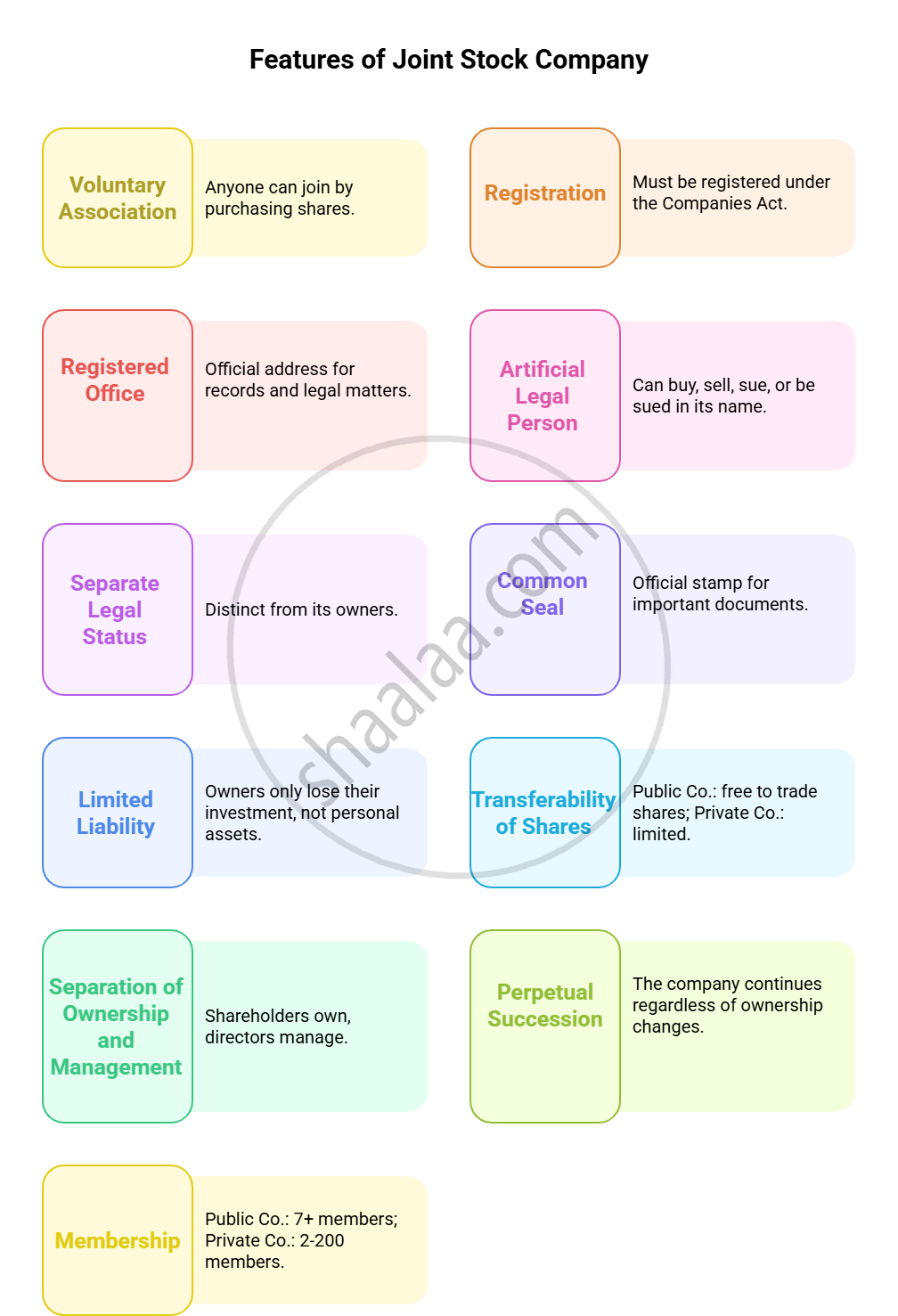
Features
Maharashtra State Board: Class 11
Merits
- Large amount of Capital: Many people can invest.
- Professional Management: Experts run the company affairs.
- More Scope for expansion: Easier to grow, start new projects.
- Public Confidence: Audited by law, it is easy to build confidence.
- Relief in Taxation: Sometimes, tax relaxation is provided for working in backward areas.
- Expert Services: Companies can hire professionals, such as legal advisors, auditors, and consultants.
- Perpetual Succession: The Company continues no matter what happens to shareholders.
- Limited Liability: Risk is only for the unpaid share amount.
Maharashtra State Board: Class 11
Demerits
- Rigid Formation: Many legal steps and fees.
- Lack of Secrecy: Important info must be published.
- Delay in the Decision-Making process: Too many people are involved, and meetings are lengthy.
- No Personal Contact: Owners don’t know workers/customers directly.
- High Cost of Management: Higher salaries, advertisement, and administrative costs.
- Reckless Speculation: Some directors might misuse information for personal gain.
Maharashtra State Board: Class 11
Real-Life Applications
Reliance Industries Ltd., Tata Motors Ltd., and Maruti Suzuki Ltd.
Maharashtra State Board: Class
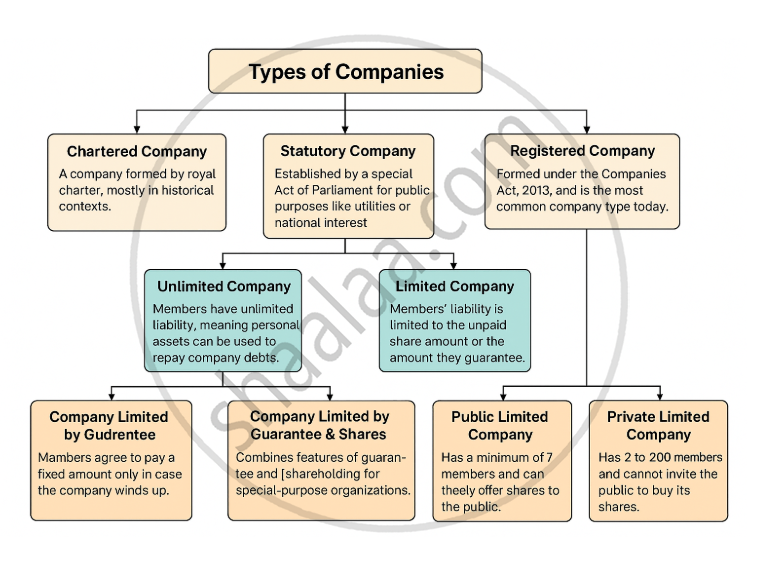
Types of Companies
Maharashtra State Board: Class 11, 12
Key Points: Joint Stock Company
- Meaning: A Joint Stock Company is a business organisation where ownership is divided into transferable shares held by shareholders.
- Origin: It emerged during the Industrial Revolution to overcome the limitations of partnerships, such as unlimited liability and limited capital, by raising funds from the public.
- Legal Status: A Joint Stock Company is an artificial legal person with a separate legal identity and perpetual succession, created under company law.
- Merits: It provides benefits like large capital, limited liability, expert management, public confidence, and better scope for expansion.
- Types: Companies can be Chartered, Statutory, or Registered, and further classified as Public, Private, Limited, or Unlimited.
