- Easy Formation: Simple setup with minimal legal formalities.
- Quick Decisions: Fast decision-making, leading to quick benefits.
- Maximum Secrecy: No need to share business secrets or publish accounts.
- Direct Motivation: The sole trader keeps all profits, driving them to work harder.
- Flexibility: Quick adaptation and changes to the business.
- Lower Cost: The owner controls operations, minimizing waste and costs.
- Efficiency: Focus on reducing waste to maximize profits.
Topics
Introduction of Commerce and Business
Trade
- Concept of Trade
- Internal Trade
- Wholesale Trade
- Retail Trade
- Types of Retailers> Itinerant Retailers
- Types of Retailers> Fixed Shop Retailer
- Small Scale Fixed Retailer
- Large Scale Fixed Retailers
- Departmental Stores
- Super Market Shop
- Chain Stores or Multiple Shops
- One Price Shop
- Concept of Mall
- International Trade
- Export Trade
- Procedure of Export Trade
- Import Trade
- Procedure of Import Trade
- Entrepot Trade
- Comparison of Different Types of Retailers and Trade Practices
Small Scale Industry and Business
Forms of Business Organisation - 1
- Private Sector Organisations
- Sole Trading Concern
- Partnership Firm
- Types of Partners
- Types of Partnerships Firms
- Hindu Undivided Family Business Or Joint Hindu Family Business
- Co-operative Society
- Types of Cooperative Societies
- Joint Stock Company
- Amul: A Successful Co-operative Movement in India
- Private Limited Company
- Public Limited Company
- Comparison of Different Forms of Business Organization
Forms of Business Organisation - 2
Institutes Supporting Business
Business Environment
- Concept of Business Environment
- Importance of Business Environment
- Dimensions of Business Environment
- Internal Factors
- External Factors> Natural Environment
- External Factors> Social Environment
- External Factors> Political Environment
- External Factors> Economic Environment
- External Factors> Technological Environment
- External Factors> Legal Environment
- New Economic Policy and Business
- Liberalisation
- Privatisation
- Globalisation
- Impact of New Economic Policy on Business
Introduction to Management
- Introduction
- Definition: Sole Trading Concern
- Features
- Merits
- Demerits
- Real-Life Application
- Key Point Summary
Maharashtra State Board: Class 11
Introduction
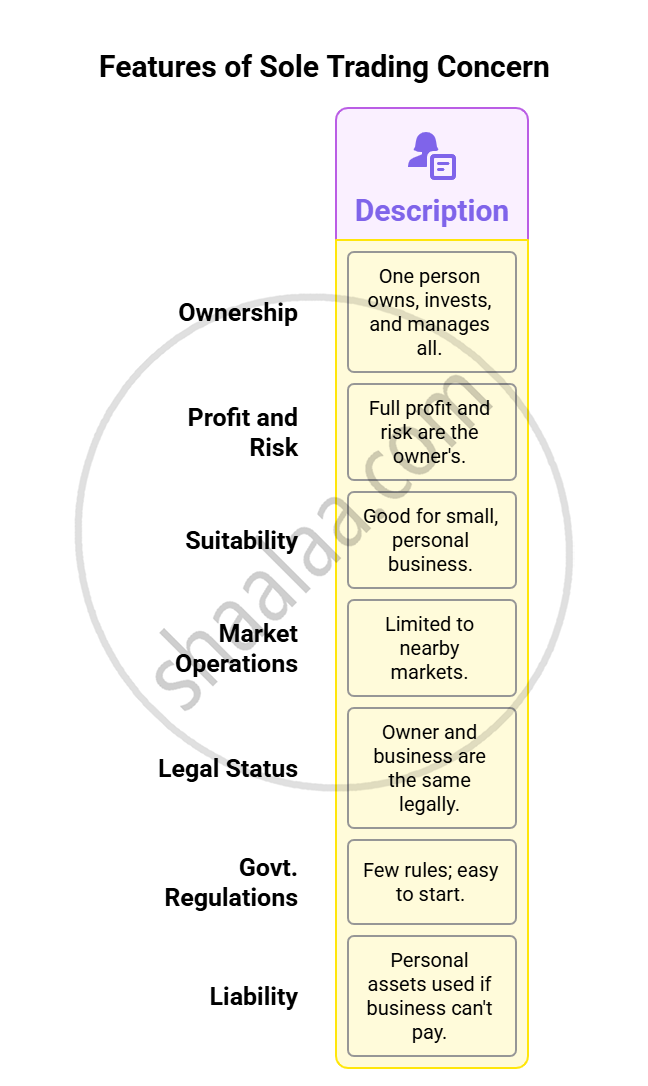
A sole trading concern (or sole proprietorship) is the simplest and oldest form of business. It is owned, managed, and controlled by a single person who makes all the decisions, retains all the profits, and bears all the risk.
Maharashtra State Board: Class 11
Definition: Sole Trading Concern
- According to Prof. J. Hansen, ‘‘ Sometimes known as one-man business, it is a type of business unit where one person is solely responsible for providing the capital, for bearing the risk of the enterprise and for the risk of ownership.’’
- According to Prof. James Lundy, ‘‘The sole proprietorship is an informal type of business owned by one person.’’
Maharashtra State Board: Class 11
Features
Maharashtra State Board: Class 11
Merits
Maharashtra State Board: Class 11
Demerits
Maharashtra State Board: Class 11
Real-Life Application
Sayali opens a tailoring shop in her neighborhood. She sets her working hours, chooses fabrics, takes orders, and fixes prices. If she earns a profit, she keeps it. If customers don’t pay, she alone covers the loss.
Maharashtra State Board: Class 11
Key Point Summary
- One owner has full control, responsibility, and rewards.
- Ideal for small businesses that require flexibility, direct customer contact, and swift decision-making.
- Offers simplicity but limits growth due to fewer funds and unlimited personal risk.
Test Yourself
Related QuestionsVIEW ALL [15]
Select the correct option:
| A | B |
| Forms of business organisation | ______________ |
Select the correct option:
| A | B |
| Minimum 2 and maximum 50 | ______________ |
