Topics
National Income and Related Aggregates
- Macroeconomics Vs Microeconomics
- Representative Goods and Sectors
- Macroeconomic Agents and Government Role
- Emergence of Macroeconomics
- Context of the Present Book of Macroeconomics
- Meaning of Economic Wealth and Final Goods
- Stocks, Flows, and Depreciation
- Capital Formation, Trade-off & Circular Flow of Income
- Circular Flow of Income and Methods of Calculating National Income
- Output Method/Product Method
- Expenditure Method
- Income Method
- Factor Cost, Basic Prices and Market Prices
- Some Macroeconomic Identities
- National Disposable Income
- Private Income
- National Income Aggregates
- Real GDP and Nominal GDP
- GDP and Welfare
Introductory Macroeconomics
Introduction
- A Simple Economy
- Central Problems of an Economy
- Concepts of Production Possibility Frontier
- Organisation of Economic Activities
- Positive and Normative Economics
- Macroeconomics Vs Microeconomics
Development Experience (1947-90) and Economic Reforms since 1991
- India's Economy Before Independence
- Low Level of Economic Development Under the Colonial Rule
- Agricultural Sector in India
- Industrial Sector
- Foreign Trade of India
- Demographic Condition
- Occupational Structure
- Infrastructure
- Post-Independence Economic Systems and Planning
- Five Year Plans (FYP)
- Agriculture
- Industry and Trade
- Trade Policy: Import Substitution
- The 1991 Economic Crisis and Reforms
- Background of the New Economic Policy
- Liberalisation
- Privatisation
- Globalisation
- World Trade Organisation (WTO)
- Impact of the Economic Reforms
Money and Banking
- Concept of Money
- Functions of Money
- Demand for Money and Supply of Money
- Money Creation by Banking System
- Limits to Credit Creation and Money Multiplier
- Policy Tools To Control Money Supply
- Demand and Supply for Money : A Detailed Discussion
- The Transaction Motive
- The Speculative Motive
- Various Measures of Supply of Money
- Narrow and Broad Money
- Demonetisation
Theory of Consumer Behaviour
- Consumer Behaviour: The Problem of Choice
- Basic Concepts of Microeconomics > Utility
- Cardinal Approach (Utility Analysis)
- Derivation of Demand Curve in the Case of a Single Commodity
- Ordinal Utility Analysis/Indifference Curve Analysis
Indian Economic Development
Current Challenges Facing Indian Economy
- Concept of Human Capital
- Sources of Human Capital
- Human Capital and Economic Growth
- Human Capital and Human Development
- State of Human Capital Formation in India
- Growth of Education Sector in India
- Challenges and Future Prospects in Education
- Rural Development in India
- Credit and Marketing in Rural Areas
- Agricultural Market System
- Diversification into Productive Activities
- Sustainable Development and Organic Farming
- The Nature and Importance of Work in Society
- Workers and Employment
- Participation of People in Employment
- Self-employed and Hired Workers
- Employment in Firms, Factories and Offices
- Growth and Changing Structure of Employment
- Informalisation of Indian Workforce
- Concept of Unemployment
- Government and Employment Generation
- Environment and Sustainable Development in India
- State of India’s Environment
- Concept of Sustainable Development
- Strategies for Sustainable Development
Development Experience of India – a Comparison with Neighbours
Determination of Income and Employment
- Aggregate Demand and Its Components
- Consumption
- Investment
- Determination of Income in Two-sector Model
- Determination of Equilibrium Income in the Short Run
- Macroeconomic Equilibrium with Price Level Fixed
- Effect of an Autonomous Change in Aggregate Demand on Income and Output
- The Multiplier Mechanism
- Paradox of Thrift
- Equilibrium Output and Employment
Introductory Microeconomics
Production and Costs
- Production Function
- Concept of Production
- Some Basic Concepts - Total, Average and Marginal Physical Products
- Relation Between Total, Average and Marginal Product
- Law of Variable Proportions
- Average and Marginal Physical Products
- Changes in Production
- Fixed Cost and Variable Cost
- Behaviour of Cost in the Short - Run
- Relationship Between Average Variable Cost and Average Total Cost and Marginal Cost
- Opportunity Cost
- Revenue Concepts
- Producer's Equilibrium
- Law of Supply
- Supply Schedule
- Distinction Between Supply and Stock
- Determinants of Supply
- Movement Along the Supply Curve Or Expansion and Contraction of Supply
- Measurement of Elasticity of Supply > Percentage Method
- Methods of Measurement of National Income
- Marginal Cost (MC)
- The Law of Diminishing Marginal Product
- Shapes of Product Curves
- Costs in Long Run Period
- Returns to Scale
Government Budget and the Economy
The Theory of the Firm Under Perfect Competition
- Concept of Market
- Market Equilibrium
- Determination of Market Equilibrium
- Effects of Changes (Shifts) in Demand on Equilibrium Price and Equilibrium Quantity
- Perfect Competition
- Imperfect Competition
- Factors Determining Market Forms
- Oligopoly
- Market Forms - Perfect Oligopoly
- Market Forms - Imperfect Oligopoly
- Equilibrium Price
- Applications of Tools of Demand and Supply Price Control
- Price Ceiling
- Price Floor
- Revenue Concepts
- Profit Maximisation Objective
- Determinants of a Firm’s Supply Curve
- Supply Schedule
- Price Elasticity of Supply
Balance of Payments
- Open Economy and Its Linkages
- Concept of Balance of Payments
- Current Account
- Capital Account
- Balance of Payments Surplus and Deficit
- Foreign Exchange Market
- Foreign Exchange Rate
- Determination of the Exchange Rate
- Merits and Demerits of Flexible and Fixed Exchange Rate Systems
- Managed Floating Exchange Rate System
Market Equilibrium
- Simple Monopoly in the Commodity Market
- Other Non - Perfectly Competitive Markets
Estimated time: 14 minutes
CBSE: Class 12
CISCE: Class 10
Tamil Nadu Board of Secondary Education: Class 9, 12
CISCE: Class 10
Tamil Nadu Board of Secondary Education: Class 9, 12
Meaning
- Sustainable development is concerned with the welfare of both the present and future generations.
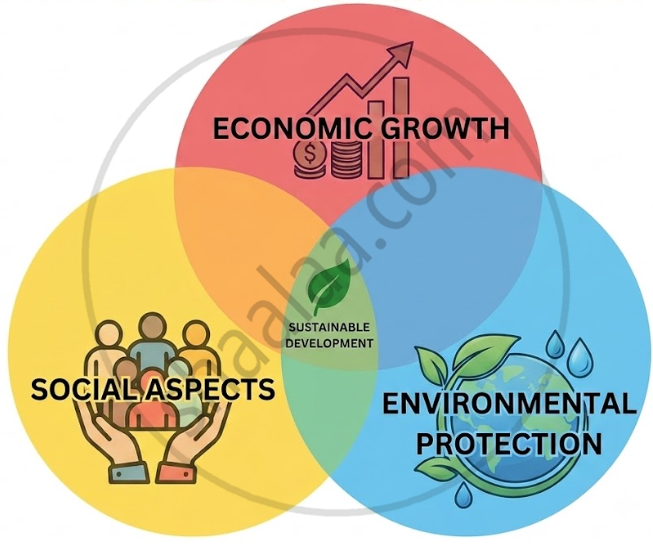
- It balances economic growth, social well-being, and environmental protection.
- Development should not damage the environment that sustains life.
- It aims to meet the basic needs of all, especially the poor, while protecting resources for future generations.
CBSE: Class 12
CISCE: Class 10
Tamil Nadu Board of Secondary Education: Class 9, 12
CISCE: Class 10
Tamil Nadu Board of Secondary Education: Class 9, 12
Definitions: Sustainable Development
- “Sustainable development is development that meets the needs of the present without compromising the ability of future generations to meet their own needs” - World Commission on Environment and Development, 1987
- “The alternative approach (to sustainable development) is to focus on natural capital assets and suggest that they should not decline through time.” - Pearce, Markandya and Barbier, 1989-
CBSE: Class 12
CISCE: Class 10
Tamil Nadu Board of Secondary Education: Class 9
CISCE: Class 10
Tamil Nadu Board of Secondary Education: Class 9
Three Pillars of Sustainable Development
| Pillar | Focus |
|---|---|
| Social Sustainability | Social well-being, equity, justice, peace, and harmony |
| Economic Sustainability | Long-term economic growth while maintaining a healthy balance with the ecosystem |
| Environmental Sustainability | Protection of the environment, conservation of natural resources, and ecological balance |
CBSE: Class 12
CISCE: Class 10
Tamil Nadu Board of Secondary Education: Class 12
CISCE: Class 10
Tamil Nadu Board of Secondary Education: Class 12
Key Concepts
- Inter-generational Equity - The present generation should use resources in a way that does not reduce the ability of future generations to meet their needs.
- Needs - Sustainable development focuses on meeting the basic needs of all, particularly the poor.
- Three Dimensions of Sustainability - Economic, social and environmental components must be integrated for development to be sustainable.
- Sustainable Development Goals (SDGs) - In 2015, the United Nations formulated 17 Sustainable Development Goals (SDGs) to be achieved by 2030.
CBSE: Class 12
CISCE: Class 10
Tamil Nadu Board of Secondary Education: Class 12
CISCE: Class 10
Tamil Nadu Board of Secondary Education: Class 12
Contributors
- Brundtland Commission (World Commission on Environment and Development, 1987) - Gave the most widely accepted definition of sustainable development.
- Lester Brown - Introduced the concept of sustainable development and highlighted the need for a sustainable society.
- Edward Barbier - Emphasised improving the material standard of living of the poor through sustainable development.
- Herman Daly - Suggested measures such as conserving natural resources, limiting resource depletion, promoting input-efficient technology, and controlling pollution to achieve sustainable development.
CBSE: Class 12
CISCE: Class 10
Tamil Nadu Board of Secondary Education: Class 9, 12
CISCE: Class 10
Tamil Nadu Board of Secondary Education: Class 9, 12
Key Points: Concept of Sustainable Development
- Sustainable development meets the needs of the present without compromising the ability of future generations to meet their own needs.
- It balances economic growth, social well-being and environmental protection.
- It is based on inter-generational equity and meeting the basic needs of all, especially the poor.
- The Brundtland Commission (1987) gave the most widely accepted definition.
- Lester Brown, Edward Barbier and Herman Daly made important contributions to the concept.
- The 17 Sustainable Development Goals (SDGs) adopted by the United Nations in 2015 provide a global framework for achieving sustainable development by 2030.
Test Yourself
Related QuestionsVIEW ALL [41]
Read the given Passage carefully and answer the questions that follow:
| Bharmaur tribal area comprises Bharmaur and Holi tehsils of Chamba district of Himachal Pradesh. It has been a notified tribal area since 21 November 1975. Bharmaur is inhabited by, Gaddi', a tribal community who have maintained a distinct identity in the Himalayan region as they practiced transhumance and conversed through Gaddiali dialect. Bharmaur tribal region has harsh climate conditions, low resource base and fragile environment. These factors have influenced the society and Economy of the region. According to the 2011 census, the total population of Bharmaur sub-division was 39,113 i.e., 21 persons per sq km. It is one of the most (economically and socially) backward areas of Himachal Pradesh. Historically, the Gaddis have experienced geographical and political isolation and socio-economic deprivation. The economy is largely based on agriculture and allied activities such as sheep and goat rearing. The process of development of the tribal area of Bharmaur started in the 1970s when Gaddis were included among 'scheduled tribes'. Under the Fifth Five Year Plan, the tribal sub-plan was introduced in 1974 and Bharmaur was designated as one of the five Integrated Tribal Development Projects (ITDP) in Himachal Pradesh. This area development plan was aimed at improving the quality of life of the Gaddis and narrowing the gap in the level of development between Bharmaur and other areas of Himachal Pradesh. This plan laid the highest priority on development of transport and communications, agriculture and allied activities, and social and community services. |
(1) How have the Gaddi Tribal Community maintained a distinct identity in the Himalayan region?
(2) Which factors have influenced the society and Economy of the region to remain backward?
(3) Under the Integrated Tribal Development Project, Which areas were given the highest priority?
