Topics
National Income and Related Aggregates
- Macroeconomics Vs Microeconomics
- Representative Goods and Sectors
- Macroeconomic Agents and Government Role
- Emergence of Macroeconomics
- Context of the Present Book of Macroeconomics
- Meaning of Economic Wealth and Final Goods
- Stocks, Flows, and Depreciation
- Capital Formation, Trade-off & Circular Flow of Income
- Circular Flow of Income and Methods of Calculating National Income
- Output Method/Product Method
- Expenditure Method
- Income Method
- Factor Cost, Basic Prices and Market Prices
- Some Macroeconomic Identities
- National Disposable Income
- Private Income
- National Income Aggregates
- Real GDP and Nominal GDP
- GDP and Welfare
Introductory Macroeconomics
Introduction
- A Simple Economy
- Central Problems of an Economy
- Concepts of Production Possibility Frontier
- Organisation of Economic Activities
- Positive and Normative Economics
- Macroeconomics Vs Microeconomics
Development Experience (1947-90) and Economic Reforms since 1991
- India's Economy Before Independence
- Low Level of Economic Development Under the Colonial Rule
- Agricultural Sector in India
- Industrial Sector
- Foreign Trade of India
- Demographic Condition
- Occupational Structure
- Infrastructure
- Post-Independence Economic Systems and Planning
- Five Year Plans (FYP)
- Agriculture
- Industry and Trade
- Trade Policy: Import Substitution
- The 1991 Economic Crisis and Reforms
- Background of the New Economic Policy
- Liberalisation
- Privatisation
- Globalisation
- World Trade Organisation (WTO)
- Impact of the Economic Reforms
Current Challenges Facing Indian Economy
- Concept of Human Capital
- Sources of Human Capital
- Human Capital and Economic Growth
- Human Capital and Human Development
- State of Human Capital Formation in India
- Growth of Education Sector in India
- Challenges and Future Prospects in Education
- Rural Development in India
- Credit and Marketing in Rural Areas
- Agricultural Market System
- Diversification into Productive Activities
- Sustainable Development and Organic Farming
- The Nature and Importance of Work in Society
- Workers and Employment
- Participation of People in Employment
- Self-employed and Hired Workers
- Employment in Firms, Factories and Offices
- Growth and Changing Structure of Employment
- Informalisation of Indian Workforce
- Concept of Unemployment
- Government and Employment Generation
- Environment and Sustainable Development in India
- State of India’s Environment
- Concept of Sustainable Development
- Strategies for Sustainable Development
Theory of Consumer Behaviour
- Consumer Behaviour: The Problem of Choice
- Basic Concepts of Microeconomics > Utility
- Cardinal Approach (Utility Analysis)
- Derivation of Demand Curve in the Case of a Single Commodity
- Ordinal Utility Analysis/Indifference Curve Analysis
Indian Economic Development
Money and Banking
- Concept of Money
- Functions of Money
- Demand for Money and Supply of Money
- Money Creation by Banking System
- Limits to Credit Creation and Money Multiplier
- Policy Tools To Control Money Supply
- Demand and Supply for Money : A Detailed Discussion
- The Transaction Motive
- The Speculative Motive
- Various Measures of Supply of Money
- Narrow and Broad Money
- Demonetisation
Development Experience of India – a Comparison with Neighbours
Determination of Income and Employment
- Aggregate Demand and Its Components
- Consumption
- Investment
- Determination of Income in Two-sector Model
- Determination of Equilibrium Income in the Short Run
- Macroeconomic Equilibrium with Price Level Fixed
- Effect of an Autonomous Change in Aggregate Demand on Income and Output
- The Multiplier Mechanism
- Paradox of Thrift
- Equilibrium Output and Employment
Introductory Microeconomics
Production and Costs
- Production Function
- Concept of Production
- Some Basic Concepts - Total, Average and Marginal Physical Products
- Relation Between Total, Average and Marginal Product
- Law of Variable Proportions
- Average and Marginal Physical Products
- Changes in Production
- Fixed Cost and Variable Cost
- Behaviour of Cost in the Short - Run
- Relationship Between Average Variable Cost and Average Total Cost and Marginal Cost
- Opportunity Cost
- Revenue Concepts
- Producer's Equilibrium
- Law of Supply
- Supply Schedule
- Distinction Between Supply and Stock
- Determinants of Supply
- Movement Along the Supply Curve Or Expansion and Contraction of Supply
- Measurement of Elasticity of Supply > Percentage Method
- Methods of Measurement of National Income
- Marginal Cost (MC)
- The Law of Diminishing Marginal Product
- Shapes of Product Curves
- Costs in Long Run Period
- Returns to Scale
Government Budget and the Economy
The Theory of the Firm Under Perfect Competition
- Concept of Market
- Market Equilibrium
- Determination of Market Equilibrium
- Effects of Changes (Shifts) in Demand on Equilibrium Price and Equilibrium Quantity
- Perfect Competition
- Imperfect Competition
- Classification of Market Structure
- Oligopoly
- Market Forms - Perfect Oligopoly
- Market Forms - Imperfect Oligopoly
- Equilibrium Price
- Applications of Tools of Demand and Supply Price Control
- Price Ceiling
- Price Floor
- Revenue Concepts
- Profit Maximisation Objective
- Determinants of a Firm’s Supply Curve
- Supply Schedule
- Price Elasticity of Supply
Balance of Payments
- Open Economy and Its Linkages
- Concept of Balance of Payments
- Current Account
- Capital Account
- Balance of Payments Surplus and Deficit
- Foreign Exchange Market
- Foreign Exchange Rate
- Determination of the Exchange Rate
- Merits and Demerits of Flexible and Fixed Exchange Rate Systems
- Managed Floating Exchange Rate System
Market Equilibrium
- Simple Monopoly in the Commodity Market
- Other Non - Perfectly Competitive Markets
Estimated time: 18 minutes
CISCE: Class 12
Classification of Receipts
| Type | Key Feature |
|---|---|
| Revenue Receipts | Do not create liabilities; do not reduce assets |
| Capital Receipts | Create liabilities or reduce financial assets |
National Testing Agency: Class 12
Definition: Revenue Receipts
Receipts which do not create a liability for the government or do not lead to reduction in assets, are known as revenue receipts.
CISCE: Class 12
National Testing Agency: Class 12
National Testing Agency: Class 12
Definition: Capital Receipts
- When the government raises funds either by incurring a liability or by disposing of/reducing assets, it is called a capital receipt.
- All those receipts of the government which create liabilities or reduce financial assets, are termed as capital receipts.
Revenue Receipts
Revenue Receipts are divided into:
- Tax Revenue
- Non-Tax Revenue
CBSE: Class 12
CISCE: Class 12
National Testing Agency: Class 12
CISCE: Class 12
National Testing Agency: Class 12
Tax Revenue
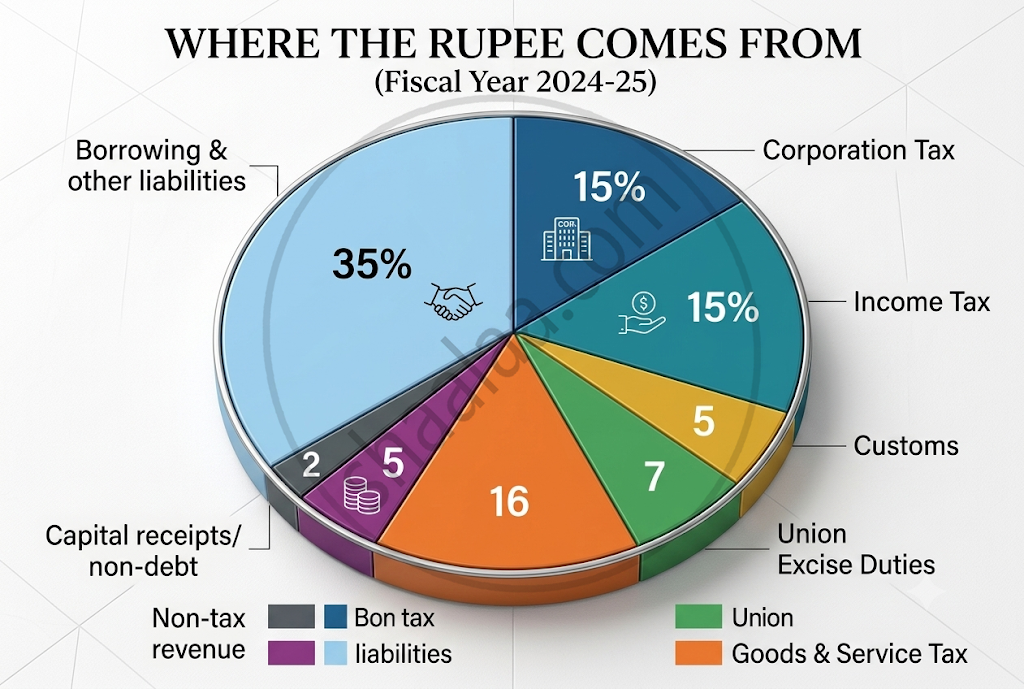
Tax Revenue consists of the proceeds of taxes and other duties levied by the Central Government.
Tax revenues comprise:
- Direct Taxes
- Indirect Taxes
A. Direct Taxes
Paid directly by the person on whom levied; cannot be shifted to another person.
Examples:
- Personal Income Tax
- Corporation Tax
- (Wealth Tax, Gift Tax and Estate Duty have been abolished.)
B. Indirect Taxes
Can be shifted to another person.
Examples:
- Customs Duties
- Union Excise Duties
- GST
- (Service Tax has been subsumed under GST from 1 July 2017.)
Types of Taxes
| Tax | Nature |
|---|---|
| Personal Income Tax | Direct; progressive - higher income = higher tax |
| Corporation Tax | Direct |
| Customs Duties | Indirect |
| Union Excise Duties | Indirect |
| Service Tax* | Indirect (subsumed under GST from 1 July 2017) |
| GST | Indirect |
| Interest Tax* | Direct (abolished; retained only as a historical reference in some older texts) |
Note: Necessities are taxed at lower rates than luxuries under indirect taxes, not under income tax.
CBSE: Class 12
CISCE: Class 12
National Testing Agency: Class 12
CISCE: Class 12
National Testing Agency: Class 12
Non-Tax Revenue
- Interest Receipts — Interest earned on loans advanced by the government.
- Dividends and Profits - Profits/dividends from Public Sector Enterprises (e.g., BHEL) and public financial institutions (e.g., LIC, nationalised banks).
- Commercial Revenue - Revenue from commercial services provided by the government (e.g., Doordarshan, Railways, Posts).
- Administrative Revenue — Fees, licence fees, fines and penalties.
- Grants-in-Aid — Grants received from individuals, private organisations, foreign governments and international organisations for specific purposes.
- Other Receipts — Miscellaneous non-tax sources.
CBSE: Class 12
CISCE: Class 12
National Testing Agency: Class 12
CISCE: Class 12
National Testing Agency: Class 12
Capital Receipts
Capital Receipts are linked to the Capital Budget.
| Capital Receipt | Key Point |
|---|---|
| Recovery of Loans & Advances | Repayments of loans given by the government - reduces financial assets. |
| Market Loans | Borrowings from the market - creates liability. |
| Special Deposits | Deposits of a special nature - creates liability. |
| Small Savings | Public savings mobilised by the government - creates liability. |
| Provident Funds | Receipts from Provident Funds - creates liability. |
| External Assistance | Loans received from foreign governments/international organisations - creates liability. |
| Disinvestment | Sale of the government's stake in Public Sector Enterprises (PSUs) - reduces financial assets. |
CISCE: Class 12
Sources of Revenue of the Government Budget 2022-23
CBSE: Class 12
CISCE: Class 12
National Testing Agency: Class 12
CISCE: Class 12
National Testing Agency: Class 12
Key Points: Classification of Budget Receipts
- Budget receipts = Revenue Receipts + Capital Receipts.
- Revenue receipts → neither create liabilities nor reduce assets.
- Capital receipts → create liabilities or reduce financial assets.
- Tax revenue = Direct (income tax, corporation tax) + Indirect (customs, excise, GST, service tax).
- Non-tax revenue includes PSU profits (BHEL, LIC) and commercial receipts (Doordarshan).
- Disinvestment is classified as capital receipt because it reduces government's financial assets.
- Borrowings = capital receipt because they create liabilities for the government.
