Topics
National Income and Related Aggregates
- Macroeconomics Vs Microeconomics
- Representative Goods and Sectors
- Macroeconomic Agents and Government Role
- Emergence of Macroeconomics
- Context of the Present Book of Macroeconomics
- Meaning of Economic Wealth and Final Goods
- Stocks, Flows, and Depreciation
- Capital Formation, Trade-off & Circular Flow of Income
- Circular Flow of Income and Methods of Calculating National Income
- Output Method/Product Method
- Expenditure Method
- Income Method
- Factor Cost, Basic Prices and Market Prices
- Some Macroeconomic Identities
- National Disposable Income
- Private Income
- National Income Aggregates
- Real GDP and Nominal GDP
- GDP and Welfare
Introductory Macroeconomics
Introduction
- A Simple Economy
- Central Problems of an Economy
- Concepts of Production Possibility Frontier
- Organisation of Economic Activities
- Positive and Normative Economics
- Macroeconomics Vs Microeconomics
Development Experience (1947-90) and Economic Reforms since 1991
- India's Economy Before Independence
- Low Level of Economic Development Under the Colonial Rule
- Agricultural Sector in India
- Industrial Sector
- Foreign Trade of India
- Demographic Condition
- Occupational Structure
- Infrastructure
- Post-Independence Economic Systems and Planning
- Five Year Plans (FYP)
- Agriculture
- Industry and Trade
- Trade Policy: Import Substitution
- The 1991 Economic Crisis and Reforms
- Background of the New Economic Policy
- Liberalisation
- Privatisation
- Globalisation
- World Trade Organisation (WTO)
- Impact of the Economic Reforms
Money and Banking
- Concept of Money
- Functions of Money
- Demand for Money and Supply of Money
- Money Creation by Banking System
- Limits to Credit Creation and Money Multiplier
- Policy Tools To Control Money Supply
- Demand and Supply for Money : A Detailed Discussion
- The Transaction Motive
- The Speculative Motive
- Various Measures of Supply of Money
- Narrow and Broad Money
- Demonetisation
Theory of Consumer Behaviour
- Consumer Behaviour: The Problem of Choice
- Basic Concepts of Microeconomics > Utility
- Cardinal Approach (Utility Analysis)
- Derivation of Demand Curve in the Case of a Single Commodity
- Ordinal Utility Analysis/Indifference Curve Analysis
Indian Economic Development
Current Challenges Facing Indian Economy
- Concept of Human Capital
- Sources of Human Capital
- Human Capital and Economic Growth
- Human Capital and Human Development
- State of Human Capital Formation in India
- Growth of Education Sector in India
- Challenges and Future Prospects in Education
- Rural Development in India
- Credit and Marketing in Rural Areas
- Agricultural Market System
- Diversification into Productive Activities
- Sustainable Development and Organic Farming
- The Nature and Importance of Work in Society
- Workers and Employment
- Participation of People in Employment
- Self-employed and Hired Workers
- Employment in Firms, Factories and Offices
- Growth and Changing Structure of Employment
- Informalisation of Indian Workforce
- Concept of Unemployment
- Government and Employment Generation
- Environment and Sustainable Development in India
- State of India’s Environment
- Concept of Sustainable Development
- Strategies for Sustainable Development
Development Experience of India – a Comparison with Neighbours
Determination of Income and Employment
- Aggregate Demand and Its Components
- Consumption
- Investment
- Determination of Income in Two-sector Model
- Determination of Equilibrium Income in the Short Run
- Macroeconomic Equilibrium with Price Level Fixed
- Effect of an Autonomous Change in Aggregate Demand on Income and Output
- The Multiplier Mechanism
- Paradox of Thrift
- Equilibrium Output and Employment
Introductory Microeconomics
Production and Costs
- Production Function
- Concept of Production
- Some Basic Concepts - Total, Average and Marginal Physical Products
- Relation Between Total, Average and Marginal Product
- Law of Variable Proportions
- Average and Marginal Physical Products
- Changes in Production
- Fixed Cost and Variable Cost
- Behaviour of Cost in the Short - Run
- Relationship Between Average Variable Cost and Average Total Cost and Marginal Cost
- Opportunity Cost
- Revenue Concepts
- Producer's Equilibrium
- Law of Supply
- Supply Schedule
- Distinction Between Supply and Stock
- Determinants of Supply
- Movement Along the Supply Curve Or Expansion and Contraction of Supply
- Measurement of Elasticity of Supply > Percentage Method
- Methods of Measurement of National Income
- Marginal Cost (MC)
- The Law of Diminishing Marginal Product
- Shapes of Product Curves
- Costs in Long Run Period
- Returns to Scale
Government Budget and the Economy
The Theory of the Firm Under Perfect Competition
- Concept of Market
- Market Equilibrium
- Determination of Market Equilibrium
- Effects of Changes (Shifts) in Demand on Equilibrium Price and Equilibrium Quantity
- Perfect Competition
- Imperfect Competition
- Factors Determining Market Forms
- Oligopoly
- Market Forms - Perfect Oligopoly
- Market Forms - Imperfect Oligopoly
- Equilibrium Price
- Applications of Tools of Demand and Supply Price Control
- Price Ceiling
- Price Floor
- Revenue Concepts
- Profit Maximisation Objective
- Determinants of a Firm’s Supply Curve
- Supply Schedule
- Price Elasticity of Supply
Balance of Payments
- Open Economy and Its Linkages
- Concept of Balance of Payments
- Current Account
- Capital Account
- Balance of Payments Surplus and Deficit
- Foreign Exchange Market
- Foreign Exchange Rate
- Determination of the Exchange Rate
- Merits and Demerits of Flexible and Fixed Exchange Rate Systems
- Managed Floating Exchange Rate System
Market Equilibrium
- Simple Monopoly in the Commodity Market
- Other Non - Perfectly Competitive Markets
Estimated time: 19 minutes
CBSE: Class 12
Introduction
- Worker-population ratio alone does not show workers’ status or working conditions.
- Status of workers in an enterprise reveals one dimension of quality of employment.
- Status indicates attachment to the job and authority over the enterprise and co-workers.
CBSE: Class 12
Definition: Self-employed
Workers who own and operate an enterprise to earn their livelihood are known as self-employed.
CBSE: Class 12
Definition: Regular Salaried Employees
When a worker is engaged by someone or an enterprise and paid his or her wages on a regular basis, they are known as regular salaried employees.
CBSE: Class 12
Concept of Workers
- The common view is that only paid agricultural labourers, factory workers, bank and office staff are workers.
- The self-employed people like pavement vegetable vendors, and professionals such as lawyers, doctors and engineers, are also workers.
CBSE: Class 12
Categories of Workers
- Self-employed: own and operate enterprises; example – cement shop owner; about 57% of India’s workforce; major source of livelihood for both men and women, accounting for more than 50% of the workforce.
- Casual wage labourers: casually engaged in others’ farms and get remuneration for work done; example – construction worker; about 22% of India’s workforce; considered the most vulnerable group.
- Regular salaried employees: engaged by enterprises and paid regularly; example – civil engineer in a construction company; 21% of India’s workforce; 24% of men and 17% of women in this category; gender gap is small.
CBSE: Class 12
Rural–Urban Pattern
- Self-employed workers are more in rural areas than in urban areas.
- In rural areas, many depending on farming own land and cultivate independently, so self-employment share is high.
- In urban areas, both self-employment and regular salaried jobs are greater because enterprises need workers on a regular basis and not everyone can run factories, shops and offices.
CBSE: Class 12
Distribution of Employment by Gender
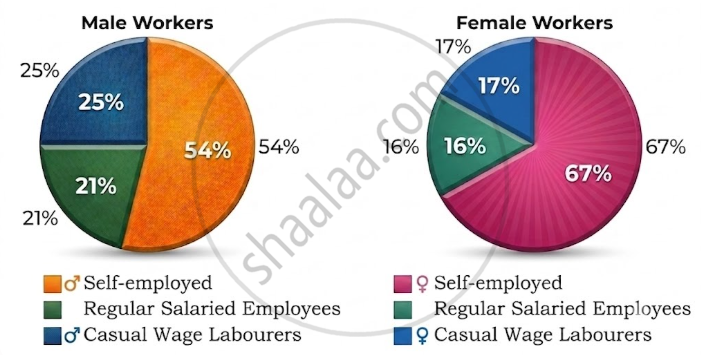
- Self-employment is the largest source of employment for both men (54%) and women (67%).
- Regular salaried employment: Men 21%, Women 16%.
- Casual wage labour: Men 25%, Women 17%.
CBSE: Class 12
Distribution of Employment by Region
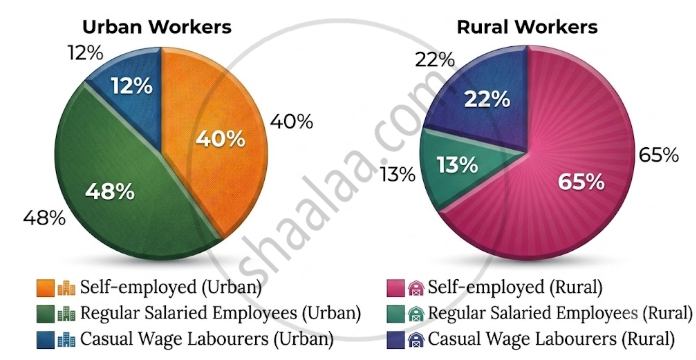
- Rural workers: Self-employed 65%, Regular salaried 13%, Casual wage labour 22%.
- Urban workers: Self-employed 40%, Regular salaried 48%, Casual wage labour 12%.
- Self-employment is higher in rural areas, while regular salaried jobs are more common in urban areas.
CBSE: Class 12
Key Points: Self-Employed and Hired Workers
- Quality of employment is understood by looking at workers’ status.
- Self-employed form the largest share of the workforce and dominate both rural areas and total male and female employment.
- Casual wage labourers form about one-fifth of workers and are considered most vulnerable.
- Regular salaried employees form about one-fifth of workers with a small gender gap.
- Self-employed persons and professionals are also counted as workers, not only formal paid employees.
