Advertisements
Chapters
1: Reproduction in Organisms
2: Sexual Reproduction in Flowering Plants
3: Human Reproduction
4: Reproductive Health-Problems and Strategies
Unit 2 – Genetics and Evolution
5: Principles of Inheritance and Variation
6: Chromosomes, Sex-Linked Inheritance and Human Genetic Disorders
7: Molecular Basis of Inheritance
8: Evolution-Origin of Life
9: Theory of Evolution and Evolution of Man
Unit 3 – Biology and Human Welfare
10: Human Health and Diseases
11: Adolescent Issues: Alcoholism and Drugs
12: Animal Breeding for Improvement in Food Production
13: Plant Breeding to Enhance Food Production
14: Microbes in Human Welfare
Unit 4 – Biotechnology
▶ 15: Biotechnology: Principles and Processes
16: Biotechnology and Its Applications
Unit 5 – Ecology and Environment
Chapter 17: Organisms and Populations
Chapter 18: Ecosystem
Chapter 19: Biodiversity and Conservation
Chapter 20: Environmental Issues
![Sarita Aggarwal solutions for Biology [English] Class 12 ISC chapter 15 - Biotechnology: Principles and Processes - Shaalaa.com](/images/biology-english-class-12-isc_6:65d11b7ee3eb4277bbdac77874c6c42a.jpg "Sarita Aggarwal solutions for Biology [English] Class 12 ISC chapter 15 - Biotechnology: Principles and Processes")
Advertisements
Solutions for Chapter 15: Biotechnology: Principles and Processes
Below listed, you can find solutions for Chapter 15 of CISCE Sarita Aggarwal for Biology [English] Class 12 ISC.
Sarita Aggarwal solutions for Biology [English] Class 12 ISC 15 Biotechnology: Principles and Processes EXERCISES [Pages 790 - 802]
A. OBJECTIVE QUESTIONS I. Multiple choice questions Choose the correct answer:
Which one of the following is not required for rDNA technology?
DNA polymerase
DNA ligase
restriction endonuclease
reverse transcriptase
Which one of the following is not a cloning vector in genetic engineering?
transposons
plasmids
bacteriophages
protozoans
Gene transfer through vectors can be done by ______.
plasmids
microinjections
tungsten particles coated with DNA
electroporation
An animal containing a foreign gene is called a ______.
plasmid
transgenic
surrogate mother
probe
The role of restriction endonucleases is ______.
to cut DNA fragment at specific sites
to join DNA fragments
to introduce DNA into plasmid
none of the above
The function of DNA ligase is ______.
to break DNA into fragments
to seal DNA fragments
to introduce DNA into plasmid
to produce desired protein
Identify the plasmid.
EcoRI
pBR322
AIUI
HindIII
Restriction endonucleases used in recombinant rDNA technology are obtained from ______.
bacteriophages
bacterial cells
plasmids
all prokaryotic cells
Plasmids are ______.
cDNA
mitochondrial DNA
circular extrachromosomal DNA in bacteria
viral RNA
One of the key factors, which makes the plasmid the vector in genetic engineering is that ______.
it is resistant to antibiotics
it is resistant to restriction enzymes
its ability to carry a foreign gene
its ability to cause infection in host
Which of the following is used as a best genetic vector in plants?
Bacillus thuringiensis
Agrobacterium tumefaciens
Pseudomonas putida
All of these
The tumour-inducing capacity of Agrobacterium tumefaciens is located in large extrachromosomal plasmids called ______.
Ri plasmid
lambda phage
pBR322
Ti plasmid
The construction of the first recombinant DNA was done by using the native plasmid of ______.
E. coli
Salmonella typhimurium
B. thuringiensis
yeast
The linking of antibiotic resistancе gene with the plasmid vector became possible with ______.
DNA polymerase
exonuclease
DNA ligase
endonucleases
Gel electrophoresis is used for ______.
construction of recombinant DNA by joining with cloning
isolation of DNA molecules
cutting of DNA into fragments
separation of DNA fragments according to their size
Fill in the blanks
A segment of DNA or a desired gene can be cut and isolated with the help of ______ enzyme.
The process of making multiple identical copies of any piece of DNA is called ______ of DNA.
The endonuclease used by scientists Cohen and Boyer was ______.
Plasmid-free E. coli are treated with chemical ______ to make their membranes more permeable to insert the recombinant plasmid.
The sequences recognised by endonucleases are typically 4-6 nucleotides long and are ______ nucleotide sequences.
In the plasmid named pSC101, S and C refer to ______.
DNA fragments can be separated by a technique called ______.
______ and ______ are natural vectors for cloning of genes in plants and animals.
Agrobacterium contains tumourinducing plasmids called ______.
Electroporation produces ______ in the plasma membrane of the host cells.
State whether the following is true or false.
rDNA involves combining of DNA from two different organisms to generate a recombinant DNA.
State whether the following is true or false.
Cutting of a DNA fragment is done with the help of enzyme DNA ligase.
State whether the following is true or false.
Cohen and Boyer used a restriction endonuclease which was obtained from bacteria Agrobacterium.
State whether the following is true or false.
Plasmid DNA acts as vector as it can transfer the piece of desired DNA to the host cell.
State whether the following is true or false.
EcoRI is the name of a plasmid obtained from bacteria E. coli.
State whether the following is true or false.
The sequences recognised by restriction endonucleases are palindrome nucleotide sequences.
State whether the following is true or false.
Chitinases are used to break open the fungal cells.
State whether the following is true or false.
DNA fragments being positively charged move towards the negative electrode during electrophoresis.
Annealing means amplification of genes.
State whether the following is true or false.
A bioreactor has an agitator and an oxygen delivery system along with pH control.
Match the following.
| Column I | Column II |
| 1. Restriction endonuclease | (a) Joining DNA fragments together |
| 2. DNA ligase | (b) Movement of DNA fragments towards anode |
| 3. Electrophoresis | (c) Production of desired gene product on large scale |
| 4. Electroporation | (d) Cutting a DNA fragment from plasmid |
| 5. Bioreactor | (e) Treatment of cells with CaCl2 |
Answer the following in one or two words.
A technique in which microparticles of gold or tungsten coated with foreign DNA are bombarded into target host cells.
Answer the following in one or two words.
Scientific name of the organism whose plasmid was used by Cohen and Boyer.
Answer the following in one or two words.
A plant pathogenic bacteria that is known as natural genetic 'engineer' as it can transfer part of its plasmid into the host plant.
Answer the following in one or two words.
A technique to make multiple copies of desired gene by using DNA polymerase.
Answer the following in one or two words.
A large vessel in which the large amount of culture can be processed and gene products can be produced on a large scale.
In the questions given below, there are two statements marked as Assertion (A) and Reason (R). Read the statements and choose the correct option
Assertion (A): Restriction enzymes cut the strand of DNA to produce sticky ends.
Reason (R): Stickiness of the ends facilitates the action of the enzyme DNA polymerase.
Both assertion (A) and reason (R) are true, and reason is the correct explanation of assertion.
Both assertion (A) and reason (R) are true, but reason is not the correct explanation of assertion.
Assertion (A) is true but reason (R) is false.
Both assertion (A) and reason (R) are false.
Assertion (A): Plasmids are extrachromosomal DNA.
Reason (R): Plasmids are found in bacteria and are useful in genetic engineering.
Both assertion (A) and reason (R) are true, and reason is the correct explanation of assertion.
Both assertion (A) and reason (R) are true, but reason is not the correct explanation of assertion.
Assertion (A) is true but reason (R) is false.
Both assertion (A) and reason (R) are false.
Assertion (A): Plasmids are single-stranded extra chromosomal DNA.
Reason (R): Plasmids are usually present in eukaryotic cells.
Both assertion (A) and reason (R) are true, and reason is the correct explanation of assertion.
Both assertion (A) and reason (R) are true, but reason is not the correct explanation of assertion.
Assertion (A) is true but reason (R) is false.
Both assertion (A) and reason (R) are false.
Assertion(A): Restriction endonucleases function by 'inspecting' the length of a DNA sequence to find the specific recognition sequence.
Reason (R): The sequences recognised by endonucleases are typically 4-6 nucleotides long and are palindromes, also called palindromic nucleotide sequences.
Both assertion (A) and reason (R) are true, and reason is the correct explanation of assertion.
Both assertion (A) and reason (R) are true, but reason is not the correct explanation of assertion.
Assertion (A) is true but reason (R) is false.
Both assertion (A) and reason (R) are false.
Assertion (A): E. coli having pBR322 with DNA insert at BamHI site cannot grow in medium containing tetracycline.
Reason (R): Recognition site for BamHI is present in tetr region of pBR322.
Both assertion (A) and reason (R) are true, and reason is the correct explanation of assertion.
Both assertion (A) and reason (R) are true, but reason is not the correct explanation of assertion.
Assertion (A) is true but reason (R) is false.
Both assertion (A) and reason (R) are false.
Assertion (A): For amplification of gene, DNA polymerase is used to copy the identified gene by polymerase chain reaction.
Reason (R): Amplification of a gene can be done by inserting it into a bacterium and allowing a bacterium to undergo repeated cell divisions.
Both assertion (A) and reason (R) are true, and reason is the correct explanation of assertion.
Both assertion (A) and reason (R) are true, but reason is not the correct explanation of assertion.
Assertion (A) is true but reason (R) is false.
Both assertion (A) and reason (R) are false.
Assertion (A): Ori is a sequence from where replication starts.
Reason (R): A prokaryotic DNA has a single origin of replication.
Both assertion (A) and reason (R) are true, and reason is the correct explanation of assertion.
Both assertion (A) and reason (R) are true, but reason is not the correct explanation of assertion.
Assertion (A) is true but reason (R) is false.
Both assertion (A) and reason (R) are false.
Assertion (A): Electroporation makes a bacterial cell a competent host to take up DNA.
Reason (R): This technique induces temporary pores in the plasma membrane of the host cell to facilitate entry of foreign DNA.
Both assertion (A) and reason (R) are true, and reason is the correct explanation of assertion.
Both assertion (A) and reason (R) are true, but reason is not the correct explanation of assertion.
Assertion (A) is true but reason (R) is false.
Both assertion (A) and reason (R) are false.
Assertion (A): Agrobacterium tumefaciens is commonly used in genetic engineering because this bacterium is associated with roots of all cereals and pulse crops.
Reason (R): A gene incorporated in the bacterial chromosomal genome gets automatically transferred to the crop with which the bacterium is associated.
Both assertion (A) and reason (R) are true, and reason is the correct explanation of assertion.
Both assertion (A) and reason (R) are true, but reason is not the correct explanation of assertion.
Assertion (A) is true but reason (R) is false.
Both assertion (A) and reason (R) are false.
Assertion (A): In a bioreactor, the desired gene products are biologically converted into specific products like proteins and enzymes.
Reason (R): A bioreactor provides the optimal growth conditions like temperature, pH, salts, vitamins and oxygen.
Both assertion (A) and reason (R) are true, and reason is the correct explanation of assertion.
Both assertion (A) and reason (R) are true, but reason is not the correct explanation of assertion.
Assertion (A) is true but reason (R) is false.
Both assertion (A) and reason (R) are false.
Read the sources given and answer any four from the questions given below:
|
A plasmid is a small, extrachromosomal DNA molecule within a cell that is physically separated and distinct from chromosomal DNA and can replicate independently. They are most commonly found as small circular, double-stranded DNA molecules. Plasmids naturally exist in all bacterial cells but can be seen in some archaebacteria and eukaryotes. Often, the genes carried in plasmids provide bacteria with genetic advantages, such as antibiotic resistance. The most commonly used cloning vectors are E. coli plasmids which include three functional regions: (1) an origin of replication (Ori), (2) a drug-resistance gene and (3) a region where DNA can be inserted without interfering with plasmid replication or expression of the drug-resistance gene. The replication origin (Ori) is a specific DNA sequence of 50-100 base pairs that must be present in a plasmid for it to replicate |
- Where are plasmids in bacteria located?
- inside the nucleus of bacteria
- outside the nuclear matter of bacteria
- as a part of chromosomal segment of bacteria
- on the surface of bacteria
- How many origins of replication are present in a bacterial plasmid
- one
- two
- three
- many
- Most bacterial plasmids have the following structure.
- large circular DNA molecule
- small circular DNA molecule
- large circular RNA molecule
- linear DNA molecule
- Most commonly used cloning vector E. coli plasmid has the following functional regions.
- a drug resistance gene
- a region where DNA can be inserted
- both (a) and (b)
- Ori having specific RNA sequence
- Plasmids can be seen in
- all bacteria
- all eukaryotes
- all viruses
- both (a) and (b)
Read the sources given and answer any four from the questions given below:
|
Restriction endonucleases are enzymes that are produced by bacteria and cut the double-stranded DNA molecule at specific recognition sequences known as restriction sites. The sequences recognised by endonucleases are typically 4–6 nucleotides long and are palindromes called palindromic nucleotide sequences. A palindrome is a base sequence that reads the same on two strands but in the opposite direction, for example, 5' GAATТС 3', 3' СТТАAG 5'. After cleavage, each DNA strand has a little single-stranded hanging portion at the end. These are called sticky ends. When cut by the same restriction enzyme, the resultant DNA fragments have the same kind of sticky ends which can be joined together by DNA ligases. |
- The function of restriction endonuclease is to
- cut RNA at specific restriction sites
- cut DNA at specific recognition sequences
- form rDNA
- cut double-stranded RNA
- Which of the following sequence is a palindrome?
- 5' GAATTC 3', 3' GAATTC 5'
- 5' CCATGG 3', 3' GGTACC 5'
- 5'AAGCTT 3', 3' GAATTC 5'
- 5' GGATCC 3', 5' CCAAGG 3'
- The overhanging parts of two strands of DNA of cut DNA
- are called sticky ends
- have single strands of RNA
- are of no use for rDNA
- are cut and deleted from DNA
- Function of DNA ligase is to
- cut and join DNA
- form sticky ends
- join fragments of DNA
- recognise restriction sites
- Restriction endonucleases are present in the following
- eukaryotes
- bacteria
- humans
- higher plants
Read the sources given and answer any four from the questions given below:
|
Agrobacterium tumefaciens is a plant pathogenic bacterium that can naturally transfer part of its plasmid DNA as it infects the host plant. The bacterium Agrobacterium contains large tumourinducing plasmids, Ti-plasmids and passes on this tumour-causing gene into the genome of the host plant. The host plant could be any dicotyledonous plant. Ti-plasmids are used as gene vectors to transfer foreign genes into target host cells. Vector-less methods involvethe transfer of gene, i.e., rDNA containing foreign gene by a direct method without any vector. These can be done by electroporation, microinjection and biolistic guns. In electroporation, temporary holes are produced in the plasma membrane of the host cell to facilitate the entry of foreign DNA. This is done by treating the bacterial cells with specific concentration of divalent cations like CaCl2. In microinjection foreign genes (rDNA) are introduced directly into the nucleus of plant or animal cells by using micropipettes. By using biolistic or gene particle gun, the microparticles of gold or tungsten particles coated with foreign DNA are bombarded into the target host cells with high velocity. |
- Agrobacterium is used as a vector because it
- infects dicot plants
- contains plasmid
- is easily available bacteria
- can transfer foreign gene into target host cell
- Which of the following statements are true for T1 plasmid?
- has a tumour-causing gene
- has foreign gene
- used in electroporation technique
- contains chromosomal DNA of bacteria
- Microparticles of gold coated with rDNA are used in the following technique:
- electroporation
- biolistic gun
- microinjection
- T1 plasmid
- What is done in the electroporation technique?
- Cells are treated with divalent cations
- Temporary holes are created in the plasma membrane
- both (a) and (b)
- plasmids are used
- rDNA are introduced directly into the nucleus of a plant by fine pipettes in the following technique:
- Agrobacterium
- microinjection
- electroporation
- gene particle gun
B. SUBJECTIVE QUESTIONS Very short answer type questions (1 mark)
Name the enzyme used to cut a segment of DNA in rDNA technology.
What is another term given for a genetically modified organism?
What is the work of DNA Ligase?
Which enzyme is used to isolate a desired gene?
What is the extra-chromosomal circular DNA in bacteria called as?
What is the role of a plasmid in rDNA technology?
Name the enzymes involved in rDNA technology.
Which enzyme is used to insert, isolate gene into the plasmid?
Which mechanism helps in insertion of plasmid into bacteria E. coli?
Name a few cloning vectors.
What is the term used for the pairs of sequence of nucleotide that read the same on two strands of DNA in their 5'-3' direction?
What is the meaning of sticky ends?
Name the bacteria which is a natural vector and transfers its Ti plasmid to the plant cells to produce cancerous cells.
Name a few vector less or direct methods of gene transfer.
Scientific term for a foreign gene that is inserted in rDNA.
Short answer type questions (2 marks)
What is recombinant DNA?
Give the basic tools required for the formation of rDNА.
Name important enzymes essential for rDNA technology.
What is a cloning vector?
Name a few cloning vectors used in rDNA technology.
What is the role of restriction endonuclease?
Name two important enzymes used in the formation of recombinant DNA.
Study the linking of DNA fragments shown below.
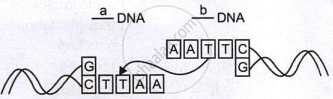
(i) Name 'a' DNA and 'b' DNA.
(ii) Name the restriction enzyme that recognises this palindrome.
(iii) Name the enzyme that can link these two DNA fragments.
What are ‘molecular scissors’?
Give one example of 'molecular scissors'.
Explain 'molecular scissors' role in recombinant DNA technology.
Why is Agrobacterium tumefaciens a good cloning vector? Explain.
DNA being hydrophilic cannot pass through the cell membranes of a host cell. Explain how does recombinant DNA get introduced into the host cell to transform the latter.
Mention the role of vectors in recombinant DNA technology.
Give any two examples of vectors in recombinant DNA technology.
With the help of diagrammatic representation only, show the steps of recombinant DNA technology.
Short answer type questions (3 marks)
What are the two basic steps in rDNA technology? Name the enzymes involved in these steps.
Explain the following steps in rDNA technology.
Isolation of desired gene
Explain the following steps in rDNA technology.
Role of plasmid
Explain the following steps in rDNA technology.
Cloning of gene
Give the role of following enzyme in formation of transgenic cell.
Restriction endonuclease
Give the role of following enzyme in formation of transgenic cell.
DNA ligase
Give the role of following enzyme in formation of transgenic cell.
DNA polymerase
How do restriction endonucleases cut DNA? Explain with one example.
How is a plasmid named?
Give one example of plasmid.
What is EcoRI?
What does the name EcoRI signify?
What is the significance of Ori?
What is the significance of selectable marker?
What is the significance of cloning site in rDNA technology?
What is the meaning of indirect method of gene transfer?
Give one example of indirect method of gene transfer.
List some direct methods also.
How can the product of a gene be obtained at a large scale? What is its significance?
What is the need for a downstream processing?
Give basic important systems present in a bioreactor.
List various steps in the process of recombinant DNA technology.
Explain amplification.
Explain annealing.
Distinguish between plasmid DNA and chromosomal DNA.
Distinguish between exonuclease and endonuclease.
Differentiate between the following:
DNA ligase and DNA polymerase
Differentiate between the following:
Normal cell and a Transgenic cell
Differentiate between the following:
Indirect and Direct methods of gene transfer
Long answer type questions (5 marks)
Give the tools needed for genetic engineering.
Explain various steps involved in rDNA technique.
What are the various ways by which the desired genes can be transferred?
Explain the contribution of Thermus aquaticus in the amplification of a gene of interest.
Name and explain the techniques used in the separation and isolation of DNA fragments to be used in recombinant DNA technology.
Plasmid is a boon to biotechnology. Justify this statement quoting the production of human insulin as an example.
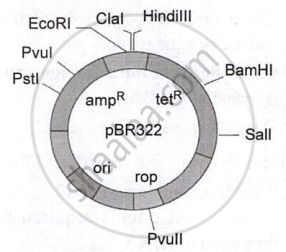
(a) Identify the selectable markers in the diagram of E. coli vector shown above.
(b) How is the coding sequence of beta-galactosidase considered a better marker than the ones identified by you in the diagram? Explain.
E. BOARD QUESTIONS 1 mark
Give a reason for the following:
DNA cannot enter directly into the host cell.
2 marks
Write a short note on Electrophoresis.
3 marks
What is a bioreactor?
Explain important features of a stirred tank bioreactor.
Name and explain the technique used for separating DNA fragments and making them available for biotechnology experiments.
5 marks
Explain the various steps involved in recombinant DNA technology.
What are the restriction endonucleases? Give the rules of their nomenclature.
Explain the mechanism of action of restriction endonucleases that makes them suitable for genetic engineering.
Explain what are the desirable characteristics of an ideal cloning vector used in rDNA technology.
Describe two vectors less methods of gene transfer used in rDNA technology.
What does PCR stand for?
Describe the steps of PCR technique.
Solutions for 15: Biotechnology: Principles and Processes
Sarita Aggarwal solutions for Biology [English] Class 12 ISC chapter 15 - Biotechnology: Principles and Processes
Shaalaa.com has the CISCE Mathematics Biology [English] Class 12 ISC CISCE solutions in a manner that help students grasp basic concepts better and faster. The detailed, step-by-step solutions will help you understand the concepts better and clarify any confusion. Sarita Aggarwal solutions for Mathematics Biology [English] Class 12 ISC CISCE 15 (Biotechnology: Principles and Processes) include all questions with answers and detailed explanations. This will clear students' doubts about questions and improve their application skills while preparing for board exams.
Further, we at Shaalaa.com provide such solutions so students can prepare for written exams. Sarita Aggarwal textbook solutions can be a core help for self-study and provide excellent self-help guidance for students.
Concepts covered in Biology [English] Class 12 ISC chapter 15 Biotechnology: Principles and Processes are .
Using Sarita Aggarwal Biology [English] Class 12 ISC solutions Biotechnology: Principles and Processes exercise by students is an easy way to prepare for the exams, as they involve solutions arranged chapter-wise and also page-wise. The questions involved in Sarita Aggarwal Solutions are essential questions that can be asked in the final exam. Maximum CISCE Biology [English] Class 12 ISC students prefer Sarita Aggarwal Textbook Solutions to score more in exams.
Get the free view of Chapter 15, Biotechnology: Principles and Processes Biology [English] Class 12 ISC additional questions for Mathematics Biology [English] Class 12 ISC CISCE, and you can use Shaalaa.com to keep it handy for your exam preparation.
