Advertisements
Chapters
1: Reproduction in Organisms
▶ 2: Sexual Reproduction in Flowering Plants
3: Human Reproduction
4: Reproductive Health-Problems and Strategies
Unit 2 – Genetics and Evolution
Chapter 5: Principles of Inheritance and Variation
Chapter 6: Chromosomes, Sex-Linked Inheritance and Human Genetic Disorders
Chapter 7: Molecular Basis of Inheritance
Chapter 8: Evolution-Origin of Life
Chapter 9: Theory of Evolution and Evolution of Man
Unit 3 – Biology and Human Welfare
Chapter 10: Human Health and Diseases
Chapter 11: Adolescent Issues: Alcoholism and Drugs
Chapter 12: Animal Breeding for Improvement in Food Production
Chapter 13: Plant Breeding to Enhance Food Production
Chapter 14: Microbes in Human Welfare
Unit 4 – Biotechnology
Chapter 15: Biotechnology: Principles and Processes
Chapter 16: Biotechnology and Its Applications
Unit 5 – Ecology and Environment
Chapter 17: Organisms and Populations
Chapter 18: Ecosystem
Chapter 19: Biodiversity and Conservation
Chapter 20: Environmental Issues
![Sarita Aggarwal solutions for Biology [English] Class 12 ISC chapter 2 - Sexual Reproduction in Flowering Plants - Shaalaa.com](/images/biology-english-class-12-isc_6:65d11b7ee3eb4277bbdac77874c6c42a.jpg "Sarita Aggarwal solutions for Biology [English] Class 12 ISC chapter 2 - Sexual Reproduction in Flowering Plants")
Advertisements
Solutions for Chapter 2: Sexual Reproduction in Flowering Plants
Below listed, you can find solutions for Chapter 2 of CISCE Sarita Aggarwal for Biology [English] Class 12 ISC.
Sarita Aggarwal solutions for Biology [English] Class 12 ISC 2 Sexual Reproduction in Flowering Plants EXERCISES [Pages 105 - 118]
A. OBJECTIVE QUESTIONS I. Multiple choice questions Choose the correct answer:
Arrangement of nuclei in normal dicot embryo sac is ______.
3 + 3 + 2
2 + 4 + 2
3 + 2 + 3
2 + 3 + 3
An anther generally has ______.
2 lobes and 2 pollen sacs
2 lobes and 4 pollen sacs
4 lobes and 4 pollen sacs
4 lobes and 2 pollen sacs
Each microspore mother cell gives rise to ______.
one microspore
two microspores
three microspores
four microspores
Each microspore develops into ______.
one pollen grain
two pollen grains
three pollen grains
four pollen grains
Anemophily refers to pollination by ______.
wind
water
animals
insects
When pollen grains of a flower are transferred to the stigma of another flower on the same plant, it is known as ______.
autogamy
allogamy
geitonogamy
xenogamy
A small pore at one end of ovule is known as ______.
funicle
nucellus
micropyle
chalaza
An embryo sac has ______.
2 haploid nuclei
4 haploid nuclei
8 haploid nuclei
4 diploid nuclei
The nuclei present in the centre of the embryo sac are called ______.
egg nuclei
polar nuclei
synergids
antipodals
Pollination in Vallisneria is by ______.
wind
animals
insects
water
Pollination by bats is known as ______.
entomophily
chiropterophily
anemophily
ornithophily
Each pollen tube has ______.
one generative nucleus and one tube nucleus
one generative nucleus and two tube nuclei
two generative nuclei and one tube nucleus
two generative nuclei and two tube nuclei
Endosperm of the seed develops from the ______.
haploid nucleus
diploid nucleus
triploid nucleus
tetraploid nucleus
Self-incompatibility due to the genotype of the pollen grain is termed as ______.
sporophytic incompatibility
gametophytic incompatibility
stigmatic incompatibility
apomixis
The fruit of mango is a ______.
drupe
berry
pepo
pome
On maturity an ovule forms a ______.
seed
fruit
embryo sac
endosperm
Pineapple is an example of ______.
simple fruit
aggregate fruit
multiple fruit
false fruit
A diploid female plant is crossed ivith tetraploid male. The ploidy of endosperm will be ______.
tetraploidy
triploidy
pentaploidy
diploidy
Double fertilisation involves fertilisation of ______.
an egg by two male gametes
two eggs in the same embryo sac by two male gametes from one pollen tube
egg cell and central cell by male gametes from two different pollen tubes
egg cell and central cell by male gametes from same pollen tube
Cleistogamous flowers are ______.
wind pollinated
self-pollinated
cross-pollinated
insect pollinated
bird-pollinated
A flower having both stamens and carpels is ______.
bisexual
unisexual
dioecious
syncarpous
A plant part having two generations is ______.
embryo
unfertilised ovule
germinated pollen grain
seed
Tetradynamous androecium is found in ______.
mustard
onion
tomato
sun flower
Edible part of mango is ______.
endocarp
receptacle
epicarp
mesocarp
Endosperm is consumed by developing embryo in ______.
pea
maize
costor bean
coconut
Unisexuality of flowers prevents ______.
autogamy and geitonogamy
both geitonogamy and xenogamy
autogamy but not geitonogamy
geitonogamy but not xenogamy
Which one of the following prevents cross-pollination?
Cleistogamy
Dichogamy
Heterostyly
Protogyny
Most common type of ovule in which an ovule bends along the funicle so that the micropyle is close to hilum.
Orthotropous
Anatropous
Amphitropous
Campylotropous
An embryo is formed by the ______.
Meiotic divisions of diploid zygote
Mitotic divisions of triploid nucleus
Meiotic divisions of triploid nucleus
Mitotic divisions of diploid zygote
Fill in the blanks
Androecium is a collection of ______.
Each stamen is a modified ______.
A generative nucleus gives rise to ______ as a result of mitotic divisions.
Wind-pollinated flowers generally have ______ stigma.
Primary endosperm nucleus is formed by the fusion of ______ and ______.
A true fruit develops from the ______.
As the ovary mature, ovules develop into ______ and zygote into ______.
Triploid nucleus undergoes mitotic divisions to form ______.
The non-albuminous seeds have food stored in ______.
The multilayered body of the ovule is called ______.
State whether the following is true or false.
A functional megaspore undergoes mitotic divisions to form 8 haploid nuclei.
State whether the following is true or false.
Tapetum is a thick outermost layer of pollen sac.
State whether the following is true or false.
On maturity each pollen contains to a small vegetative cell and a large generative cell.
State whether the following is true or false.
A megaspore mother cell is a diploid cell that undergoes meiotic division.
State whether the following is true or false.
Vallisneria had flowers modified for wind pollination.
Pollen tube is positively chemotropic and negatively aerotropic.
State whether the following is true or false.
Formation of a diploid zygote and triploid nucleus is called double fertilisation.
State whether the following is true or false.
The edible part in coconut is the mesocarp.
State whether the following is true or false.
The fruits developed by parthenocarpy are seedless.
State whether the following is true or false.
Protogyny ensures self fertilisation.
Match the following:
| Column A | Column B |
| 1. Raceme with sessile flowers | (a) Catkin |
| 2. Spike with fleshy axis | (b) Umbel |
| 3. Equal flower stalks from the same point | (c) Spike |
| 4. Flattened convex receptacle bearing stalkless flowers | (d) Cyathium |
| 5. Spike with pendulous axis | (e) Spadix |
| 6. Cup-shaped involucre with single female flower | (f) Corymb |
| 7. Flower stalks of varying length on a shortened raceme axis. | (g) Capitulum |
Answer the following in one or two words.
An arrangement when filaments of the stamens join together to form two bundles.
Answer the following in one or two words.
A special tissue of inner wall of ovary to which ovules are attached.
Answer the following in one or two words.
An ovule that is straight with funicle, chalaza and micropyle in the same vertical line.
Answer the following in one or two words.
Outer thick and tough sculptured layer of pollen grains.
Answer the following in one or two words.
A multicarpellary condition when the carpels are free.
Answer the following in one or two words.
Self-pollination in which pollens from one flower are deposited to another flower present on a different plant.
Answer the following in one or two words.
In an embryo, the part of embryonal axis above the level of cotyledons.
Answer the following in one or two words.
A resting stage of seed when all its metabolic activities are greatly reduced.
Answer the following in one or two words.
When a diploid cell of an ovule from nucellus or megaspore develops into an embryo.
Answer the following in one or two words.
The protective layers of ovule.
In the questions given below, there are two statements marked as Assertion (A) and Reason (R). Read the statements and choose the correct option.
Assertion (A): The megaspore mother cell divides meiotically to produce four megaspores.
Reason (R): One functional megaspore develops into a female gametophyte.
Both assertion (A) and reason (R) are true, and reason (R) is the correct explanation of assertion.
Both assertion (A) and reason (R) are true, but reason (R) is not the correct explanation of assertion.
Assertion (A) is true but reason (R) is false.
Both assertion (A) and reason (R) are false.
Assertion (A): A typical microsporangium of angiosperms is generally surrounded by four wall layers.
Reason (R): The outer three wall layers perform the function of protection and help in dehiscence of anther to release the pollen and the innermost layer called tapetum nourishes the pollen grains.
Both assertion (A) and reason (R) are true, and reason (R) is the correct explanation of assertion.
Both assertion (A) and reason (R) are true, but reason (R) is not the correct explanation of assertion.
Assertion (A) is true but reason (R) is false.
Both assertion (A) and reason (R) are false.
Assertion (A): Hydrophily is a major mode of pollination in most of the aquatic plants in angiosperms.
Reason (R): All aquatic dicot and monocot plants require water for the transport of male gametes and for fertilisation.
Both assertion (A) and reason (R) are true, and reason (R) is the correct explanation of assertion.
Both assertion (A) and reason (R) are true, but reason (R) is not the correct explanation of assertion.
Assertion (A) is true but reason (R) is false.
Both assertion (A) and reason (R) are false.
Assertion (A): Double fertilisation is a characteristic feature of angiosperms.
Reason (R): Double fertilisation leads to the formation of zygote and primary endosperm nucleus.
Both assertion (A) and reason (R) are true, and reason (R) is the correct explanation of assertion.
Both assertion (A) and reason (R) are true, but reason (R) is not the correct explanation of assertion.
Assertion (A) is true but reason (R) is false.
Both assertion (A) and reason (R) are false.
Assertion (A): Xenogamy is pollination between flowers on different plants.
Reason (R): Cross-pollination can occur by various agencies like wind, water, air or animals.
Both assertion (A) and reason (R) are true, and reason (R) is the correct explanation of assertion.
Both assertion (A) and reason (R) are true, but reason (R) is not the correct explanation of assertion.
Assertion (A) is true but reason (R) is false.
Both assertion (A) and reason (R) are false.
Assertion (A): A dicot embryo consists of an embryonal axis and cotyledons.
Reason (R): Cotyledons provide food for the developing embryo during seed germination.
Both assertion (A) and reason (R) are true, and reason (R) is the correct explanation of assertion.
Both assertion (A) and reason (R) are true, but reason (R) is not the correct explanation of assertion.
Assertion (A) is true but reason (R) is false.
Both assertion (A) and reason (R) are false.
Assertion (A): Nuclear endosperm is formed by successive nuclear divisions without cell wall formation.
Reason (R): The coconut water from tender coconut is cellular endosperm and surrounding white kernel is free nuclear endosperm.
Both assertion (A) and reason (R) are true, and reason (R) is the correct explanation of assertion.
Both assertion (A) and reason (R) are true, but reason (R) is not the correct explanation of assertion.
Assertion (A) is true but reason (R) is false.
Both assertion (A) and reason (R) are false.
Assertion (A): The exine of a pollen grain is made up of a resistant material called sporopollenin.
Reason (R): Pollen grain intine has prominent apertures called germ pores where sporopollenin is absent.
Both assertion (A) and reason (R) are true, and reason (R) is the correct explanation of assertion.
Both assertion (A) and reason (R) are true, but reason (R) is not the correct explanation of assertion.
Assertion (A) is true but reason (R) is false.
Both assertion (A) and reason (R) are false.
Assertion (A): Apomixis is a special type of reproduction where seeds are formed without fertilisation.
Reason (R): In apomixis a diploid egg is formed without reductional division and develops into an embryo without fertilisation.
Both assertion (A) and reason (R) are true, and reason (R) is the correct explanation of assertion.
Both assertion (A) and reason (R) are true, but reason (R) is not the correct explanation of assertion.
Assertion (A) is true but reason (R) is false.
Both assertion (A) and reason (R) are false.
Assertion (A): An embryo sac has three cells called egg apparatus towards the micropylar end, three cells called antipodals on the chalazal end and a large central cell with two nuclei.
Reason (R): 2-Nucleate embryo sac undergoes two sequential mitotic divisions and results in the formation of 4-nucleate and later the 8-nucleate stage of embryo sac.
Both assertion (A) and reason (R) are true, and reason (R) is the correct explanation of assertion.
Both assertion (A) and reason (R) are true, but reason (R) is not the correct explanation of assertion.
Assertion (A) is true but reason (R) is false.
Both assertion (A) and reason (R) are false.
Read the sources given and answer any four from the questions given below.
|
In angiosperms, the pollination is mainly of two types, self-pollination and crosspollination. Self-pollination is transfer of pollens from the anthers of a flower to the stigma of the same flower or another flower on the same plant. Cross pollination also known as xenogamy is transfer of pollens from the anther of a flower to the stigma of a flower on another plant. The agents involved in cross pollination could be abiotic or biotic agents. Abiotic agents include wind and water. Biotic agents include insects, birds, bats and other animals. Wind-pollinated flowers are generally colourless, small and light. Flowers have well-exposed stamens with feathery stigma. Pollens are light and non-sticky. Water-pollinated flowers have ribbonlike pollen grains for easy transport via water. The insect-pollinated flowers are usually colourful and have fragrance or nectar. The diagram given below shows two plants of the same species showing different types of pollination.
|
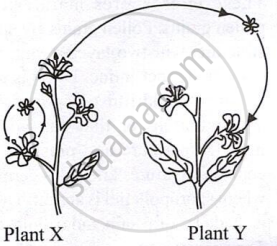
- What is transferred between the plants in the process indicated by arrowA?
- nectar
- nutrients
- pollens
- seeds
- Name the process shown by the arrow B.
- fertilisation
- self-pollination
- cross-pollination
- xenogamy
- If flower of plant X and plant Y are wind pollinated.
- pollens will be sticky
- pollens will be light
- flowers will have fragrance
- pollens are ribbon-like
- Which of the following is a biotic agent that helps in pollination?
- air
- water
- wind
- bats
- The following feature helps in the pollination of water-pollinated flowers.
- fragrant flowers
- feathery stigma
- ribbon-like pollen grains
- bright colours
Read the sources given and answer any four from the questions given below.
| The formation of microspores or pollen grains from a pollen mother cell by meiosis is called microsporogenesis. When the anther is young, a layer of homogenous cells, the sporogenous tissue, occupies the centre of each microsporangium. It is diploid in nature. The sporogenous tissue undergo meiotic divisions to form microspore tetrads (four microspores) which are haploid. These microspores mature to form pollen grains. Pollen grains are spherical structures with two-layered wall: an outer exine and inner intine. Exine is covered by the deposition of sporopollenin, a resistant layer that can withstand high temperature and pressure. Exine contains apertures known as germ pores, where sporopollenin is absent. The intine is made up of pectin and cellulose. |
- The special outer cover of pollen grains has deposition of
- cellulose
- sporopollenin
- exine
- intine
- The formation of pollen grains from pollen mother cell is called
- sporopollenin
- sporogenesis
- homogenesis
- microsporogenesis
- The sporogenous tissueis
- haploid
- diploid
- forms outer layer of microsporangium
- present in microspores
- The places where exine is absent in the pollen grain are called
- intinepore
- germ pore
- stoma
- micropore
- Which of the following undergoes meiotic divisions?
- sporogenous tissue
- microspore tetrads
- microspores
- pollen grains
Read the sources given and answer any four from the questions given below.
| The most important structure formed after double fertilisation is endosperm. Endosperm is triploid in nature and serves for the nourishment of the growing embryo. The cells of this tissue store reserve food materials. Zygote forms the embryo. A dicot embryo consists of embryonal axis with two cotyledons. The portion of embryonal axis which is above the level of cotyledons is the epicotyl. Epicotyl gives rise to plumule or stem tip. The portion below the level of cotyledons is hypocotyl. Hypocotyl terminates at its lower end in the radicle or root tip. The root tip is protected by root cap. Monocots have only single cotyledon. The cotyledon of monocot is known as scutellum. At its lower end, the embryonal axis has the radical and root cap enclosed in an undifferentiated sheath called coleorhiza. The epicotyl has a shoot apex which is enclosed in a hollow structure called coleoptile. |
- Which of the following is not true for the endosperm?
- stores food
- diploid
- triploid
- formed as a result of double fertilisation
- Part of the embryonal axis which is above the level of cotyledons is called
- cotyledon
- epicotyl
- hypocotyl
- embryo
- Нуросotyl has ______ at its lower end.
- radicle
- plumule
- cotyledon
- shoot tip
- The cotyledon in the monocots is known as
- endosperm
- coleoptile
- embryonal axis
- scutellum
- In monocots, the epicotyl is enclosed in the
- coleoptile
- coleorhiza
- root cap
- radicle
B. SUBJECTIVE QUESTIONS I. Very short answer type questions (1 mark)
Which part of the flower is called a microsporophyll?
What is the meaning of a dioecious plant?
If the ovary is half inferior what term is used for the flower?
What kind of arrangement of stamens is present in China rose? What is it called?
What is it called if anthers are united and filaments are free?
Which plant shows tetradynamous conditions of stamens.
What is the meaning of apocarpous condition?
Give one example of apocarpous condition.
What kind of inflorescence does banana have?
What is nucellus?
How many cells does embryosac contain? Name them.
What is another term of embryo sac?
Which cell undergoes mitotic division and forms the eight haploid nuclei?
Which cells are present at the chalazal end?
Name the pollination when pollen of form one flower are deposited on stigma of another flower on the same plant.
What kind of flowers are called cleistogamous flowers?
The term given for wind pollination.
Name the nuclei present in the pollen tube.
Which nucleus produces two male nuclei?
How is endosperm formed?
Name the nuclei that fuse to form the zygote?
What is the function of endosperm?
What is coleoptile?
What are non-endospermic seeds?
Name two endospermic and two nonendospermic seeds.
Name various parts of pericarp.
Name a false fruit and why is it so?
Is coconut a true or false fruit?
What type of fruit is as raspberry?
Why is pineapple called multiple fruit?
What is apomixis?
What is sporophytic budding?
Name the parts that develop from a mature ovule anda mature ovary.
Arrange the following terms in the correct developmental sequence:
Pollen grain, sporogenous tissue, microspore tetrad, pollen mother cell, male gametes.
Explain the role of the tapetum in the formation of the pollen-grain wall.
What is the technique employed to preserve pollen grains for germplasm collection?
In a culture there is a mixture of haploid and diploid cells. It must be because of ______.
generative cells
vegetative cells
anther wall
pollen cells
What kind of flowers are called cleistogamous flowers?
Name the nuclei present in the pollen tube.
Which nucleus produces two male nuclei?
How is endosperm formed?
What is the function of endosperm?
What are non-endospermic seeds?
Name various parts of pericarp.
Name a false fruit and why is it so?
What is apomixis?
What is sporophytic budding?
Arrange the following terms in the correct developmental sequence:
Pollen grain, sporogenous tissue, microspore tetrad, pollen mother cell, male gametes.
Explain the role of the tapetum in the formation of the pollen-grain wall.
Short answer type questions (2 marks)
Which part of a plant is termed as a male gametophyte?
What is sporopollenin?
Name two important layers enclosing a pollen grain.
Which part of a plant is termed as microsporangia.
Which part of a plant is termed as megasporangia.
Which part of a plant is termed as female gametophyte.
How are the eight cells placed in an embryo-sac? Name them.
What is a megaspore?
What is autogamy?
What is geitonogamy?
List two important advantages of geitonogamy.
Give two important adaptations found in anemophilic flowers.
What is entomophily?
What is syngamy?
Name the cells involved in triple fusion.
What is the significance of double fertilisation?
How is cellular endosperm development. different from helobial?
What is a suspensor?
What is the function of suspensor?
What do you understand by the term callus?
Why is the process of fertilisation in a flowering plant referred to as double fertilisation? Explain.
What is pericarp?
What is the site of microsporogenesis?
Give the term for pollination by bats.
Define parthenocarpy. Give one example in which it occurs naturally.
Name the type of cross-pollination found in silk cotton tree respectively.
Name the type of cross-pollination found in Vallisneria respectively.
Coconut palm is monoecious, while date palm is dioecious. Why are they so called?
Explain any two devices by which autogamy is prevented in flowering plants.
Name the type of flower which favours cross-pollination.
Mention the pollinating agent of an inflorescence of small dull coloured flowers with well exposed stamens and large feathery stigma. Give any one characteristic of pollen grains produced by such flowers.
What is the function of meiocytes?
Explain the difference between self-pollination and cross-pollination.
From which part of the ovary does the pericarp of fruit develop?
What is Parthenocarpy?
What do you understand by the term callus?
Banana is a parthenocarpic fruit whereas oranges showpolyembryony. How are they different from each other with respect to seeds?
List various parts of a pericarp of a fruit.
Where is the food stored in a nonendospermic seed?
Why is apple called a false fruit?
What do you understand by the term complete flower?
What is the difference between a bisexual and a unisexual flower?
What do you understand by monoadelphous stamens?
Give one example of monoadelphous stamens.
What is the meaning of epipetalous condition? In which flower and family is it found?
What is the significance of the following plant parts?
- microsores
- male sporophyte and
- female gametophyte
The flower of brinjal is referred to as chasmogamous while that of beans is cleistogamous. How are they different from each other?
The microscopic pollen grains of the past are obtained as fossils. Mention the characteristic of the pollen grains that makes it happen. Name the cells present in a pollen grain.
Draw a well-labelled diagram of a mature ovule, showing its internal structure.
Incompatibility is a natural barrier in the fusion of gametes. How will you explain this statement?
What is agamospermy?
How is agamospermy different from parthenogenesis and parthenocarpy?
Write three post-fertilisation changes leading to the formation of seed.
Give two important adaptations found in anemophilic flowers.
Give two important adaptations found in wind-pollinated flowers.
What is the significance of double fertilisation?
Name the cells involved in triple fusion.
What is the site of microsporogenesis?
Define parthenocarpy. Give one example in which it occurs naturally.
Coconut palm is monoecious, while date palm is dioecious. Why are they so called?
Explain any two devices by which autogamy is prevented in flowering plants.
Name the type of flower which favours cross-pollination.
Explain the difference between self-pollination and cross-pollination.
Differentiate between wind and insect-pollinated flowers.
Differentiate between the following:
Vegetative and generative cell
Differentiate between apocarpous ovary and syncarpous ovary.
Differentiate between autogamy and geitonogamy.
Differentiate between microsporogenesis and megasporogenesis.
Differentiate between hypocotyl and epicotyl.
Differentiate between the following:
Maize seed and gram seed
Differences between racemose and cymose inflorescence.
Differentiate between true and false fruits.
Long answer type questions (5 marks)
Explain the development of the male gemetophyte in plants.
Explain the development of a pollen grain in the anther.
Discuss the development of an ovule till the formation of an embryo-sac.
Pollination is an important phenomenon in the life cycle of a flowering plant. Describe the agencies responsible for it.
What modifications do plants have for hydrophily?
What modifications do plants have for entomophily?
What modifications do plants have for anemophily?
What modifications do plants have for cross-pollination?
Write a note on the need and significance of pollination in plants.
Describe the structure of a pollen grain and the process of its germination.
Write an essay on the development of female gametophyte. Illustrate the answer with suitable diagrams.
Draw a well-labelled diagram of a mature ovule, showing its internal structure.
Describe the structure of a typical monosporic embryo-sac found in flowering plants.
What do you understand by the development of an embryo?
Write a note on the development of endosperm. Mention the types with examples.
Incompatibility is a natural barrier in the fusion of gametes. How will you explain this statement?
Describe in brief the various special modes of reproduction. Mention their economic significance.
Trace the development of embryo after syngamy in a dicot plant.
Trace the development of a mature ovule from a megaspore mother cell.
Draw a diagram of the transverse section of an angiospermic anther. Label any six parts.
Describe the structure of a typical monosporic embryo-sac found in flowering plants.
Draw labelled diagram:
T.S. of bilobec anther
Draw labelled diagram:
Internal structure of pollen grain
What is double fertilisation?
Write three post-fertilisation changes leading to the formation of seed.
Differentiate between monoecious and dioecious plants.
Explain the difference between self-pollination and cross-pollination.
Draw a labelled diagram of the longitudinal section of a pistil showing pollen germination.
What is double fertilisation? Explain.
Give advantages of self-pollination.
What is agamospermy?
How is agamospermy different from parthenogenesis and parthenocarpy?
Draw the diagram of a monocot embryo and label the position of scutellum, coleorrhiza and root cap.
Draw a labelled diagram of the sectional view of a mature pollen grain in angiospenns. Explain the functions of its different parts.
Draw a diagrammatic sketch of a sectional view of a typical anatropous ovule.
List the components of embryo sac and mention their fate after fertilization.
Draw a labelled diagram of a fertilised embryo-sac of an angiosperm.
Describe the stages in embryo development in a dicot plant.
Endosperm development precedes embryo development. Justify.
Draw a diagram of a mature dicot embryo and label cotyledons, plumule, radicle and hypocotyl in it.
How does the pollen mother cell develop into a mature pollen grain? Illustrate the stages with labelled diagrams.
Draw a vertical section of a maize grain and label pericarp, scutellum, coleoptile and radicle.
Draw a labeled diagram of a mature embryo sac.
Why does a pollen grain possess two male gametes? Explain.
Name the cell from which the endosperm of coconut develops.
Give the characteristic features of the endosperm of coconut.
E. BOARD QUESTIONS - 1 mark
The flowers which open their petals to expose their reproductive parts to allow pollination are called ______.
Cleistogamous
Geitonogamous
Chasmogamous
Autogamous
Define Parthenocarpy.
Pollen grains of wind-pollinated flowers are produced in large quantities.
Define perisperm.
Give a term for the following:
Fusion of male gamete and secondary nucleus in angiosperms.
2 marks
State four features of flowers pollinated by insects.
Briefly discuss any two methods by which plants avoid self-pollination.
3 marks
Describe the process of double fertilisation in angiosperms.
Give any four points of significance of double fertilization.
Draw a neat labelled diagram of L.S. of anatropous ovule.
Solutions for 2: Sexual Reproduction in Flowering Plants
Sarita Aggarwal solutions for Biology [English] Class 12 ISC chapter 2 - Sexual Reproduction in Flowering Plants
Shaalaa.com has the CISCE Mathematics Biology [English] Class 12 ISC CISCE solutions in a manner that help students grasp basic concepts better and faster. The detailed, step-by-step solutions will help you understand the concepts better and clarify any confusion. Sarita Aggarwal solutions for Mathematics Biology [English] Class 12 ISC CISCE 2 (Sexual Reproduction in Flowering Plants) include all questions with answers and detailed explanations. This will clear students' doubts about questions and improve their application skills while preparing for board exams.
Further, we at Shaalaa.com provide such solutions so students can prepare for written exams. Sarita Aggarwal textbook solutions can be a core help for self-study and provide excellent self-help guidance for students.
Concepts covered in Biology [English] Class 12 ISC chapter 2 Sexual Reproduction in Flowering Plants are .
Using Sarita Aggarwal Biology [English] Class 12 ISC solutions Sexual Reproduction in Flowering Plants exercise by students is an easy way to prepare for the exams, as they involve solutions arranged chapter-wise and also page-wise. The questions involved in Sarita Aggarwal Solutions are essential questions that can be asked in the final exam. Maximum CISCE Biology [English] Class 12 ISC students prefer Sarita Aggarwal Textbook Solutions to score more in exams.
Get the free view of Chapter 2, Sexual Reproduction in Flowering Plants Biology [English] Class 12 ISC additional questions for Mathematics Biology [English] Class 12 ISC CISCE, and you can use Shaalaa.com to keep it handy for your exam preparation.
