Advertisements
Chapters
1: Reproduction in Organisms
2: Sexual Reproduction in Flowering Plants
3: Human Reproduction
▶ 4: Reproductive Health-Problems and Strategies
Unit 2 – Genetics and Evolution
5: Principles of Inheritance and Variation
6: Chromosomes, Sex-Linked Inheritance and Human Genetic Disorders
Chapter 7: Molecular Basis of Inheritance
Chapter 8: Evolution-Origin of Life
Chapter 9: Theory of Evolution and Evolution of Man
Unit 3 – Biology and Human Welfare
Chapter 10: Human Health and Diseases
Chapter 11: Adolescent Issues: Alcoholism and Drugs
Chapter 12: Animal Breeding for Improvement in Food Production
Chapter 13: Plant Breeding to Enhance Food Production
Chapter 14: Microbes in Human Welfare
Unit 4 – Biotechnology
Chapter 15: Biotechnology: Principles and Processes
Chapter 16: Biotechnology and Its Applications
Unit 5 – Ecology and Environment
Chapter 17: Organisms and Populations
Chapter 18: Ecosystem
Chapter 19: Biodiversity and Conservation
Chapter 20: Environmental Issues
![Sarita Aggarwal solutions for Biology [English] Class 12 ISC chapter 4 - Reproductive Health-Problems and Strategies - Shaalaa.com](/images/biology-english-class-12-isc_6:65d11b7ee3eb4277bbdac77874c6c42a.jpg "Sarita Aggarwal solutions for Biology [English] Class 12 ISC chapter 4 - Reproductive Health-Problems and Strategies")
Advertisements
Solutions for Chapter 4: Reproductive Health-Problems and Strategies
Below listed, you can find solutions for Chapter 4 of CISCE Sarita Aggarwal for Biology [English] Class 12 ISC.
Sarita Aggarwal solutions for Biology [English] Class 12 ISC 4 Reproductive Health-Problems and Strategies EXERCISES [Pages 200 - 212]
A. OBJECTIVE QUESTIONS I. Multiple choice questions Choose the correct answer:
Which one of the following is an IUCD?
Copper – T
Oral pills
Diaphragm
Tubectomy
The sterilisation in males is performed surgically by ______.
tubectomy
vasectomy
contraceptives
chemicals
Which of the following is not a sexually transmitted disease?
syphilis
AIDS
gonorrhoea
tuberculosis
In vitro fertilisation or test tube babies technique involves ______.
fertilisation outside the female body
development of foetus in the test tube
both (i) and (ii)
none of the above
Human population was estimated to be 7.9 billion in ______.
2000
2005
2021
2015
Certain characteristic demographic features of developing countries are ______.
high fertility, rapid mortality rate and a very young age distribution
high infant mortality rate, low fertility and a very young age distribution
high mortality, high fertility and a very old age distribution
high fertility, falling mortality rate, and a very young age distribution
Which of the following birth control measures can be considered as the safest?
The rhythm method
The use of physical barriers
Termination of unwanted pregnancy
Sterilisation techniques
Consider the statements given below regarding contraception and answer as directed thereafter.
- Medical Termination of Pregnancy (MTP) during first trimester is generally safe
- Generally, chances of conception are nil until mother breast-feeds the infant up to two year
- Intrauterine devices like copper-T are effective contraceptives
- Contraception pills may be taken up to one week after coitus to prevent
B, C
C, D
A, C
A, B
The following statement is true of IUI technique.
Ovum is fertilised outside the female body.
Embryo at 8-cell stage is transferred to the uterus.
Semen from a healthy donor is introduced into the uterus.
Sperm is directly injected into the ovum.
Amniocentesis is a technique which is used to ______.
detect the chromosomal abnormality in the foetus.
detect the physical defect of the child.
detect infertility.
detect blood group of foetus.
Fill in the blanks
Copper T is an example of an ______ device.
The popular sign of family planning is ______.
______ is a surgical method in males as a contraceptive method.
______ is the scientific study of human population.
Oral pills contain small doses of ______ combinations to avoid pregnancy.
MTP is considered to be a safe method up to ______ weeks of pregnancy.
Another name for veneral diseases is ______.
In ______ technique the zygote or early embryos are transferred into the fallopian tube.
In ______ fertilisation the fusion of gametes occurs outside the body.
The term ICSI is an abbreviated form of ______.
State whether the following is true or false.
Lactational amenorrhoea is when a baby is breast fed by the mother, chances of conception are minimal.
State whether the following is true or false.
Oral contraceptive pills need to be taken for at least 27 days in a month without a break.
State whether the following is true or false.
IUD devices block the transport of gametes.
State whether the following is true or false.
Biologically, it is the gametes from father that determine the sex of a child and not the mother.
State whether the following is true or false.
Syphilis is caused by a protozoan and causes sores and lesions in the genital tract.
Match the following.
| Column A | Column B |
|---|---|
| 1. Progestasert | (a) STD |
| 2. IUI | (b) IUD |
| 3. IVF | (c) Artificial insemination |
| 4. HIV | (d) Test tube baby |
Answer the following in one or two words.
A method of fertility control in males by tying of vas deferens.
Answer the following in one or two words.
A type of intrauterine device for birth control.
Answer the following in one or two words.
A method of tying of fallopian tubes in females for birth control.
Answer the following in one or two words.
A technique in which amniotic fluid surrounding the foetus is withdrawn to detect certain chromosomal disorders.
Answer the following in one or two words.
A disease that destroys the immune system and is an STD.
Answer the following in one or two words.
A scientific term for induced abortion.
Answer the following in one or two words.
A barrier method used by males to prevent conception in females.
Answer the following in one or two words.
A technique by which ‘the babies formed are called test tube babies'.
Answer the following in one or two words.
Highly infectious diseases that spread from one person to another by sexual contact.
Answer the following in one or two words.
Estimated world population in 2021.
In the questions given below, there are two statements marked as Assertion (A) and Reason (R). Read the statements and choose the correct option.
Assertion (A): Family planning is a programme to achieve total reproductive health among people.
Reason (R): RCH programmes create awareness among people about STD, AIDS, adolescence and related changes.
Both assertion (A) and reason (R) are true, and reason is the correct explanation of assertion.
Both assertion (A) and reason (R) are true, but reason is not the correct explanation of assertion.
Assertion (A) is true but reason (R) is false.
Both assertion (A) and reason (R) are false.
Assertion (A): Amniocentesis is often misused.
Reason (R): Amniocentesis is meant for determining the genetic disorders in the foetus, but it is being used to determine the sex of the foetus, leading to death of the normal female foetus.
Both assertion (A) and reason (R) are true, and reason is the correct explanation of assertion.
Both assertion (A) and reason (R) are true, but reason is not the correct explanation of assertion.
Assertion (A) is true but reason (R) is false.
Both assertion (A) and reason (R) are false.
Assertion (A): A pill called ‘Saheli', a new oral contraceptive pill for the females, contains Saheli-a nonsteroidal preparation.
Reason (R): This pill blocks the transport of ova and prevents fertilisation.
Both assertion (A) and reason (R) are true, and reason is the correct explanation of assertion.
Both assertion (A) and reason (R) are true, but reason is not the correct explanation of assertion.
Assertion (A) is true but reason (R) is false.
Both assertion (A) and reason (R) are false.
Assertion (A): There is a chance of fertilisation during 10-17 days of the menstrual cycle.
Reason (R): Ovulation occurs during the middle of a menstrual cycle.
Both assertion (A) and reason (R) are true, and reason is the correct explanation of assertion.
Both assertion (A) and reason (R) are true, but reason is not the correct explanation of assertion.
Assertion (A) is true but reason (R) is false.
Both assertion (A) and reason (R) are false.
Assertion (A): Barrier methods prevent physical meeting of sperms and ova.
Reason (R): Barrier methods prevent conception.
Both assertion (A) and reason (R) are true, and reason is the correct explanation of assertion.
Both assertion (A) and reason (R) are true, but reason is not the correct explanation of assertion.
Assertion (A) is true but reason (R) is false.
Both assertion (A) and reason (R) are false.
Assertion (A): Copper-T is a contraceptive device in human females.
Reason (R): Copper-T blocks fertilisation of egg in the fallopian tubes.
Both assertion (A) and reason (R) are true, and reason is the correct explanation of assertion.
Both assertion (A) and reason (R) are true, but reason is not the correct explanation of assertion.
Assertion (A) is true but reason (R) is false.
Both assertion (A) and reason (R) are false.
Assertion (A): HIV infection can be avoided by use of condoms.
Reason (R): Condoms secrete antiviral interferons.
Both assertion (A) and reason (R) are true, and reason is the correct explanation of assertion.
Both assertion (A) and reason (R) are true, but reason is not the correct explanation of assertion.
Assertion (A) is true but reason (R) is false.
Both assertion (A) and reason (R) are false.
Assertion (A): Tubectomy prevents ova from reaching the uterus.
Reason (R): Vasectomy prevents sperms from entering the urethra.
Both assertion (A) and reason (R) are true, and reason is the correct explanation of assertion.
Both assertion (A) and reason (R) are true, but reason is not the correct explanation of assertion.
Assertion (A) is true but reason (R) is false.
Both assertion (A) and reason (R) are false.
Assertion (A): In zygote intra fallopian transfer (ZIFT), the zygote is transferred to the fallopian tubes of the female.
Reason (R): ZIFT is an in vivo fertilisation method.
Both assertion (A) and reason (R) are true, and reason is the correct explanation of assertion.
Both assertion (A) and reason (R) are true, but reason is not the correct explanation of assertion.
Assertion (A) is true but reason (R) is false.
Both assertion (A) and reason (R) are false.
Assertion (A): Intra cytoplasmic sperm injection (ICSI) is a procedure to form an embryo in vitro.
Reason (R): Sperm is directly injected into the ovum in the laboratory.
Both assertion (A) and reason (R) are true, and reason is the correct explanation of assertion.
Both assertion (A) and reason (R) are true, but reason is not the correct explanation of assertion.
Assertion (A) is true but reason (R) is false.
Both assertion (A) and reason (R) are false.
Read the sources given and answer any four from the questions given below:
| For the good health of females and to control overpopulation, a number of scientific methods are advised for birth control. These include barrier, chemical and surgical methods. Barrier methods prevent ovum and sperm to physically meet by putting a barrier between them. These include physical devices like condoms in males and diaphragms in females. Chemical methods can be by use of pills or intrauterine contraceptive devices (IUCD) like copper T which releases copper that prevents implantation of ovum in uterus. The surgical methods like vasectomy and tubectomy block the transport of gametes. Vasectomy is performed in males. It is cutting and tying of vas deferens to prevent sperms to reach urethra. Tubectomy is performed in females. It is cutting and tying of fallopian tubes to prevent eggs to reach the uterus. |
- Which of the following is an IUCD?
- copper T
- pills
- diaphragm
- tubectomy
- The technique used to block the transport of eggs to reach uterus is
- tubectomy
- vasectomy
- pills
- diaphragm
- The following technique prevents the implantation of ovum in uterus.
- pills
- copper-T
- condom
- tubectomy
- Vasectomy is a surgical method involving the
- tying of fallopian tubes
- removal of ovaries
- tying of vas deferens
- removal of testis
- Condoms and diaphragms are birth control methods which
- release chemicals
- implanted in the body
- prevent physical meeting of sperm and ova
- block formation of gametes
Read the sources given and answer any four from the questions given below:
| The couples can be assisted to have children by certain special techniques called assisted reproductive technologies (ART). ART includes a number of technologies. In vitro fertilisation (IVF) or test tube babies is a technique in which the ovum is fertilised using a donor sperm outside the body and the fertilised ovum is implanted in the uterus of female for further development. Test tube babies, as the name suggests are not reared in test tubes. Test tube fertilisation is a delicate surgery where the ova from a female are removed under aseptic conditions and fertilised externally with the sperm in the laboratory. The zygote or early embryos with up to 8 blastomeres are transferred into the fallopian tube called zygote intra fallopian transfer (ZIFT) or the embryos with more than 8 blastomeres are transferred into uterus called intrauterine transfer (IUT). Intra uterine insemination (IUI), is another technique in which the semen collected from the husband or donor is artificially introduced into either the vagina or uterus of the female. Gamete intra fallopian transfer (GIFT) is another method in which an ovum is collected from a female donor and transferred to fallopian tube of another female who cannot produce ovum but can provide environment for fertilisation and further development of the foetus. |
- IUI is a technique in which
- fertilisation occurs in a test tube
- fertilisation occurs in the fallopian tubes
- blastomere stage is implanted in the uterus
- zygote is transferred to fallopian tubes
- 'In vitro' fertilisation means
- development of foetus occurs in a lab
- fertilisation occurs in fallopian tubes in female
- intrauterine insemination method is used
- ovum is fertilised outside the body
- Test tube babies is a technique in which
- development of foetus occurs in a test tube
- embryo is formed in the fallopian tube
- embryo up to 8 blastomere stage is formed in a test tub
- foetus is formed in a test tube
- Which of the following statements is true for GIFT?
- ovum from donor female is transferred to another female
- fertilisation is done in test tube
- embryo is implanted in uterus
- zygote is transferred to uterus
- ZIFT is a kind of ART in which
- zygote is transferred to the uterus
- zygote is transferred to the fallopian tube
- zygote is implanted in the uterus
- zygote is formed in the fallopian tube
Read the sources given and answer any four from the questions given below:
| Amniocentesis is a prenatal diagnostic technique in which a sample of amniotic fluid is taken from the uterus of a pregnant women to detect the early development of foetus. Amniotic fluid surrounds the foetus in the womb. It protects the foetus and acts as a shock absorber. This fluid contains some of the foetal cells and is used to find out if your baby has any genetic abnormalities. This type of amniocentesis is usually performed in the second trimester, typically between 11 and 15 weeks. A small amount of amniotic fluid is collected by using a long, thin needle. This fluid surrounds and protects the foetus while in the womb. The benefits of amniocentesis are the diagnosis of chromosomal abnormalities and developmental disorders of foetus like thalassemia, sickle cell anaemia, Down's syndrome, spina bifida and cystic fibrosis. However, it is being misused for sex determination of foetus that leads to female foeticides. Therefore, there is a statutory ban on amniocentesis for sex determination so as to keep a check on the female foeticides. |
- Which is the recommended time to perform amniocentesis?
- 8-11 weeks
- 11-15 weeks
- 14-17 weeks
- 16-18 weeks
- The technique used in amniocentesis is to
- study foetal cells from amniotic fluid
- study maternal cells from amniotic fluid
- study placental cells
- study the foetal cells from uterus
- Which of the following diseases cannot be detected by amniocentesis?
- Thalassemia
- Down's syndrome
- German measles
- cystic fibrosis
- Amniocentesis is banned unless advised by the doctor or necessary, because
- it uses amniotic fluid
- it is misused for sex determination
- it can cause genetic abnormality
- it can cause Down's syndrome
- The function of amniotic fluid is to
- provide oxygen
- remove wastes
- act as a shock absorber
- remove carbon dioxide
B. SUBJECTIVE QUESTIONS I. Very short answer type questions (1 mark)
According to the 2021 census report what is the population growth rate of India?
Which type of contraceptive is considered to be an ideal contractive?
Name any three natural methods of contraception.
What is the principle of contraception through barrier method?
Name one barrier method used by males.
Name one barrier method used by females.
How do oral pills help in preventing conception?
Name two irreversible contraceptive techniques.
How do surgical methods help to prevent conception?
Vasectomy is performed on which part of the body?
Name a contraceptive device that prevent implantation of ovum.
Short answer type questions (2 marks)
What would be the basic intention to encourage each couple to restrict to have two children only?
Name two contraceptive methods that prevent fusion of gametes.
How does copper-T prevent pregnancy?
Expand the following abbreviation:
IUCD
Expand the following:
ZIFT
Define the technique of IVF.
What is amniocentesis?
What is the meaning of the term homogametic?
Why are males said to be heterogametic?
List three important symptoms of AIDS.
Which organisms cause syphilis?
Which organisms cause AIDS?
III. Short answer type questions (3 marks)
What is the full form of RCH?
Name three important strategies for successful implementation of RCH program.
Give three important reasons for the decline in the death rate in last two decades.
Explain three contraceptive methods that help in family planning.
Give three ways of contraception that prevent fusion of gametes or fertilisation.
Name and explain two sterilisation techniques used to prevent conception.
What is amniocentesis?
In which type of diagnosis does amniocentesis help?
Name three STDs. Give their causative organisms and two important symptoms of each.
What is the need for assisted reproductive strategies?
What is the principle behind ZIFT?
What is the principle behind GIFT?
Give three important reasons of infertility. Name three techniques that can help in such circumstances.
Is a female responsible for sex of the child? Justify your answer.
Distinguish between the following pair:
Tubectomy and Vasectomy.
Differentiate between the following:
IVF and GIFT
Compare GIFT with ICSI.
Differentiate between the following:
IUI and ZIFT
What do you understand by reproductive health?
Name the programmes that have been initiated in India. In which ways do these programmes help people.
What is demography?
What has been the impact of population explosion in the world?
Give some reasons for decline in death rate.
What are the advantages of a small family?
What is the need for birth control methods?
Name some effective contraceptive methods.
How are barrier methods different from surgical methods?
What is the need for assisted reproductive strategies?
Explain the basis of the following technique:
IVF
Explain the basis of the following technique:
ZIFT
Explain the basis of the following technique:
ICSI
Explain the basis of the following technique:
IUI
Why is increased food production only a temporary solution for growing population?
Name various ways the rate of population can be controlled. Explain any three mechanisms.
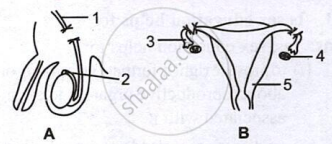
(i) Label the parts 1-5.
(ii) What does diagram A depict?
(iii) What does diagram B depict?
(iv) State one function each of parts 2 and 5.
E. BOARD QUESTIONS 1 mark
The pathogen which causes Syphilis ______.
Neisseria
Chlamydia
Treponema
Papilloma virus
Expand the following:
IUI
Give a term for the following:
An ART in which eggs are removed from the ovary of the female, fertilised and then placed in her fallopian tube.
2 marks
What is reproductive fitness? Explain it with the help of an example.
Define amniocentesis.
Give the role of amniocentesis.
Name the causative agent of gonorrhea.
Give any one a symptom of gonorrhea.
Give four causes of infertility in males.
5 marksS
According to a survey conducted by the Government of India in the year 1950, the population of the country was 350 million. In the next survey conducted in the year 2010, the population had reached above 1000 million.
- List any two reasons for this rise in the population.
- Suggest any two steps which should be taken by the Government to control this rise.
- How does the population explosion affect the growth of a country?
- What is the difference between the natural and artificial contraceptive methods? Give one example of each method.
Solutions for 4: Reproductive Health-Problems and Strategies
Sarita Aggarwal solutions for Biology [English] Class 12 ISC chapter 4 - Reproductive Health-Problems and Strategies
Shaalaa.com has the CISCE Mathematics Biology [English] Class 12 ISC CISCE solutions in a manner that help students grasp basic concepts better and faster. The detailed, step-by-step solutions will help you understand the concepts better and clarify any confusion. Sarita Aggarwal solutions for Mathematics Biology [English] Class 12 ISC CISCE 4 (Reproductive Health-Problems and Strategies) include all questions with answers and detailed explanations. This will clear students' doubts about questions and improve their application skills while preparing for board exams.
Further, we at Shaalaa.com provide such solutions so students can prepare for written exams. Sarita Aggarwal textbook solutions can be a core help for self-study and provide excellent self-help guidance for students.
Concepts covered in Biology [English] Class 12 ISC chapter 4 Reproductive Health-Problems and Strategies are .
Using Sarita Aggarwal Biology [English] Class 12 ISC solutions Reproductive Health-Problems and Strategies exercise by students is an easy way to prepare for the exams, as they involve solutions arranged chapter-wise and also page-wise. The questions involved in Sarita Aggarwal Solutions are essential questions that can be asked in the final exam. Maximum CISCE Biology [English] Class 12 ISC students prefer Sarita Aggarwal Textbook Solutions to score more in exams.
Get the free view of Chapter 4, Reproductive Health-Problems and Strategies Biology [English] Class 12 ISC additional questions for Mathematics Biology [English] Class 12 ISC CISCE, and you can use Shaalaa.com to keep it handy for your exam preparation.
