Advertisements
Advertisements
Questions
Name and explain the technique used for separating DNA fragments and making them available for biotechnology experiments.
Name and describe the technique that helps in the separation and isolation of DNA fragments.
Advertisements
Solution
Gel electrophoresis is a technique which is used for separating DNA fragments in a gel on the basis of their electric charge and size.
The process of gel electrophoresis is as follows:
-
The fragments obtained after cutting with restriction enzymes are separated by using gel electrophoresis.
-
Electric field is applied to the agarose gel matrix and the negatively-charged DNA fragments move towards the anode.
-
Fragments separate according to their size by the sieving properties of agarose gel. The smaller the fragment, the farther it moves.
-
Staining dyes such as ethidium bromide, upon exposure to UV radiation, are used to visualise the DNA fragments.
-
DNA fragments are visible as bright orange-coloured bands in the agarose matrix.
- These bands are cut from the agarose gel and extracted from the gel piece (elution).
- DNA fragments are purified and used in constructing recombinant DNAs

APPEARS IN
RELATED QUESTIONS
Retroviruses have no DNA. However, the DNA of the infected host cell does possess viral DNA. How is it possible?
What would be the molar concentration of human DNA in a human cell?
Name the most commonly used bioreactor and describe its working.
Explain the mechanism of action of restriction endonucleases that makes them suitable for genetic engineering.
In vitro amplification of DNA or RNA segment is known as ___________.
Define biotechnology? Which are the basic principles and process of biotechnology?
What is PCR? Explain different steps involved in it.
In which of the following techniques, charged molecules (DNA, RNA and Proteins) are separated by applying the electric field?
Human insulin is produced by culturing the genetically engineered ______
Nucleic acid segment tagged with a radioactive molecule is called ______.
The most important feature in a plasmid to serve as a vector in gene cloning experiment is ______.
Cloning of genes, play a very significant role in genetic engineering, helping the transfer of desirable foreign genes into different hosts. The scientists, to make this process easier and effective are creating engineered vectors in such a way that they help easy linking of foreign DNA and selection of recombinants from non-recombinants. 'pBR322' is one such engineered vectors developed by scientists. A diagram of an engineered vector pBR322 is given below:

- Name the host for this cloning vector.
- Identify 'Rop' and 'Ori' in the diagram from 'U', 'V', 'W', 'X', 'Y' and 'Z'. Write their functions.
- Draw the fragments that will be formed by the action of 'Z' (marked in the diagram) on the specific site of the DNA segment given below:
5' --- GTACGAATCCTGA --- 3'
3' --- CATGCTTAGGACT --- 3'
The given figure is the diagrammatic representation of the E. coli vector pBR322. Which one of the given options correctly indentites its certain component(s)?
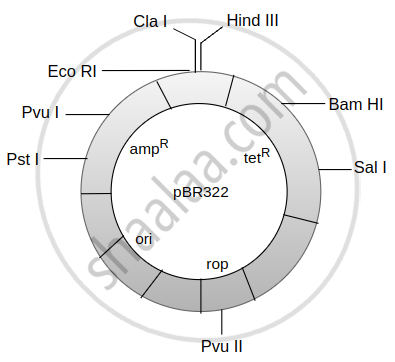
Which of these are most widely used in genetic engineering?
______technique is used for in vitro gene cloning or gene multiplication.
Name the enzymes that are called molecular scissors.
How many sets of primers are required in each cycle of PCR?
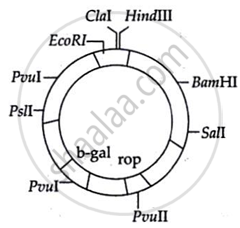
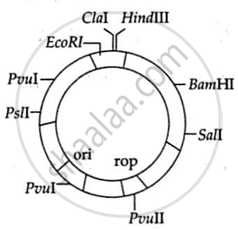
Suneeta is planning an experiment to clone a gene in a vector. So, she has to choose a good cloning vector.
Which one of the vectors shown below should she choose? Justify your answer by giving two reasons.
 |
 |
 |
| Vector A | Vector B | Vector C |
The manipulation of genetic material towards a desired end using "in-vitro" process is called______.
