Advertisements
Advertisements
Question
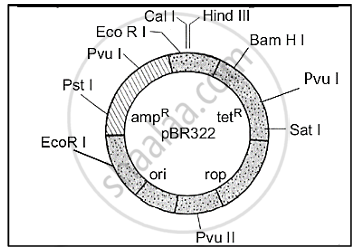
Study the diagram given below and answer the questions that follow.

- Name the cloning vector shown above. In which organism in this cloning vector inserted?
-
Mention any two restriction sites shown in the diagram.
- Name any two selectable markers shown in the diagram.
Advertisements
Solution
- The given cloning vector is called pBR322 and it is inserted into E. coli bacteria.
- In the image shown, the two restriction sites are Hind III and Bam H I.
- The selectable markers in the cloning vector pBR322 include ampicillin and tetracycline resistance genes.
APPEARS IN
RELATED QUESTIONS
Write a short note on Electrophoresis.
Enlist different types of restriction enzymes commonly used in rDNA technology? Write about their role.
ECoRI is obtained from ______.
What is plasmid?
Match the List I with List II and List ill. Select the correct option.
| List I | List II | List ill | |||
| i. | Hind III | a. | Agarose ge | 1. | Six base pairs |
| ii. | pBR322 | b. | Agrobacterium | 2. | Selectable marke |
| iii. | T-DNA | c. | Ampicillin | 3. | Elution |
| iv. | DNA | d. | Recognition sequenc | 4. | Transgenic plant |
From which of the following organisms the enzyme Taq polymerase used in PCR technique is obtained?
Name a recombinant vaccine that is currently being used in vaccination programme.
Which vector is mostly used in rDNA technology in plants?
How many sets of primers are required in each cycle of PCR?
Give a reason for the following:
The diagram given below represents vector pBr322 which was modified by a research scholar Dr. Rayon, but the vector was rejected by his guide.