Advertisements
Advertisements
Question
Distinguish between plasmid DNA and chromosomal DNA.
Advertisements
Solution
| Sr. no. | Plasmid DNA | Chromosomal DNA |
| 1. | Plasmids are circular external DNA that is self-replicating and are naturally found in bacteria and yeast. | Chromosomal DNA sequence, including recognition site, is present in the chromosomes of all organisms. |
| 2. | It is not necessary for normal growth and division. | This is necessary for growth and division. |
| 3. | It contains information about some properties of the cell. | It contains information about all the properties. |
APPEARS IN
RELATED QUESTIONS
State the role of DNA ligase in biotechnology.
What would be the molar concentration of human DNA in a human cell?
What are the restriction endonucleases? Give the rules of their nomenclature.
The bacterium which causes a plant disease called crown gall is _______________.
The recognition sequence of restriction enzymes is generally ______ nucleotide long.
Explain the properties of a good or ideal cloning vector for rDNA technology.
Enlist and write in brief about the different biological tools required in rDNA technology.
The technique which involves addition or deletion of genes is ______.
Alu-I is obtained from which organism?
Identify the characters that a cloning vector should possess.
i. Origin of replication (Ori)
ii. Ability to destroy the alien DNA
ii. Cloning site to link the alien DNA
iv. The tumour inducing plasmid Ti
v. Selectable marker
vi. Low molecular weight
Identify the CORRECT sequence of steps in PCR.
Match the Column I (Restriction enzyme) with Column II (Recognition sequence) and select the correct option.
| column I (Restriction Enzyme) | column II (Recognition sequence) | ||
| i. | Alu | P. | 5'---G- ↓-G-A-T-C-C---3' 3'---C-C-T-A-G- -G---5 |
| ii. | BamHI | Q. | 5'--- A-G- ↓ -C-T---3' 3' ---T-C- G-A--- 5' |
| iii. | Eco RI | R. | 5'--G-T-C- ↓ -G-A-C--3' I 3'--C-A-G-t-C-T-G--5' |
| iv. | HindII | S. | 5'---G- ↓ -A-A-T-T-C---3' 3'---C-T-T-A-A- -G---5' |
Identify the properties that a cloning vector must possess to be efficiently used in rDNA technology.
- Control elements like promoter, operator, ribosomal binding sites
- Restriction sites
- Marker genes
- Ori of replication
- Ability to replicate independently
In which of the following techniques, charged molecules (DNA, RNA and Proteins) are separated by applying the electric field?
Match the column I (PCR steps) and Column II (Temperature). Select the correct option.
| Column I (PCR steps) | Column II (Temperature) | ||
| i. | Polymerization | P. | 40 - 60°C |
| ii. | Denaturation | Q. | 70 - 75°C |
| iii. | Primer annealing | R. | 90 - 98°C |
| S. | 28 - 37°C |
Which one is a true statement regarding DNA polymerase used in PCR?
DNA fingerprinting refers to ______.
Annealing step of PCR operates at ______ °C.
Which of the following is the correct recognition sequence of restriction enzyme Eco RI?
Name two restriction enzymes used in PCR.
The given figure is the diagrammatic representation of the E. coli vector pBR322. Which one of the given options correctly indentites its certain component(s)?
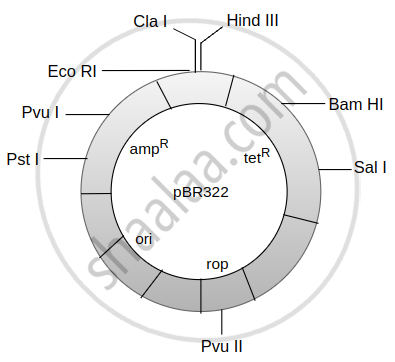
Which of these are most widely used in genetic engineering?
How gene amplification is done?
Write steps involved in gene amplification.
Tissue plasminogen activator and urokinase are used in the treatment of ______.
Which amino acid is coded by the initiation codon?
Give a reason for the following:
DNA cannot enter directly into the host cell.
Suneeta is planning an experiment to clone a gene in a vector. So, she has to choose a good cloning vector.
Which one of the vectors shown below should she choose? Justify your answer by giving two reasons.
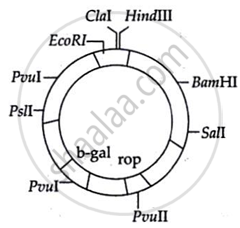 |
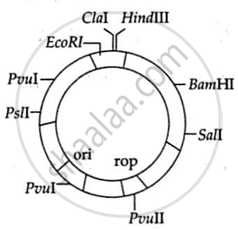 |
 |
| Vector A | Vector B | Vector C |
The restriction enzymes used as molecular scissors are type of ______.
What is the relationship between alien DNA and the origin of replication in the concept of cloning?
