Advertisements
Online Mock Tests
Chapters
2: Polynomials
3: Pair of Linear Equations in Two Variables
4: Quadratic Equations
5: Arithmetic Progressions
6: Co-ordinate Geometry
7: Triangles
8: Circles
9: Constructions
10: Trigonometric Ratios
11: Trigonometric Identities
12: Heights and Distances
13: Areas Related to Circles
14: Surface Areas and Volumes
15: Statistics
▶ 16: Probability
![R.D. Sharma solutions for Mathematics [English] Class 10 chapter 16 - Probability - Shaalaa.com](/images/mathematics-english-class-10_6:df8cedf76b7f4149972b35ec991c0c9d.jpg "R.D. Sharma solutions for Mathematics [English] Class 10 chapter 16 - Probability")
Advertisements
Solutions for Chapter 16: Probability
Below listed, you can find solutions for Chapter 16 of CBSE, Karnataka Board R.D. Sharma for Mathematics [English] Class 10.
R.D. Sharma solutions for Mathematics [English] Class 10 16 Probability EXERCISE 16.1 [Pages 16.19 - 16.23]
BASIC
The probability that it will rain tomorrow is 0.85. What is the probability that it will not rain tomorrow?
A die is thrown. Find the probability of getting a prime number.
A die is thrown. Find the probability of getting 2 or 4
A die is thrown. Find the probability of getting a multiple of 2 or 3
A die is thrown. Find the probability of getting:
an even prime number
A die is thrown. Find the probability of getting a number greater than 5
A die is thrown once. Find the probability of getting a number lying between 2 and 6.
A die is thrown once. Find the probability of getting a composite number
A box contains 20 cards numbered from 1 to 20. A card is drawn at random from the box. Find the probability that the number on the drawn card is divisible by 2 or 3
A box contains 20 cards numbered from 1 to 20. A card is drawn at random from the box. Find the probability that the number on the drawn card is a prime number
A bag contains 3 red balls, 5 black balls and 4 white balls. A ball is drawn at random from the bag. What is the probability that the ball drawn is White
A bag contains 3 red balls, 5 black balls and 4 white balls. A ball is drawn at random from the bag. What is the probability that the ball drawn is Red
A bag contains 3 red balls, 5 black balls and 4 white balls. A ball is drawn at random from the bag. What is the probability that the ball drawn is Black
A bag contains 3 red balls, 5 black balls and 4 white balls. A ball is drawn at random from the bag. What is the probability that the ball drawn is Not red
A bag contains cards numbered from 1 to 49. A card is drawn from the bag at random, after mixing the card thoroughly. Find the probability that the number on the drawn card is an odd number
A bag contains cards numbered from 1 to 49. A card is drawn from the bag at random, after mixing the card thoroughly. Find the probability that the number on the drawn card is a multiple of 5
A bag contains cards numbered from 1 to 49. A card is drawn from the bag at random, after mixing the card thoroughly. Find the probability that the number on the drawn card is a perfect square
A bag contains cards numbered from 1 to 49. A card is drawn from the bag at random, after mixing the card thoroughly. Find the probability that the number on the drawn card is an even prime number
A piggy bank contains hundred 50 paise coins, fifity ₹1 coins, twenty ₹2 coins and ten ₹5 coins. If it is equally likely that one of the coins will fall out when the bank is turned upside down, find the probability that the coin which fell will be a 50 paise coin
A piggy bank contains hundred 50 paise coins, fifity ₹1 coins, twenty ₹2 coins and ten ₹5 coins. If it is equally likely that one of the coins will fall out when the bank is turned upside down, find the probability that the coin which fell will be of value more than ₹1
A piggy bank contains hundred 50 paise coins, fifity ₹1 coins, twenty ₹2 coins and ten ₹5 coins. If it is equally likely that one of the coins will fall out when the bank is turned upside down, find the probability that the coin which fell will be of value less than ₹5
A piggy bank contains hundred 50 paise coins, fifity ₹1 coins, twenty ₹2 coins and ten ₹5 coins. If it is equally likely that one of the coins will fall out when the bank is turned upside down, find the probability that the coin which fell will be a ₹1 or ₹2 coin
Cards numbered 1 to 30 are put in a bag. A card is drawn at random from this bag. Find the probability that the number on the drawn card is not divisible by 3
Cards numbered 1 to 30 are put in a bag. A card is drawn at random from this bag. Find the probability that the number on the drawn card is a prime number greater than 7
Cards numbered 1 to 30 are put in a bag. A card is drawn at random from this bag. Find the probability that the number on the drawn card is not a perfect square number
A bag contains 4 red, 5 black and 6 white balls. A ball is drawn from the bag at random. Find the probability that the ball drawn is White
A bag contains 4 red, 5 black and 6 white balls. A ball is drawn from the bag at random. Find the probability that the ball drawn is Red
A bag contains 4 red, 5 black and 6 white balls. A ball is drawn from the bag at random. Find the probability that the ball drawn is Not black
A bag contains 4 red, 5 black and 6 white balls. A ball is drawn from the bag at random. Find the probability that the ball drawn is Red or white
One card is drawn from a well shuffled deck of 52 cards. Find the probability of getting a king of red suit
One card is drawn from a well shuffled deck of 52 cards. Find the probability of getting a face card
One card is drawn from a well shuffled deck of 52 cards. Find the probability of getting a red face card
One card is drawn from a well shuffled deck of 52 cards. Find the probability of getting a queen of black suit
One card is drawn from a well shuffled deck of 52 cards. Find the probability of getting a jack of hearts
One card is drawn from a well shuffled deck of 52 cards. Find the probability of getting a spade
One card is drawn from a well shuffled deck of 52 cards. Find the probability of getting a queen of hearts.
One card is drawn from a well shuffled deck of 52 cards. Find the probability of getting not a jack.
Five cards, the ten, jack, queen, king and ace of diamonds, are well-shuffled with their face downwards. One card is then picked up at random. What is the probability that the card is the queen?
Five cards—ten, jack, queen, king, and an ace of diamonds are shuffled face downwards.One card is picked at random If a king is drawn first and put aside, what is the probability that the second card picked up is the ace?
Five cards-ten, jack, queen, king, and an ace of diamonds are shuffled face downwards. One card is picked at random. If a king is drawn first and put aside, what is the probability that the second card picked up is the king?
A group consists of 12 persons, of which 3 are extremely patient, other 6 are extremely honest and rest are extremely kind. A person form the group is selected at random. Assuming that each person is equally likely to be selected, find the probability of selecting a person who is extremely patient
A group consists of 12 persons, of which 3 are extremely patient, other 6 are extremely honest and rest are extremely kind. A person form the group is selected at random. Assuming that each person is equally likely to be selected, find the probability of selecting a person who is extremely kind or honest. Which of the above you prefer more.
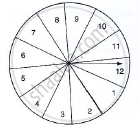
A game of chance consists of spinning an arrow which is equally likely to come to rest pointing to one of the number, 1, 2, 3, ..., 12 as shown in Fig. below. What is the probability that it will point to 10?
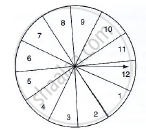
A game of chance consists of spinning an arrow which is equally likely to come to rest pointing to one of the number, 1, 2, 3, ..., 12 as shown in Fig. below. What is the probability that it will point to an odd number?
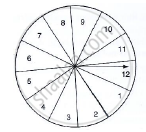
A game of chance consists of spinning an arrow which is equally likely to come to rest
pointing to one of the number, 1, 2, 3, ..., 12 as shown in Fig. below. What is the
probability that it will point to a number which is multiple of 3?
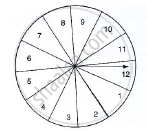
A game of chance consists of spinning an arrow which is equally likely to come to rest
pointing to one of the number, 1, 2, 3, ..., 12 as shown in Fig. below. What is the
probability that it will point to an even number?
A box contains cards numbered 3, 5, 7, 9, ..., 35, 37. A card is drawn at random form the box. Find the probability that the number on the drawn card is a prime number.
A bag contains 5 red, 8 white and 7 black balls. A ball is drawn at random from the bag. Find the probability that the drawn ball is red or white
A bag contains 5 red, 8 white and 7 black balls. A ball is drawn at random from the bag. Find the probability that the drawn ball is not black
A bag contains 5 red, 8 white and 7 black balls. A ball is drawn at random from the bag. Find the probability that the drawn ball is neither white nor black.
Find the probability that a number selected from the numbers 1 to 25 is not a prime number when each of the given numbers is equally likely to be selected.
A box contains loo red cards, 200 yellow cards and 50 blue cards. If a card is drawn at random from the box, then find the probability that it will be a blue card
A box contains loo red cards, 200 yellow cards and 50 blue cards. If a card is drawn at random from the box, then find the probability that it will be not a yellow card
A box contains loo red cards, 200 yellow cards and 50 blue cards. If a card is drawn at random from the box, then find the probability that it will be neither yellow nor a blue card.
Find the probability that a number selected at random from the numbers 1, 2, 3, ..., 35 is a prime number.
Find the probability that a number selected at random from the numbers 1, 2, 3, ..., 35 is a multiple of 7.
Find the probability that a number selected at random from the numbers 1, 2, 3, ..., 35 is a multiple of 3 or 5.
A bag contains tickets numbered 11, 12, 13,..., 30. A ticket is taken out from the bag at random. Find the probability that the number on the drawn ticket is a multiple of 7
A bag contains tickets numbered 11, 12, 13,..., 30. A ticket is taken out from the bag at random. Find the probability that the number on the drawn ticket is greater than 15 and a multiple of 5.
A bag contains lemon flavoured candies only. Malini takes out one candy without looking into the bag. What is the probability that she takes out an orange flavoured candy?
A bag contains lemon flavoured candies only. Malini takes out one candy without looking into the bag. What is the probability that she takes out a lemon flavoured candy?
It is given that m a group of 3 students, the probability of 2 students not having the same birthday is 0.992. What is the probability that the 2 students have the same birthday?
Cards marked with numbers 13, 14, 15, ...., 60 are placed in a box and mixed thoroughly.One card is drawn at random from the box. Find the probability that number on the card drawn is divisible by 5
Cards marked with numbers 13, 14, 15, ...., 60 are placed in a box and mixed thoroughly.One card is drawn at random from the box. Find the probability that number on the card drawn is a number is a perfect square
Harpreet tosses two different coins simultaneously (say, one is of Re 1 and other of Rs 2). What is the probability that he gets at least one head?
A lot consists of 144 ball pens of which 20 are defective and the others are good. Nuri will buy a pen if it is good, but will not buy if it is defective. The shopkeeper draws one pen at random and gives it to her. What is the probability that she will buy it?
A lot consists of 144 ball pens, of which 20 are defective and the others are good. Nuri will buy a pen if it is good, but will not buy if it is defective. The shopkeeper draws one pen at random and gives it to her. What is the probability that she will not buy it?
12 defective pens are accidently mixed with 132 good ones. It is not possible to just look at pen and tell whether or not it is defective. one pen is taken out at random from this lot. Determine the probability that the pen taken out is good one.
Examine the following statement and comment:
If two coins are tossed at the same time, there are 3 possible outcomes—two heads,
two tails, or one of each. Therefore, for each outcome, the probability of occurrence
is 1/3
Examine the following statement and comment:
If a die is thrown once, there are two possible outcomes—an odd number or an
even number. Therefore, the probability of obtaining an odd number is 1 /2 and the
probability of obtaining an even number is 1/2
.
BASED ON LOTS
In a simultaneous throw of a pair of dice, find the probability of getting 8 as the sum
In a simultaneous throw of a pair of dice, find the probability of getting 2 will not come either time.
In a simultaneous throw of a pair of dice, find the probability of getting a doublet of prime numbers
In a simultaneous throw of a pair of dice, find the probability of getting a doublet of odd numbers
In a simultaneous throw of a pair of dice, find the probability of getting a sum greater than 9
In a simultaneous throw of a pair of dice, find the probability of getting an even number on first
In a simultaneous throw of a pair of dice, find the probability of getting an even number on one and a multiple of 3 on the other
In a simultaneous throw of a pair of dice, find the probability of getting neither 9 nor 11 as the sum of the numbers on the faces
In a simultaneous throw of a pair of dice, find the probability of getting a sum less than 6
Two different dice are thrown together. Find the probability that the numbers obtained have a sum less than 7.
In a simultaneous throw of a pair of dice, find the probability of getting a sum more than 7
In a simultaneous throw of a pair of dice, find the probability of getting 5 at least once.
In a simultaneous throw of a pair of dice, find the probability of getting a number other than 5 on any dice.
In a simultaneous throw of a pair of dice, find the probability of getting even number on each die.
In a simultaneous throw of a pair of dice, find the probability of getting 5 as the sum.
In a simultaneous throw of a pair of dice, find the probability of getting 2 will come up at least once.
What is the probability that a leap year has 53 Tuesdays and 53 Mondays?
A black die and a white die are thrown at the same time. Write all the possible outcomes. What is the probability? that the sum of the two numbers that turn up is 8?
A black die and a white die are thrown at the same time. Write all the possible outcomes. What is the probability? of obtaining a total of 6?
A black die and a white die are thrown at the same time. Write all the possible outcomes. What is the probability of obtaining a total of 10?
A black die and a white die are thrown at the same time. Write all the possible outcomes. What is the probability? of obtaining the same number on both dice?
A black die and a white die are thrown at the same time. Write all the possible outcomes. What is the probability of obtaining a total more than 9?
A black die and a white die are thrown at the same time. Write all the possible outcomes. What is the probability that the sum of the two numbers appearing on the top of the dice is 13?
A black die and a white die are thrown at the same time. Write all the possible outcomes. What is the probability that the sum of the numbers appearing on the top of the dice is less than or equal to 12?
A black die and a white die are thrown at the same time. Write all the possible outcomes. What is the probability? that the product of numbers appearing on the top of the dice is less than 9.
A black die and a white die are thrown at the same time. Write all the possible outcomes. What is the probability?
that the difference of the numbers appearing on the top of two dice is 2.
A black die and a white die are thrown at the same time. Write all the possible outcomes. What is the probability?
that the numbers obtained have a product less then 16.
All red face cards are removed from a pack of playing cards. The remaining cards are well shuffled and then a card is drawn at random from them. Find the probability that the drawn card is a red card.
All red face cards are removed from a pack of playing cards. The remaining cards are well shuffled and then a card is drawn at random from them. Find the probability that the drawn card is a face card.
All red face cards are removed from a pack of playing cards. The remaining cards are well shuffled and then a card is drawn at random from them. Find the probability that the drawn card is a card of clubs.
In a bag there are 44 identical cards with figure of circle or square on them. There are 24 circles, of which 9 are blue and rest are green and 20 squares of which 11 are blue and rest are green. One card is drawn from the bag at random. Find the probability that it has the figure of square
In a bag there are 44 identical cards with figure of circle or square on them. There are 24 circles, of which 9 are blue and rest are green and 20 squares of which 11 are blue and rest are green. One card is drawn from the bag at random. Find the probability that it has the figure of green colour
In a bag there are 44 identical cards with figure of circle or square on them. There are 24 circles, of which 9 are blue and rest are green and 20 squares of which 11 are blue and rest are green. One card is drawn from the bag at random. Find the probability that it has the figure of blue circle and
In a bag there are 44 identical cards with figure of circle or square on them. There are 24 circles, of which 9 are blue and rest are green and 20 squares of which 11 are blue and rest are green. One card is drawn from the bag at random. Find the probability that it has the figure of green colour
All kings and queens are removed from a pack of 52 cards. The remaining cards are well shuffled and then a card is randomly drawn from it. Find the probability that this card is a red face card
All kings and queens are removed from a pack of 52 cards. The remaining cards are well shuffled and then a card is randomly drawn from it. Find the probability that this card is a black card.
All kings and queens are removed from a pack of 52 cards. The remaining cards are well-shuffled and then a card is randomly drawn from it. Find the probability that this card is either a red card or a queen.
All kings and queens are removed from a pack of 52 cards. The remaining cards are well-shuffled and then a card is randomly drawn from it. Find the probability that this card is red and a queen.
The king, queen and jack of clubs are removed from a deck of 52 playing cards and the remaining cards are shuffled. A card is drawn from the remaining cards. Find the
probability of getting a card of heart
The king, queen and jack of clubs are removed from a deck of 52 playing cards and the remaining cards are shuffled. A card is drawn from the remaining cards. Find the
probability of getting a card of queen
The king, queen and jack of clubs are removed from a deck of 52 playing cards and the remaining cards are shuffled. A card is drawn from the remaining cards. Find the
probability of getting a card of clubs.
The king, queen and jack of clubs are removed form a deck of 52 playing cards and the remaining cards are shuffled. A card is drawn from the remaining cards. Find the probability of getting a card of a face card
The king, queen and jack of clubs are removed form a deck of 52 playing cards and the remaining cards are shuffled. A card is drawn from the remaining cards. Find the probability of getting a card of a queen of diamond.
- A lot of 20 bulbs contain 4 defective ones. One bulb is drawn at random from the lot. What is the probability that this bulb is defective?
- Suppose the bulb drawn in (1) is not defective and is not replaced. Now one bulb is drawn at random from the rest. What is the probability that this bulb is not defective?
A box contains 90 discs which are numbered from 1 to 90. If one disc is drawn at random from the box, find the probability that it bears a two-digit number.
A box contains 90 discs which are numbered from 1 to 90. If one disc is drawn at random from the box, find the probability that it bears a perfect square number.
A box contains 90 discs which are numbered from 1 to 90. If one disc is drawn at random from the box, find the probability that it bears a number divisible by 5.
Two dice, one blue and one grey, are thrown at the same time.
(i) Write down all the possible outcomes and complete the following table:
| Event : ‘Sum on 2 dice’ |
2 | 3 | 4 | 5 | 6 | 7 | 8 | 9 | 10 | 11 | 12 |
| Probability | `1/36` | `5/36` | `1/36` |
Three unbiased coins are tossed simultaneously. Find the probability of getting:
- at least one head
- exactly one tail
- two heads and one tail
- at most two heads
The numbers on a die are replaced by the first six even numbers. The die is rolled once. Find the probability that the number appearing on the die is:
- greater than 4
- divisible by 3
- not a multiple of 10
If 65% of the population has black eyes, 25% have brown eyes and the remaining have blue eyes, what is the probability that a person selected at random has:
- blue eyes
- brown or black eyes?
Saima and Arya were born in the month of June in the year 2012. Find the probability that:
- They have different dates of birth.
- They have the same date of birth.
All face cards of spades are removed from a pack of 52 playing cards and the remaining pack is shuffled well. A card is then drawn at random from the remaining pack. Find the probability of getting:
- a face card
- an ace or a jack
Renu and Simran were born in the year 2000, which is a leap year. Find the probability that:
- Both have the same birthday.
- Both have different birthdays.
While shuffling a pack of 52 cards, one card was accidently dropped. Find the probability that the dropped card
- is not a face card.
- is a black king.
All the face cards are removed from the pack of 52 cards and a card is drawn at random from the remaining cards. Find the probability that the card so drawn is
- a spade.
- not an ace.
From a pack of 52 cards, all aces and all kings are removed. A card is drawn at random from the remaining cards. Find the probability that the card so drawn is
- a face card.
- a card of red colour.
The number of red balls in a bag is three more than the number of black balls. If the probability of drawing a red ball at random from the given bag is `12/23`, find the total number of balls in the given bag.
A bag contains cards which are numbered from 5 to 100, such that each card bears a different number. A card is drawn at random. Find the probability that the number on the card is:
- a perfect square.
- a 2-digit number.
A bag contains balls numbered 2 to 91 such that each ball bears a different number. A ball is drawn at random from the bag. Find the probability that:
- It bears a 2-digit number.
- It bears as a multiple of 1.
BASED ON HOTS
Two customers are visiting a particular shop in the same week (Monday to Saturday). Each is equally likely to visit the shop on any one day as on another. What is the robability that both will visit the shop on the same day?
Two customers are visiting a particular shop in the same week (Monday to Saturday). Each is equally likely to visit the shop on any one day as on another. What is the probability that both will visit the shop on different days?
Two customers are visiting a particular shop in the same week (Monday to Saturday). Each is equally likely to visit the shop on any one day as on another. What is the probability that both will visit the shop on consecutive days?
R.D. Sharma solutions for Mathematics [English] Class 10 16 Probability EXERCISE 16.2 [Pages 16.27 - 16.28]
BASED ON LOTS
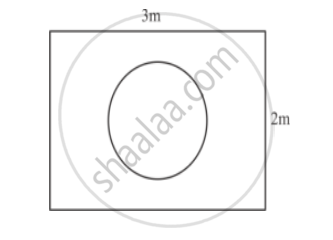
Suppose you drop a tie at random on the rectangular region shown in the given figure. What is the probability that it will land inside the circle with diameter 1 m?
BASED ON HOTS
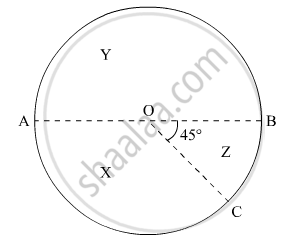
In the accompanying diagram a fair spinner is placed at the center O of the circle.
Diameter AOB and radius OC divide the circle into three regions labelled X, Y and Z. If
∠BOC = 45°. What is the probability that the spinner will land in the region X?(See fig)
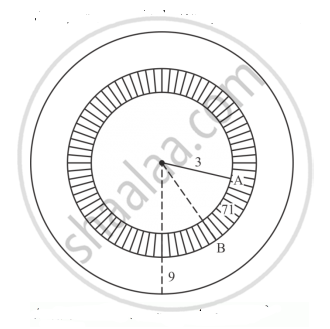
A target shown in Fig. below consists of three concentric circles of radii, 3, 7 and 9 cm
respectively. A dart is thrown and lands on the target. What is the probability that the dart will land on the shaded region?
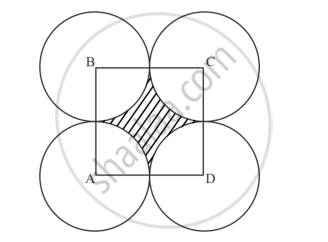
In below Fig., points A, B, C and D are the centers of four circles that each have a radius of length one unit. If a point is selected at random from the interior of square ABCD. What is the probability that the point will be chosen from the shaded region?
In the Fig. below, JKLM is a square with sides of length 6 units. Points A and B are the
mid- points of sides KL and LM respectively. If a point is selected at random from the
interior of the square. What is the probability that the point will be chosen from the interior of ΔJAB?

In the given figure, a square dart board is shown. The length of a side of the larger square is 1.5 times the length of a side of the smaller square. If a dart is thrown and lands on the larger square. What is the probability that it will land in the interior of the smaller square?
R.D. Sharma solutions for Mathematics [English] Class 10 16 Probability VERY SHORT ANSWER TYPE QUESTIONS (VSAQS) [Pages 16.28 - 16.29]
BASIC
Cards each marked with one of the numbers 4, 5, 6, ..., 20 are placed in a box and mixed thoroughly. One card is drawn at random from the box. What is the probability of getting an even number?
One card is drawn from a well shuffled deck of 52 playing cards. What is the probability of getting a non-face card?
A bag contains 5 red, 8 green and 7 white balls, One ball is drawn at random from the bag. What is the probability of getting a white ball or a green ball?
A die is thrown once. What is the probability of getting a prime number?
A die thrown once. What is the probability of getting a number lying between 2 and 6?
A die is thrown once. What is the probability of getting an odd number?
If \[\bar{E}\] denote the complement or negation of an even E, what is the value of P(E) + P(\[\bar{E}\]) ?
One card is drawn at random from a well shuffled deck of 52 cards. What is the probability of getting an ace?
Two coins are tossed simultaneously. What is the probability of getting at least one head?
Tickets numbered 1 to 20 are mixed up and then a ticket is drawn at random. What is the probability that the ticket drawn bears a number which is a multiple of 3?
From a well shuffled pack of cards, a card is drawn at random. Find the probability of getting a black queen.
A die is thrown once. Find the probability of getting a number less than 3.
Two coins are tossed simultaneously. Find the probability of getting exactly one head.
A die is thrown once. What is the probability of getting a number greater than 4?
What is the probability that a number selected at random from the numbers 3, 4, 5, ....9 is a multiple of 4?
A letter of English alphabet is chosen at random. Determine the probability that the chosen letter is a consonant.
A bag contains 3 red and 5 black balls. A ball is drawn at random from the bag. What is the probability that the ball drawn is not red.
A number is chosen at random from the number –3, –2, –1, 0, 1, 2, 3. What will be the probability that square of this number is less then or equal to 1?
If the probability of winning a game is 0.07, what is the probability of losing it?
If a number x is chosen at random from the numbers –3, –2, –1, 0, 1, 2, 3, then find the probability of x2 < 4.
A bag contains 4 red, 3 blue and 2 yellow balls. One ball is drawn at random from the bag. Find the probability that drawn ball is (i) red (ii) yellow.
If a fair coin is tossed twice, find the probability of getting 'almost one head'.
The probability of guessing the correct answer of a certain test question is `x/12`. If the probability of not guessing the correct answer is `5/6` then find the value of x.
R.D. Sharma solutions for Mathematics [English] Class 10 16 Probability FILL IN THE BLANK TYPE QUESTIONS (FBQs) [Pages 16.30 - 16.31]
BASIC
An experiment in which all the outcomes are known in advance and the exact outcome is not known in advance is called a ______ experiment.
Outcomes of a random experiment are called ______events.
The set of all possible outcomes of a random experiment is called the ______.
Subsets of a sample space are called ______.
An event obtained by combining two or more elementary events is called a ______ event.
The range of probability of any event of a random experiment is ______.
The probability of any event associated to a random experiment cannot exceed ______.
If Ac or `barA` or A' denote the complement of an event A, then P(Ac) = ______.
If an event A cannot occur, then P(A) = ______.
The probability expressed as a percentage of a particular occurrence can never be less than ______ and greater than ______.
Getting any one of the numbers from 1 to 6 on the upper face of a die when thrown is called ______ event.
Probability of a sure event is ______.
Probability of an impossible event is ______.
The probability of an event (other than sure and impossible event) lies between ______.
Every elementary event associated to a random experiment has ______ probability.
Probability of an event A + Probability of event 'not A' = ______.
Sum of the probabilities of each outcome in an experiment is ______.
BASED ON LOTS
An urn contains 9 red balls and x green balls. If the probability of picking a red ball is thrice that of picking a green ball, then x = ______.
An urn 6 blue and x green balls. If the probability of drawing a green ball is double that of drawing a blue ball, then x = ______.
If one natural number is selected from the first 70 natural numbers, the probability that it is a solution of the inequation 3x – 2 > x + 42, is ______.
Two dice are thrown together, the probability of getting a doublet is ______.
Three dice are thrown together, the probability of getting the same number on all the dice is ______.
A number is selected from the set {1, 2, 3, 4, 5, 6, 7, 8}. The probability that it is a root of the equation x2 – 6x + 8 = 0, is ______.
A girl calculates that the probability of her winning the first prize in a lottery is 0.08. If 6000 tickets are sold, then the number of tickets she bought, is ______.
If the probability of getting a bad egg in a lot of 400 is 0.035, then the number of bad eggs in the lot is ______.
If an event cannot occur i.e. it is an impossible event, then its probability is ______.
The probability that the month of April has exactly 5 Mondays is ______.
Two numbers 'a' and 'b'are selected, successively without replacement in that order, from integers 1 to 10. The probability that a/b is an integer, is ______.
A box contains 5 apples, 6 oranges and 'x' bananas. If the probability of selecting an apple from the box is 1/3, then the number of bananas is ______.
A die has its six faces marked 0, 1, 1, 1, 6, 6. If two such dice are thrown together, then the probability of getting a total of 7 is ______.
A letter of English alphabets is chosen at random. The probability that it is a consonant is ______.
Solutions for 16: Probability
R.D. Sharma solutions for Mathematics [English] Class 10 chapter 16 - Probability
Shaalaa.com has the CBSE, Karnataka Board Mathematics Mathematics [English] Class 10 CBSE, Karnataka Board solutions in a manner that help students grasp basic concepts better and faster. The detailed, step-by-step solutions will help you understand the concepts better and clarify any confusion. R.D. Sharma solutions for Mathematics Mathematics [English] Class 10 CBSE, Karnataka Board 16 (Probability) include all questions with answers and detailed explanations. This will clear students' doubts about questions and improve their application skills while preparing for board exams.
Further, we at Shaalaa.com provide such solutions so students can prepare for written exams. R.D. Sharma textbook solutions can be a core help for self-study and provide excellent self-help guidance for students.
Concepts covered in Mathematics [English] Class 10 chapter 16 Probability are .
Using R.D. Sharma Mathematics [English] Class 10 solutions Probability exercise by students is an easy way to prepare for the exams, as they involve solutions arranged chapter-wise and also page-wise. The questions involved in R.D. Sharma Solutions are essential questions that can be asked in the final exam. Maximum CBSE, Karnataka Board Mathematics [English] Class 10 students prefer R.D. Sharma Textbook Solutions to score more in exams.
Get the free view of Chapter 16, Probability Mathematics [English] Class 10 additional questions for Mathematics Mathematics [English] Class 10 CBSE, Karnataka Board, and you can use Shaalaa.com to keep it handy for your exam preparation.
