Advertisements
Online Mock Tests
Chapters
2: Polynomials
3: Pair of Linear Equations in Two Variables
4: Quadratic Equations
5: Arithmetic Progressions
6: Co-ordinate Geometry
7: Triangles
8: Circles
9: Constructions
10: Trigonometric Ratios
11: Trigonometric Identities
12: Heights and Distances
13: Areas Related to Circles
14: Surface Areas and Volumes
15: Statistics
16: Probability
![R.D. Sharma solutions for Mathematics [English] Class 10 chapter 1 - Real Numbers - Shaalaa.com](/images/mathematics-english-class-10_6:df8cedf76b7f4149972b35ec991c0c9d.jpg "R.D. Sharma solutions for Mathematics [English] Class 10 chapter 1 - Real Numbers")
Advertisements
Solutions for Chapter 1: Real Numbers
Below listed, you can find solutions for Chapter 1 of CBSE, Karnataka Board R.D. Sharma for Mathematics [English] Class 10.
R.D. Sharma solutions for Mathematics [English] Class 10 1 Real Numbers EXERCISE 1.1 [Page 1.9]
BASIC
Prove that the product of two consecutive positive integers is divisible by 2.
Prove that the product of three consecutive positive integer is divisible by 6.
Show that any positive odd integer is of the form 6q + 1 or, 6q + 3 or, 6q + 5, where q is some integer.
BASED ON LOTS
Show that one and only one of n, n + 1 and n + 2 is divisible by 3, where n is a positive integer.
Show that the square of an odd positive integer is of the form 8q + 1, for some integer q.
Prove that the square of any positive integer is of the form 4q or 4q + 1 for some integer q.
For any positive integer n, prove that n3 – n is divisible by 6.
Show that the square of any positive integer cannot be of the form 6m + 2 or 6m + 5 for any integer m.
Show that the cube of a positive integer is of the form 6q + r, where q is an integer and r = 0, 1, 2, 3, 4, 5.
Show that one and only one out of n, n + 4, n + 8, n + 12 and n + 16 is divisible by 5, where n is any positive integer.
[Hint: Any positive integer can be written in the form 5q, 5q + 1, 5q + 2, 5q + 3, 5q + 4].
Show that the square of an odd positive integer can be of the form 6q + 1 or 6q + 3 for some integer q.
BASED ON HOTS
A positive integer is of the form 3q + 1, q being a natural number. Can you write its square in any form other than 3m + 1, i.e., 3m or 3m + 2 for some integer m? Justify your answer.
Show that the square of any positive integer cannot be of the form 3m + 2, where m is a natural number.
If a and b are two odd positive integers such that a > b, then prove that one of the two numbers `(a + b)/2` and `(a - b)/2` is odd and the other is even.
R.D. Sharma solutions for Mathematics [English] Class 10 1 Real Numbers EXERCISE 1.2 [Page 1.21]
BASIC
Define HCF of two positive integers and find the HCF of the following pair of numbers:
475 and 495
Define HCF of two positive integers and find the HCF of the following pair of numbers:
75 and 243
Define HCF of two positive integers and find the HCF of the following pair of numbers:
240 and 6552
Define HCF of two positive integers and find the HCF of the following pair of numbers:
155 and 1385
Define HCF of two positive integers and find the HCF of the following pair of numbers:
100 and 190
Define HCF of two positive integers and find the HCF of the following pair of numbers:
105 and 120
Using Euclid's division algorithm to find the HCF of 135 and 225.
Use Euclid's division algorithm to find the HCF of 867 and 255.
Using Euclid’s division algorithm to find the HCF of 1260 and 7344.
Use Euclid's division algorithm to find the HCF of 2048 and 960.
If the HCF of 408 and 1032 is expressible in the form 1032 m – 408 × 5, find m.
If the HCF of 657 and 963 is expressible in the form 657x + 963y – 15, find x.
Find the largest number which divides 615 and 963 leaving remainder 6 in each case.
During a sale, colour pencils were being sold in packs of 24 each and crayons in packs of 32 each. If you want full packs of both and the same number of pencils and crayons, how many of each would you need to buy?
144 cartons of Coke Cans and 90 cartons of Pepsi Cans are to be stacked in a Canteen. If each stack is of the same height and is to contain cartons of the same drink, what would be the greatest number of cartons each stack would have?
Two brands of chocolates are available in packs of 24 and 15 respectively. If I need to buy an equal number of chocolates of both kinds, what is the least number of boxes of each kind I would need to buy?
BASED ON LOTS
Use Euclid's division algorithm to find the HCF of 184, 230 and 276.
Use Euclid's division algorithm to find the HCF of 136, 170 and 255.
What is the largest number that divides 626, 3127 and 15628 and leaves remainders of 1, 2 and 3 respectively?
Find the greatest number that will divide 445, 572 and 699 leaving remainders 4, 5 and 6 respectively.
Using Euclid’s division algorithm, find the largest number that divides 1251, 9377 and 15628 leaving remainders 1, 2 and 3, respectively.
A merchant has 120 litres of oil of one kind, 180 litres of another kind and 240 litres of a third kind. He wants to sell the oil by filling the three kinds of oil in tins of equal capacity. What should be the greatest capacity of such a tin?
BASED ON HOTS
Find the HCF of the following pair of integers and express it as a linear combination of 963 and 657.
Find the HCF of the following pair of integers and express it as a linear combination of 592 and 252.
Find the HCF of the following pair of integers and express it as a linear combination of 506 and 1155.
Express the HCF of 468 and 222 as 468x + 222y where x, y are integers in two different ways.
R.D. Sharma solutions for Mathematics [English] Class 10 1 Real Numbers EXERCISE 1.3 [Page 1.25]
BASIC
Express the following integers as a product of its prime factors:
420
Express the following integers as a product of its prime factors:
468
Express the following integers as a product of its prime factors:
945
Express the following integers as a product of its prime factors:
7325
Express the following integers as a product of its prime factors:
`1/sqrt(5)`
Determine the prime factorisation of the following positive integer:
20570
Determine the prime factorisation of the following positive integer:
58500
Determine the prime factorisation of the following positive integer:
45470971
Explain why 7 × 11 × 13 + 13 and 7 × 6 × 5 × 4 × 3 × 2 × 1 + 5 are composite numbers.
Explain why 3 × 5 × 7 + 7 is a composite number.
Check whether 6n can end with the digit 0 for any natural number n.
Can the number (15)n, n being a natural number, end with the digit 0? Give reasons.
Find the values of x, y, z and w in the following factor tree. Also write the prime factorisation of x.
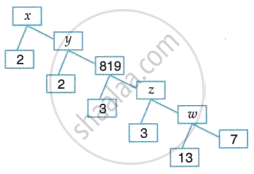
State true or false for the following statement and justify your answer:
2 × 3 × 5 × 7 + 7 is a composite number
State true or false for the following statement and justify your answer:
2 × 3 × 5 × 7 + 1 is a composite number
Let p, q and r be three distinct prime numbers.
Check whether p × q × r + q is a composite number or not.
Further, give an example for 3 distinct primes p, q, r such that
- p × q × r + 1 is a composite number.
- p × q × r + 1 is a prime number.
R.D. Sharma solutions for Mathematics [English] Class 10 1 Real Numbers EXERCISE 1.4 [Pages 1.30 - 1.31]
BASIC
Find the LCM and HCF of the following pair of integers and verify that LCM × HCF = Product of the integers.
336 and 54
Find the LCM and HCF of the following pair of integers and verify that LCM × HCF = Product of the integers.
404 and 96
Find the LCM and HCF of the following pair of integers and verify that LCM × HCF = Product of the integers.
96 and 120
Find the LCM and HCF of the following pair of integers and verify that LCM × HCF = Product of the integers.
72 and 120
Find the LCM and HCF of the following integers by applying the prime factorisation method.
12, 15 and 21
Find the LCM and HCF of the following integers by applying the prime factorisation method.
17, 23 and 29
Find the LCM and HCF of the following integers by applying the prime factorisation method.
8, 9 and 25
Find the LCM and HCF of the following integers by applying the prime factorisation method:
40, 36 and 126
Find the LCM and HCF of the following integers by applying the prime factorisation method:
26, 65 and 117
Find by prime factorisation the LCM of the numbers 18180 and 7575. Also, find the HCF of the two numbers.
Given that HCF (306, 657) = 9, find LCM (306, 657).
Write the smallest number which is divisible by both 306 and 657.
Can two numbers have 16 as their HCF and 380 as their LCM? Give reason.
The HCF of two numbers is 145 and their LCM is 2175. If one number is 725, find the other.
The HCF of two numbers is 16 and their product is 3072. Find their LCM.
The LCM and HCF of two numbers are 180 and 6 respectively. If one of the numbers is 30, find the other number.
Three bells ring at intervals of 6, 12 and 18 minutes. If all the three bells rang at 6 AM, when will they ring together again?
BASED ON LOTS
Find the smallest number which when increased by 17 is exactly divisible by both 520 and 468.
What is the smallest number that, when divided by 35, 56 and 91 leaves remainders of 7 in each case?
A rectangular courtyard is 18 m 72 cm long and 13 m 20 cm broad. It is to be paved with square tiles of the same size. Find the least possible number of such tiles.
Find the largest number which on dividing 1251, 9377 and 15628 leave remainders 1, 2 and 3 respectively.
In a morning walk three persons step off together, their steps measure 80 cm, 85 cm and 90 cm respectively. What is the minimum distance each should walk so that he can cover the distance in complete steps?
On a morning walk, three persons step out together and their steps measure 30 cm, 36 cm, and 40 cm respectively. What is the minimum distance each should walk so that each can cover the same distance in complete steps?
The traffic lights at three different road crossings change after every 48 seconds, 72 seconds and 108 seconds. If they change simultaneously at 7 a.m., at what time will they change together next?
BASED ON HOTS
Find the smallest number which leaves remainders 8 and 12 when divided by 28 and 32 respectively.
Find the greatest number of 6 digits exactly divisible by 24, 15 and 36.
R.D. Sharma solutions for Mathematics [English] Class 10 1 Real Numbers EXERCISE 1.5 [Pages 1.36 - 1.37]
BASIC
Show that the following numbers are irrational.
Show that the following numbers are irrational.
Show that the following numbers are irrational.
Show that the following numbers are irrational.
Show that the following numbers are irrational.
`1/sqrt(5)`
Prove that following number is irrational:
Prove that following number is irrational:
Prove that following number is irrational:
Prove that following number is irrational:
Show that `3 + sqrt(2)` is an irrational number.
Prove that `4 - 5sqrt(2)` is an irrational number.
Prove that `2sqrt(3) - 1` is an irrational number.
Prove that `2 - 3sqrt(5)` is an irrational number.
BASED ON LOTS
Prove that `sqrt(5) + sqrt(3)` is irrational.
Given that `sqrt(2)` is irrational, prove that `(5 + 3sqrt(2))` is an irrational number.
Prove that `(2 + sqrt(3))/5` is an irrational number, given that `sqrt(3)` is an irrational number.
Prove that `2 + 5sqrt(3)` is an irrational number, given that `sqrt(3)` is an irrational number.
Prove that `sqrt(2) + sqrt(3)` is irrational.
Prove that `(2 + sqrt(3))` is an irrational number, given that `sqrt(3)` is an irrational number.
Prove that `(5 - 2sqrt(3))` is an irrational number. It is given that `sqrt(3)` is an irrational number.
Prove that `(2 - sqrt(3))/5` is an irrational number, given that `sqrt(3)` is an irrational number.
Prove that `(sqrt(2) + sqrt(3))^2` is an irrational number, given that `sqrt(6)` is an irrational number.
Prove that `(5 sqrt(3) + 2/3)` is an irrational number given that `sqrt(3)` is an irrational number.
Prove that `(4sqrt(2) + 5/3)` is an irrational number given that `sqrt(2)` is an irrational number.
BASED ON HOTS
Prove that for any prime positive integer p, `sqrt(p)` is an irrational number.
If p, q are prime positive integers, prove that `sqrt(p) + sqrt(q)` is an irrational number.
R.D. Sharma solutions for Mathematics [English] Class 10 1 Real Numbers EXERCISE 1.6 [Page 1.42]
BASIC
Without actually performing the long division, state whether the following rational numbers will have a terminating decimal expansion or a non-terminating repeating decimal expansion.
Without actually performing the long division, state whether the following rational numbers will have a terminating decimal expansion or a non-terminating repeating decimal expansion.
Without actually performing the long division, state whether the following rational numbers will have a terminating decimal expansion or a non-terminating repeating decimal expansion.
Without actually performing the long division, state whether the following rational numbers will have a terminating decimal expansion or a non-terminating repeating decimal expansion.
Without actually performing the long division, state whether the following rational numbers will have a terminating decimal expansion or a non-terminating repeating decimal expansion.
Without actually performing the long division, state whether the following rational numbers will have a terminating decimal expansion or a non-terminating repeating decimal expansion.
Write down the decimal expansions of the following rational numbers by writing their denominators in the form 2m × 5n, where m, n are non-negative integers.
\[\frac{3}{8}\]
Write down the decimal expansions of the following rational numbers by writing their denominators in the form 2m × 5n, where m, n are non-negative integers.
\[\frac{13}{125}\]
Write down the decimal expansions of the following rational numbers by writing their denominators in the form 2m × 5n, where m, n are non-negative integers.
\[\frac{7}{80}\]
Write down the decimal expansions of the following rational numbers by writing their denominators in the form 2m × 5n, where m, n are non-negative integers.
\[\frac{14588}{625}\]
Write down the decimal expansions of the following rational numbers by writing their denominators in the form 2m × 5n, where m, n are non-negative integers.
\[\frac{129}{2^2 \times 5^7}\]
Write the denominator of the rational number `257/5000` in the form 2m × 5n, where m, n are non-negative integers. Hence, write the decimal expansion, without actual division.
BASED ON LOTS
What can you say about the prime factorisations of the denominators of the following rationals:
43.123456789
What can you say about the prime factorisations of the denominators of the following rationals:
`43.bar(123456789)`
What can you say about the prime factorisations of the denominators of the following rationals:
`27.bar(142857)`
What can you say about the prime factorisations of the denominators of the following rationals:
0.120120012000120000....
A rational number in its decimal expansion is 327.7081. What can you say about the prime factors of q, when this number is expressed in the form `p/q`? Given reasons.
R.D. Sharma solutions for Mathematics [English] Class 10 1 Real Numbers VERY SHORT ANSWER TYPE QUESTIONS (VSAQs) [Pages 1.42 - 1.44]
Answer each of the following questions either in one word or one sentence or as per requirement of the questions:
BASIC
State Euclid’s division lemma.
State Fundamental Theorem of Arithmetic.
Write 98 as product of its prime factors.
Write the exponent of 2 in the prime factorization of 144.
Write the sum of the exponents of prime factors in the prime factorization of 98.
If the prime factorization of a natural number n is 23 × 32 × 52 × 7, write the number of consecutive zeros in n.
If the product of two numbers is 1080 and their HCF is 30, find their LCM.
Complete the missing entries in the following factor tree.
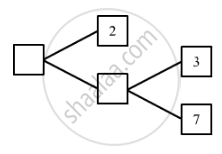
The decimal expansion of the rational number \[\frac{43}{2^4 \times 5^3}\] will terminate after how many places of decimals?
Has the rational number \[\frac{441}{2^2 \times 5^7 \times 7^2}\] a terminating or a nonterminating decimal representation?
If p and q are two prime numbers, then what is their HCF?
If p and q are two prime numbers, then what is their LCM?
What is the total number of factors of a prime number?
BASED ON LOTS
Write the condition to be satisfied by q so that a rational number \[\frac{p}{q}\] has a terminating decimal expansion.
Write the condition to be satisfied by q so that a rational number \[\frac{p}{q}\] has a non-terminating decimal expansion.
Write whether \[\frac{2\sqrt{45} + 3\sqrt{20}}{2\sqrt{5}}\] on simplification gives a rational or an irrational number.
What is the HCF of the smallest composite number and the smallest prime number?
HCF of two numbers is always a factor of their LCM (True/False).
Find after how many places of decimal the decimal form of the number `27/(2^3. 5^4. 3^2)` will terminate.
Express 429 as the product of its prime factors.
Two positive integers a and b can be written as a = x3y2 and b = xy3, x, y are prime numbers. Find LCM (a, b).
If HCF (336, 54) = 6, find LCM (336, 54).
Show that the number 5 × 11 × 17 + 3 × 11 is a composite number.
BASED ON HOTS
What is an algorithm?
What is a lemma?
What is a composite number?
π is an irrational number (True/False).
The sum of two prime number is always a prime number (True/ False).
The product of any three consecutive natural numbers is divisible by 6 (True/False).
Every even integer is of the form 2m, where m is an integer (True/False).
Every odd integer is of the form 2m – 1, where m is an integer (True/False).
The product of two irrational numbers is an irrational number (True/False).
The sum of two irrational numbers is an irrational number (True/False).
For what value of n, 2n × 5n ends in 5.
If a and b are relatively prime numbers, then what is their HCF?
If a and b are relatively prime numbers, then what is their LCM?
Two numbers have 12 as their HCF and 350 as their LCM (True/False).
R.D. Sharma solutions for Mathematics [English] Class 10 1 Real Numbers FILL IN THE BLANK TYPE QUESTIONS (FBQs) [Pages 1.44 - 1.45]
BASIC
If HCF (306, 657) = 9, then LCM (306, 657) ______.
The sum of the exponents of prime factors in the prime factorisation of 250 is ______.
If the prime factorisation of a natural number n is 24 × 34 × 53 × 7, then the number of consecutive zeros in n, is ______.
If 23 × 3a × b × 7 is the prime factorisation of 2520, then 5a + 2b = ______.
If 2520 = 2a × 3b × 5c × 7d, then a + b – 2c – 3d = ______.
BASED ON LOTS
If a and b are two positive co-prime integers such that a = 12b, then HCF (a, 12) = ______.
If two positive integers m and n are expressible in the form m = a2b3 and n = a3b2, where a, b are prime numbers, then HCF (m, n) = ______ and LCM (a, b) = ______.
If the HCF and LCM of two positive integers a and b are x and y respectively, then `(x^2y^2)/(a^2b^2)` = ______.
The ratio between the HCF and LCM of 5, 15 and 20 is ______.
The HCF and LCM of two numbers are 33 and 264 respectively. When the first number is completely divided by 2 the quotient is 33. The other number is ______.
Two numbers are in the ratio 21: 17. If their HCF is 5, the numbers are ______ and ______.
Given that LCM (91, 26) = 182, then HCF (91, 26) = ______.
Two numbers are in the ratio 3 : 4 and their LCM is 120. The sum of the numbers is ______.
The LCM of 2x, 5x and 7x and 7x is ______, where x is a positive integer.
BASED ON HOTS
A positive integer m when divided by 11 gives remainder 6. If 4m + 5 is divided by 11, the remainder is ______.
The LCM of the smallest prime number and the smallest odd composite number is ______.
The LCM of the smallest prime number and the smallest composite number is ______.
6n can not end with digit 0 for ______ value of n.
If n is a natural number, then the number of consecutive zeros in 7n, is ______.
If the least prime factors of two positive integers a and b are 5 and 13 respectively, then the least prime factor of a + b, is ______.
The decimal expansion of `17/8` will terminate after ______ places of decimal.
One of the three consecutive positive integers is always divisible by ______.
6n cannot end with digit 5 for ______ value of n.
The values of the remainder r, when a positive integer 'a' is divided by 3, are ______.
12n cannot end with the digit 0 or 5 for ______ value of n.
Solutions for 1: Real Numbers
R.D. Sharma solutions for Mathematics [English] Class 10 chapter 1 - Real Numbers
Shaalaa.com has the CBSE, Karnataka Board Mathematics Mathematics [English] Class 10 CBSE, Karnataka Board solutions in a manner that help students grasp basic concepts better and faster. The detailed, step-by-step solutions will help you understand the concepts better and clarify any confusion. R.D. Sharma solutions for Mathematics Mathematics [English] Class 10 CBSE, Karnataka Board 1 (Real Numbers) include all questions with answers and detailed explanations. This will clear students' doubts about questions and improve their application skills while preparing for board exams.
Further, we at Shaalaa.com provide such solutions so students can prepare for written exams. R.D. Sharma textbook solutions can be a core help for self-study and provide excellent self-help guidance for students.
Concepts covered in Mathematics [English] Class 10 chapter 1 Real Numbers are .
Using R.D. Sharma Mathematics [English] Class 10 solutions Real Numbers exercise by students is an easy way to prepare for the exams, as they involve solutions arranged chapter-wise and also page-wise. The questions involved in R.D. Sharma Solutions are essential questions that can be asked in the final exam. Maximum CBSE, Karnataka Board Mathematics [English] Class 10 students prefer R.D. Sharma Textbook Solutions to score more in exams.
Get the free view of Chapter 1, Real Numbers Mathematics [English] Class 10 additional questions for Mathematics Mathematics [English] Class 10 CBSE, Karnataka Board, and you can use Shaalaa.com to keep it handy for your exam preparation.
