Advertisements
Online Mock Tests
Chapters
2: Chemical Bonding
3: Acids, Bases and Salts
4: Analytical Chemistry
5: Mole Concept and Stoichiometry
6: Electrolysis
7: Metallurgy
8: Study of Compounds: Hydrogen Chloride
9: Study of Compounds: Ammonia
10: Study of Compounds: Nitric Acid
11: Study of Compounds: Sulphuric Acid
▶ 12: Organic Chemistry
13: Practical Work
![Lakhmir Singh solutions for Chemistry [English] Class 10 ICSE chapter 12 - Organic Chemistry - Shaalaa.com](/images/chemistry-english-class-10-icse_6:b9d33ffc3c864725b49a398fa5334703.jpg "Lakhmir Singh solutions for Chemistry [English] Class 10 ICSE chapter 12 - Organic Chemistry")
Advertisements
Solutions for Chapter 12: Organic Chemistry
Below listed, you can find solutions for Chapter 12 of CISCE Lakhmir Singh for Chemistry [English] Class 10 ICSE.
Lakhmir Singh solutions for Chemistry [English] Class 10 ICSE 12 Organic Chemistry Intext Question [Pages 232 - 256]
TEST YOUR UNDERSTANDING - 1
State whether the following statement is True or False.
The formula of heptane will be C7H14.
State whether the following statement is True or False.
Members of a homologous series have same physical properties.
State whether the following statement is True or False.
The number of electrons in the outermost shell of carbon is 6.
State whether the following statement is True or False.
A hydrocarbon having 2 carbon atoms, linked by a double bond, will have two hydrogen atoms bonded to each carbon.
Fill in the following blanks with suitable words.
The first organic compound prepared in the laboratory was ______.
Hydrocarbons are compounds made up of ______ and ______.
Carbon can form ______, ______ and ______ bonds to satisfy its valency.
The next member of C9H20O in its homologous series is ______.
Choose the correct option for each of the following questions.
Which of the following is an example of an unsaturated compound?
Alkane
Alkyne
Alkene
Both alkyne and alkene
An alkane with six carbon atoms will have ______.
12 hydrogen atoms
10 hydrogen atoms
14 hydrogen atoms
13 hydrogen atoms
Organic compounds are ______.
strong electrolytes
non-electrolytes
good conductor of electricity
Both strong electrolytes and good conductor of electricity
Define Hydrocarbons.
Name the properties of carbon that are responsible for its unique nature?
Define homologous series. Give an example.
Give the name and the formula of three consecutive members of the homologous series, alkynes.
Give four differences between organic and inorganic compounds.
TEST YOUR UNDERSTANDING - 2
State whether the following statement is True or False.
The presence of the group —CHO in a compound means it is a carboxylic acid.
State whether the following statement is True or False.
Alkyl group is responsible for the physical properties of an organic compound.
State whether the following statement is True or False.
Isomers differ in physical properties.
State whether the following statement is True or False.
While naming a compound according to IUPAC, the substituent occurring at the lower number is written first.
State whether the following statement is True or False.
Formula of propyl is —C3H7.
Fill in the following blanks with suitable words.
A functional group is responsible for the ______ properties of an organic compound.
The suffix used for ketones is ______.
The general formula of ether is ______.
Compounds having ______ molecular formula but ______ structural formulae are called isomers.
Choose the correct option for each of the following questions.
IUPAC stands for ______.
International Unit of Pure and Applied Chemistry
International Union of Pure and Applied Chemistry
International Union of Physical and Applied Chemistry
International Unit of Physical and Applied Chemistry
Which of the following names of a compound is not correct according to the IUPAC?
2-Ethyl-3-methylbutane
3,3-Dimethylpentane
3-Methyl-but-3-ene
Both 2-Ethyl-3-methylbutane and 3-Methyl-but-3-ene
Which of the following are pairs of position isomers?
Pentane and butane
Butene and but-2-ene
Propanol and dimethyl ether
None of these
Define a functional group.
Give the name and structure of any two aldehydes.
Give the name and structure of any two ketones.
Write the structure of the following compound:
3-Methylpent-2-ene
Write the structure of the following compound:
5-Bromopentan-2-one
Define the term ‘structural isomerism’.
Define or explain position isomerism with an example.
Draw two structural isomers of butane.
TEST YOUR UNDERSTANDING - 3
State whether the following statement is True or False.
Ethane is present in the blood of human beings and animals and also in intestinal gases.
State whether the following statement is True or False.
Methane is prepared by sodium ethanoate and soda lime in the laboratory.
State whether the following statement is True or False.
Ethane is highly soluble in water and polar solvents.
State whether the following statement is True or False.
Ethanol is oxidised to acetic acid in the presence of platinum at 300°C.
State whether the following statement is True or False.
Acetic acid in the laboratory can be prepared by oxidation of ethanol with K2Cr2O7.
Fill in the following blanks with suitable words.
Alkanes are also known as ______.
The reaction of methyl iodide with metallic sodium in dry ether is known as ______ reaction.
Methane and ethane when burn in air form ______ and ______.
Pyrolysis is the decomposition of a compound by heat in the ______ of air.
Denatured alcohol is also known as ______ spirit.
Choose the correct option for each of the following questions.
Which of the following is obtained on the reaction of water with aluminium carbide?
Methane
Ethane
Ethene
Ethyne
When a manganese-based catalyst is used at 100 °C, methane can be oxidised to ______.
ethanol
methanol
formic acid
ethane
Acetylene reacts with chlorine gas in the presence of sunlight to form ______.
carbon
1, 2-dichloroethane
1,1,2,2-tetrachloroethane
ethane
Ethanol is used as :
antiseptic
preservative
fuel
All of these
Name the reactants used for the preparation of ethane.
Name the reactants used for the preparation of ethene.
Name the reactants used for the preparation of ethyne.
Complete the following reaction:
\[\ce{CH3I ->[Zn/HCl]}\] ______ + ______
Complete the following reaction:
\[\ce{2CH4 + \underset{(limited)}{3O2} ->}\] ______ + ______
Complete the following reaction:
______ + \[\ce{H2O ->[H+] C2H5OH}\]
Complete the following reaction:
\[\ce{CH ≡ CH + I2 ->}\] ______
Give three uses of methane.
Give three uses of ethane.
Write three uses of ethyne.
Give the reaction of methanol with active metals.
Give the reaction of methanol with acetic acid.
Give the reaction of methanol with PCl5.
Give the reaction of methanol with conc. H2SO4.
Write the chemical tests to distinguish between alkanes, alkenes and alkynes.
Write the preparation of ethanoic acid.
Write the two physical properties of ethanoic acid.
DO IT RIGHT
We studied that on combustion of alkanes a huge amount of energy is released. This makes hydrocarbons a very good source of energy and they are used in different fuels. Find out the hydrocarbons that are present in the following fuels.
- LPG
- LNG
- CNG
- Diesel
- Petrol
Lakhmir Singh solutions for Chemistry [English] Class 10 ICSE 12 Organic Chemistry EXERCISE [Pages 261 - 265]
Objective Questions
True or False.
Most of the inorganic compounds form ionic bonds.
True or False.
The IUPAC name of \[ \text{CH}_3\text{CH}_2\overset{\substack{\textstyle \text{C}\rlap{\text{H}_2\text{OH}} \\[-0.2ex] \textstyle | \\[-0.2ex]}}{\text{C}}\text{HCH}_2\text{CH}_2\text{CH}_3 \] is butan-1-ol.
True or False.
Methane is also known as marsh gas.
True or False.
Ethanol is an essential constituent of all wine and is grain alcohol.
True or False.
Acetic acid is miscible in water.
True or False.
Acetic acid on reaction with zinc form zinc acetate.
Fill in the Blanks
The next member of C8H16 in its homologous series is ______.
The functional isomer of ethanol is ______.
______ is the second most abundant greenhouse gas.
In the laboratory, ethyne is prepared form ______ and ______.
______ alcohol is used as a solvent for paints and varnishes.
Acetic acid is used for coagulation ______ from latex.
Multiple Choice Questions
Which of the following are isomers?
Ethyl alcohol and dimethyl ether
Methyl alcohol and dimethyl ether
Acetone and acetaldehyde
Propionic acid and propanone
Which of the following represents a homologous series?
ethane, ethylene, ethyne
methane, methanol, methanal
methane, ethane, propane
1-hexene, 2-hexene, 3-hexene
The common and IUPAC names for the group, (CH3)2CHCH2 respectively are ______.
Isobutyl, 2-methylpropyl
Isobutyl, 1-methylpropyl
tert-Butyl, 1, 1-dimethyethyl
Sec-Butyl, 2-methylpropyl
The IUPAC name for -
\[ \text{CH}_3\underset{\substack{\textstyle | \\[-0.2ex] \textstyle \text{O}\rlap{\text{H}}}}{\text{C}}\text{HCH}_2\overset{\substack{\textstyle \text{C}\rlap{\text{H}_3} \\[-0.2ex] \textstyle |}}{\underset{\substack{\textstyle | \\[-0.2ex] \textstyle \text{O}\rlap{\text{H}}}}{\text{C}}}\text{CH}_3 \] is:
1, 1-Dimethylbutane-1,3-diol
4-Methylpentane-2, 4-diol
2-Methylpentane-2, 4-diol
1, 3, 3-Trimethylpropane-1, 3-diol
The number of isomers of C4H18 is ______.
2
3
4
5
Which of the following is produced from sodium acetate and soda lime?
methane
ethane
ethene
ethyne
Ethane can be prepared from bromoethane by using ______.
Zn/HСl
H2O
O2
dry ether
Propane and ethene can be prepared from which of the following by using alumina or silica at 400-600°C?
Methane
Ethane
Pentane
Heptane
Which of the following reactions is used as a test for unsaturation in organic compound?
Reaction of Cl2 with ethene
Reaction of Br2 with ethene
Reaction of Cl2 with ethane
Reaction of Br2 with ethane
Match the Column with Column II and choose the correct option.
| Column I | Column II |
| (p) \[\ce{C2H4 + H2O ->}\] | (i) C2H2Br2 |
| (q) \[\ce{CH≡CH ->[H2][Ni]}\] | (ii) C2H5OН |
| (r) \[\ce{C2H2 ->[Br2]}\] | (iii) CH2=CHCl |
| (s) \[\ce{CH≡CH ->[HCl]}\] | (iv) C2H6 |
(p) - (i), (q) - (ii), (r) - (iii), (s) - (iv)
(p) - (ii), (q) - (iv), (r) - (i), (s) - (iii)
(p) - (i), (q) - (ii), (r) - (iv), (s) - (iii)
(p) - (iv), (q) - (i), (r) - (ii), (s) - (iii)
Ethene can be prepared from ethanol by using ______.
dil. H2SO4
Na
CH3COОН
Al2O3
Acetic acid is used as:
laboratory reagent
vinegar
solvent
All of the above
The catalyst used for the conversion of ethene to ethane.
Iron
Nickel
Cobalt
Molybdenum
Descriptive Questions Short Answer Questions
Give the IUPAC name for the following compound.
CH3CH2CH2CHOHCH3
Give the IUPAC name for the following compound.
\[ \text{CH}_3\text{CH}_2\underset{\substack{\textstyle | \\[-0.2ex] \textstyle \text{C}\rlap{\text{H}_3}}}{\text{C}}\text{HCH}_2\text{CHO} \]
Write the structural formulae of the following:
But-3-en-1-ol
Write the structural formulae of the following:
2-Ethoxypropane
Write the structural formulae of the following:
2-Chlorobuta-1,3-diene
Draw two structural isomers of butane.
Write the positional isomers of but-1-ene.
Addition reactions and substitution reactions are types of organic reactions.Which type of reaction is shown by?
Ethane
Addition reactions and substitution reactions are types of organic reactions.Which type of reaction is shown by?
Ethene?
What are structural isomers?
Draw all structural isomers of hydrocarbon having the molecular formula C5H12. Also give their IUPAC names.
What is a homologous series?
Give any two characteristics of a homologous series.
Write the first four homologues of alcohols and give their IUPAC names.
How can methanol be prepared in the laboratory? Give the reactions involved.
Write two physical properties of methane.
Write the physical properties of ethene.
Write two physical properties of ethyne.
Write the reaction of ethene with bromine.
Write the reaction of ethene with hydrochloric acid.
Write the reaction of ethene with hydrogen.
Write two physical properties of ethyne.
Write the chemical properties of ethyne.
Give the industrial preparation of ethanol.
Give the structural formulae of acetic acid.
Write the important uses of acetic acid.
Draw the structural formula for the following:
Ethanoic acid
Draw the structural formula for the following:
But-2-yne
From the following organic compounds given below, choose one compound in the given case which relates to the description:
An unsaturated hydrocarbon used for welding purposes.
Ethyne
Ethanol
Acetic acid
Ethene
Methane
From the following organic compounds given below, choose one compound in the given case which relates to the description:
An organic compound whose functional group is carboxyl.
Ethyne
Ethanol
Acetic acid
Ethene
Methane
From the following organic compounds given below, choose one compound in the given case which relates to the description:
A hydrocarbon which on catalytic hydrogenation gives a saturated hydrocarbon.
Ethyne
Ethanol
Acetic acid
Ethene
Methane
From the following organic compounds given below, choose one compound in the given case which relates to the description:
An organic compound used as a thermometric liquid.
Ethyne
Ethanol
Acetic acid
Ethene
Methane
Give balanced equation for the laboratory preparations of the following organic compound:
A saturated hydrocarbon from iodomethane
Give balanced equation for the laboratory preparations of the following organic compound:
An unsaturated hydrocarbon from an alcohol
Give balanced equation for the laboratory preparations of the following organic compound:
An unsaturated hydrocarbon from calcium carbide
Give balanced equation for the laboratory preparations of the following organic compound:
An alcohol from ethyl bromide
Give reason for the following :
Methane does not undergo addition reaction, but ethane does
Give reason for the following :
Ethyne is more reactive than ethane
Give reason for the following :
Hydrocarbons are excellent fuels
Give the structural formulae for the following:
An isomer of n-butane.
Give the structural formulae for the following:
2-propanol
Give the structural formula for the following :
Diethyl ether
Name the kind of particles present in sodium hydroxide solution.
Name the kind of particles present in carbonic acid.
Name the kind of particles present in the sugar solution.
Give the structural formula of the following:
Ethanol
Give the structural formula of the following:
1-propanal
Give the structural formula of the following:
1,2,dichlormethene
Give balanced chemical equations for the following conversion :
Ethanoic acid to ethyl ethanote
Give a balanced chemical equation for the following conversion:
Calcium carbide to ethyne.
Give a balanced chemical equation for the following conversion:
Sodium ethanoate to methane.
Using the structural formula, identify the functional group by circling it:
Dimethyl ether
Using the structural formula, identify the functional group by circling it:
Propanone
Give the structural formulae of the following:
2-methyl propane
Give the structural formulae of the following :
Ethanoic acid
Give the structural formulae of the following :
Butna-2ol
Equation for the reaction when compound A is bubbled through bromine dissolved in carbon tetrachloride is as follows:
\[\begin{array}{cc}
\ce{A ->[Br2/CCl4] CH2Br}\\
\phantom{.........}|\\
\phantom{.................}\ce{CH2Br}\\
\end{array}\]
- Draw the structure of compound A.
- State your observation during this reaction.
Identify the term or substance based on the descriptions given below:
Ice like crystals formed on cooling an organic acid sufficiently.
Identify the term or substance based on the descriptions given below:
Hydrocarbon containing a triple bond used for welding purposes
Identify the term or substance based on the descriptions given below:
The property by virtue of which the compound has the same molecular formula but different structural formulae.
The compound formed where two alkyl groups are linked by 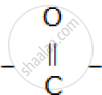 group.
Give a balanced chemical equation for the following :
Preparation of ethane from sodium propionate
Give a balanced chemical equation for the following :
Action of alcoholic KOH on bromoethane
Draw the structural formula for the following:
2, 3-dimethyl butane
Draw the structural formula for the following:
Diethyl ether
Draw the structural formula for the following :
propanoic acid
A compound X (having vinegar like smell) when treated with ethanol in the presence of the acid Z, gives a compound Y which has a fruity smell.
The reaction is: \[\ce{C2H5OH + X ->[Z] Y + H2O}\]
- Identify Y and Z.
- Write the structural formula of X.
- Name the above reaction.
Name the following organic compound:
The compound with 3 carbon atoms whose functional group is a carboxylic acid.
Name the following organic compound:
The first homologue whose general formula is CnH2n.
Name the following organic compound:
The compound that reacts with acetic acid to form ethyl ethanoate.
Name the following organic compound:
The compound formed by complete chlorination of ethyne.
Identify the substance underlined:
The catalyst used to oxidise ammonia.
Identify the substance underlined:
The organic compound which when solidified, forms an ice like mass.
Identify the substance underlined:
The dilute acid which is an oxidizing agent.
Write a balanced chemical equation for the preparation of :
Ethene from bromoethane
Write a balanced chemical equation for the preparation of :
Ethyne using calcium carbide
Write a balanced chemical equation for the preparation of:
Methane from sodium acetate.
Copy and complete the following paragraph using the options given in brackets:
Alkenes are a homologous series of (i) ______ (saturated/unsaturated) hydrocarbons characterised by the general formula (ii) ______ (CnH2n+2/CnH2n). Alkenes undergo (iii) ______ (addition/substitution) reactions and also undergo (iv) ______ (hydrogenation/dehydrogenation) to form alkanes.
Draw different isomers having the following molecular formula:
Pentane (C5H12)
Long Answer Questions
Give the chemical equation for the laboratory preparation of methane from sodium acetate.
Give the chemical equation for the industrial preparation of methanol from water gas.
Give chemical equation for:
The reaction of one mole of ethene with one mole chlorine gas.
Give chemical equation for:
The preparation of ethyne from 1,2 - dibromoethane.
Write the equation for the following reaction:
Calcium carbide and water
Write the equation for the following reaction:
Ethene and water (steam)
Write the equation for the following reaction:
Bromoethane and an aqueous solution of sodium hydroxide.
Write the balanced equation for the complete combustion of ethane.
Give three uses of ethane.
Write the important uses of acetic acid.
Write three uses of ethyne.
Give three uses of ethene.
Define isomerism.
Differentiate between chain and position isomerism using suitable examples.
Give four differences between organic and inorganic compounds.
Give three points to differentiate between saturated and unsaturated
hydrocarbons.
Differentiate between the following:
Alkanes and alkynes
Give reason for the following:
Alkenes are known as olefins.
Give reason for the following:
The reaction of Br2 with ethyne is used as a test for unsaturation.
Give reason for the following:
Alcohol is denatured by adding methanol.
Compound A is bubbled through bromine dissolved in carbon tetrachloride, and the product is CH2Br – CH2Br.
\[\ce{A ->[Br2/CCl4] CH2Br - CH2Br}\]
- Draw the structural formula of A.
- What type of reaction has A undergone?
- What is your observation?
- Name (not formula) the compound formed when steam reacts with A in the presence of phosphoric acid.
- What is the procedure for converting the product of (iv) back to A?
Write a balanced chemical equation for the following:
Monochloroethane is hydrolysed with aqueous KOH.
Write a balanced chemical equation for the following:
A mixture of sodalime and sodium acetate is heated.
Write a balanced chemical equation for the following:
Ethanol under high pressure and low temperature is treated with acidified potassium dichoromate.
Write a balanced chemical equation for the following:
Water is added to calcium carbide.
Write a balanced chemical equation for the following:
Ethanol reacts with sodium at room temperature.
Choose the correct word/phrase from within the brackets to complete the following sentences:
The catalyst used for the conversion of ethane to ethane is commonly ______.
nickel
iron
cobalt
When acetaldehyde is oxidized with acidified potassium dichromate, it forms ______.
ester
ethanol
acetic acid
Ethanoic acid reacts with ethanol in the presence of concentrated H2SO4, so as to form a compound and water. The chemical reaction which takes place is called ______.
dehydration
hydrogenation
esterification
Write the equation for the reaction taking place between 1, 2-dibromoethane and alcoholic potassium hydroxide.
The product formed when ethene gas reacts with water in the presence of sulphuric acid is ______.
ethanal
ethanol
ethanoic acid
State the conditions required for the given reaction to take place:
Catalytic hydrogenation of ethyne.
State the conditions required for the given reaction to take place:
Preparation of ethyne from ethylene dibromide.
State the conditions required for the given reaction to take place:
Catalytic oxidation of ammonia to nitric oxide.
State the conditions required for the given reaction to take place:
Any two conditions for the conversion of sulphur dioxide to sulphur trioxide.
Name the following:
Process by which ethane is obtained from ethene.
Name the following:
A hydrocarbon which contributes towards the greenhouse effect.
Name the following:
Distinctive reaction that takes place when ethanol is treated with acetic acid.
Name the following:
The property of elements by virtue of which atoms of the element can link to each other in the form of a long chain or ring structure.
Name the following:
Reaction when an alkyl halide is treated with alcoholic potassium hydroxide.
Complete the following table which relates to the homologous series of hydrocarbons.
| General formula | IUPAC name of the homologous series | Characteristic bond type | IUPAC name of the first member of the series |
| CnH2n−2 | (A) ______ | (B) ______ | (C) ______ |
| CnH2n+2 | (B) ______ | (E) ______ | (F) ______ |
Solutions for 12: Organic Chemistry
Lakhmir Singh solutions for Chemistry [English] Class 10 ICSE chapter 12 - Organic Chemistry
Shaalaa.com has the CISCE Mathematics Chemistry [English] Class 10 ICSE CISCE solutions in a manner that help students grasp basic concepts better and faster. The detailed, step-by-step solutions will help you understand the concepts better and clarify any confusion. Lakhmir Singh solutions for Mathematics Chemistry [English] Class 10 ICSE CISCE 12 (Organic Chemistry) include all questions with answers and detailed explanations. This will clear students' doubts about questions and improve their application skills while preparing for board exams.
Further, we at Shaalaa.com provide such solutions so students can prepare for written exams. Lakhmir Singh textbook solutions can be a core help for self-study and provide excellent self-help guidance for students.
Concepts covered in Chemistry [English] Class 10 ICSE chapter 12 Organic Chemistry are .
Using Lakhmir Singh Chemistry [English] Class 10 ICSE solutions Organic Chemistry exercise by students is an easy way to prepare for the exams, as they involve solutions arranged chapter-wise and also page-wise. The questions involved in Lakhmir Singh Solutions are essential questions that can be asked in the final exam. Maximum CISCE Chemistry [English] Class 10 ICSE students prefer Lakhmir Singh Textbook Solutions to score more in exams.
Get the free view of Chapter 12, Organic Chemistry Chemistry [English] Class 10 ICSE additional questions for Mathematics Chemistry [English] Class 10 ICSE CISCE, and you can use Shaalaa.com to keep it handy for your exam preparation.
